Dr. Jitendra Singh Backs India's Vikram1 Space Push
Synopsis
Union Science and Technology Minister Dr. Jitendra Singh on 19 July 2026 rallied public support behind India's space programme with the hashtag #IndiaWithVikram1, sharing a live broadcast that signals a fresh milestone in ISRO's ongoing lunar and deep-space exploration roadmap.
Key Takeaways
Jitendra Singh posted #IndiaWithVikram1 on 19 July 2026 , directing followers to a live broadcast of what appears to be a new ISRO space event.
The hashtag invokes the Vikram lander , named after space pioneer Vikram Sarabhai and central to India's Chandrayaan missions.
Chandrayaan-3 achieved India's first lunar soft landing near the south pole of the Moon on 23 August 2023 , making India the fourth nation to land on the Moon.
India's space roadmap under the Atmanirbhar Bharat framework includes follow-on missions such as Gaganyaan and the planned Chandrayaan-4 sample-return mission.
The minister's active social media engagement is part of a broader government strategy to build public support for India's space programme.
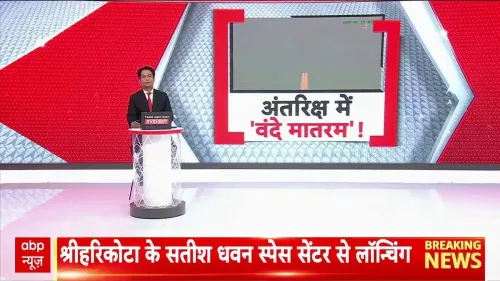
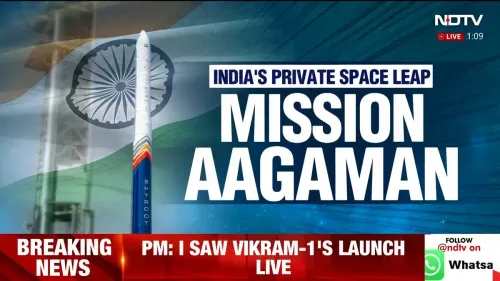
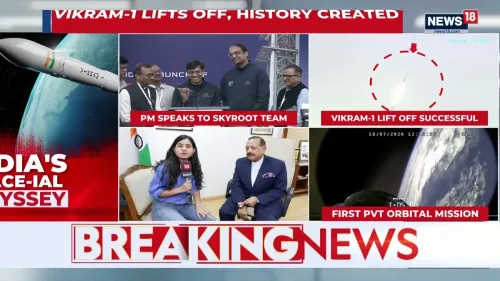
Union Science and Technology Minister Dr. Jitendra Singh on Sunday, 19 July 2026, posted in solidarity with India's space mission under the hashtag #IndiaWithVikram1, sharing a live broadcast link that drew public attention to what appears to be a new chapter in India's lunar or space exploration programme. The post, shared from his official X account, carried an image and directed followers to a live stream, signalling active ministerial engagement with an unfolding space event.
Context
The hashtag #IndiaWithVikram1 evokes the legacy of India's celebrated Vikram lander, the soft-landing module developed by the Indian Space Research Organisation (ISRO) and named after space pioneer Vikram Sarabhai, the founder of India's space programme. The Vikram lander gained global recognition when Chandrayaan-3 achieved India's first successful soft landing near the lunar south pole on 23 August 2023, making India only the fourth country in the world to land on the Moon and the first to reach its southern polar region.
Dr. Jitendra Singh's post amplifies what appears to be a significant event in India's continuing space journey. The minister has consistently used social media to build public momentum around ISRO milestones, and his direct engagement with a live broadcast underscores the government's intent to make space achievements a matter of national pride and public participation.
Policy Backdrop
India's lunar exploration roadmap has advanced steadily under the Atmanirbhar Bharat framework, which prioritises indigenous development of launch vehicles, landers, and rovers. The Department of Science and Technology and the Department of Space, both overseen by Dr. Jitendra Singh, have positioned successive ISRO missions as proof points of India's technological self-reliance in deep-space operations.
Following the landmark success of Chandrayaan-3 in 2023 — itself a recovery from the partial success of Chandrayaan-2 in 2019 — ISRO has been charting an ambitious follow-on roadmap. This includes the human spaceflight mission Gaganyaan and early planning stages for Chandrayaan-4, which is expected to attempt a sample-return mission from the lunar surface. Each milestone has been accompanied by high-profile ministerial communication to sustain domestic and international interest.
Stakeholders and Impact
ISRO scientists and engineers remain the backbone of India's space ambitions, with thousands of personnel across centres including the Vikram Sarabhai Space Centre (VSSC) in Thiruvananthapuram and the ISRO Telemetry, Tracking and Command Network (ISTRAC) in Bengaluru contributing to mission operations. Ministerial visibility on platforms like X helps sustain public funding support and inspires the next generation of space scientists.
For the broader space research community, each successful mission reinforces India's credentials as a low-cost, high-reliability space-faring nation — a positioning that has attracted international collaboration and commercial launch partnerships. The #IndiaWithVikram1 hashtag, by invoking the Vikram name, also connects the present mission to a lineage stretching back to Vikram Sarabhai's founding vision in the 1960s.
What's Next
All eyes will be on ISRO's upcoming mission calendar as India pushes deeper into space exploration. The Gaganyaan human spaceflight programme, which has been in advanced testing phases, and the prospective Chandrayaan-4 sample-return mission represent the next major milestones on India's space roadmap. Ministerial posts such as this one are likely to be followed by formal announcements and press briefings from the Department of Space as mission details become public.
India's growing confidence in deep-space operations, anchored in the success of the Vikram lander, positions the country as a serious contender in the emerging global lunar economy — including potential roles in international lunar gateway collaborations and commercial lunar payload services.
Point of View
Blurring the line between institutional communication and political branding. The Vikram name carries enormous symbolic weight after Chandrayaan-3's historic south-pole landing, and invoking it for a new event suggests the government is framing whatever follows as a continuation of that legacy. At a time when India is competing for a seat at the table in international lunar governance and commercial space partnerships, such ministerial visibility serves both domestic and diplomatic purposes. The post, sparse as it is, is a reliable leading indicator that a formal announcement of significance is imminent from the Department of Space.
NationPress
18 Oct 2026
Frequently Asked Questions
What is #IndiaWithVikram1?
#IndiaWithVikram1 is a hashtag used by Union Science and Technology Minister Dr. Jitendra Singh on 19 July 2026 to rally public support around what appears to be a new ISRO space mission or event related to India's Vikram space programme.
Who is the Vikram lander named after?
The Vikram lander is named after Dr. Vikram Sarabhai , the founding father of India's space programme and the first chairman of ISRO.
What did Chandrayaan-3 achieve?
Chandrayaan-3 achieved India's first successful soft landing on the Moon on 23 August 2023 , touching down near the lunar south pole and making India the fourth country to land on the Moon and the first to reach its southern polar region.
What is Dr. Jitendra Singh's role in India's space programme?
Dr. Jitendra Singh is the Union Minister of State (Independent Charge) for Science and Technology and Earth Sciences, giving him oversight of the Department of Space and making him the key political interface for ISRO's activities and announcements.
What are India's next major space missions?
India's upcoming space milestones include the Gaganyaan human spaceflight mission and the planned Chandrayaan-4 lunar sample-return mission, both being developed by ISRO under the Atmanirbhar Bharat framework.