Giriraj Singh: India Ready to Lead Global Textiles
Synopsis
Union Textiles Minister Giriraj Singh, reflecting on Bharat Tex 2026, declared India a trusted global textile partner and called for combining heritage with AI, sustainability, and smart manufacturing under PM Modi's 5F Vision to lead the world's textile value chain.
Key Takeaways
Bharat Tex 2026 reinforced Minister Giriraj Singh 's confidence in India's ability to lead the global textile industry.
India is described as a 'trusted and preferred partner' in the global textile value chain, backed by growing international demand.
The minister's vision for the sector's next phase centres on innovation, sustainability, AI, and smart manufacturing layered onto India's textile heritage.
PM Modi 's 5F Vision — spanning fibre to fashion and foreign markets — is the guiding policy framework for the ministry's direction.
The PLI scheme for man-made fibre and technical textiles, notified in 2021 , remains a key instrument in shifting India's export basket toward higher-value products.
The push for 'globally admired Indian brands' signals an ambition to move beyond contract manufacturing toward proprietary label creation.
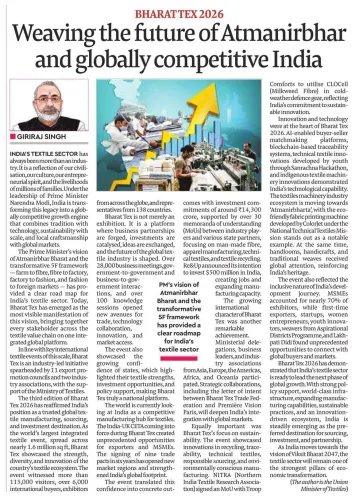
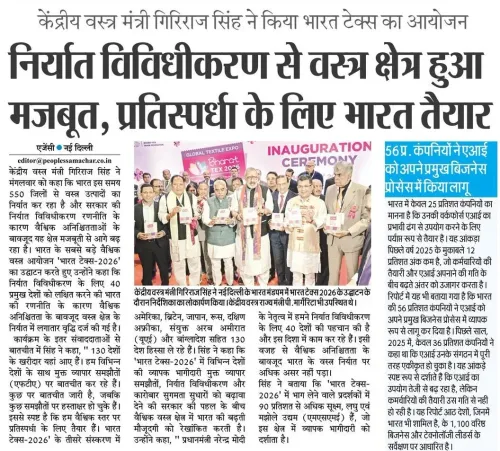
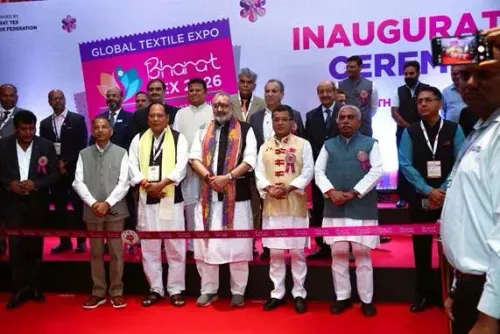
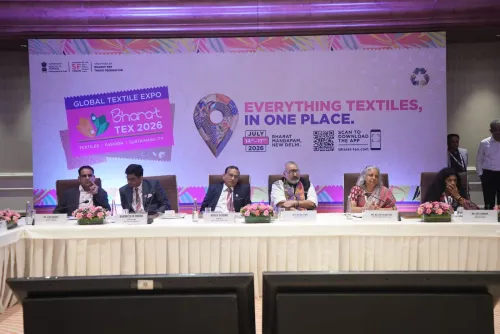
Union Textiles Minister Giriraj Singh on Thursday, 16 July 2026 declared that Bharat Tex 2026 had reinforced his confidence in India's ability to lead the future of the global textile industry, citing growing international demand for Indian products and the country's emergence as a trusted partner in the global textile value chain.
Context
Posting on X after engagements at Bharat Tex 2026 — a major national textile showcase bringing together entrepreneurs, innovators, and international buyers — Minister Singh said interactions at the event made 'one thing clear: Indian products are witnessing growing global demand.' He described India as 'a trusted and preferred partner in the global textile value chain,' framing the event as a validation of the sector's upward trajectory.
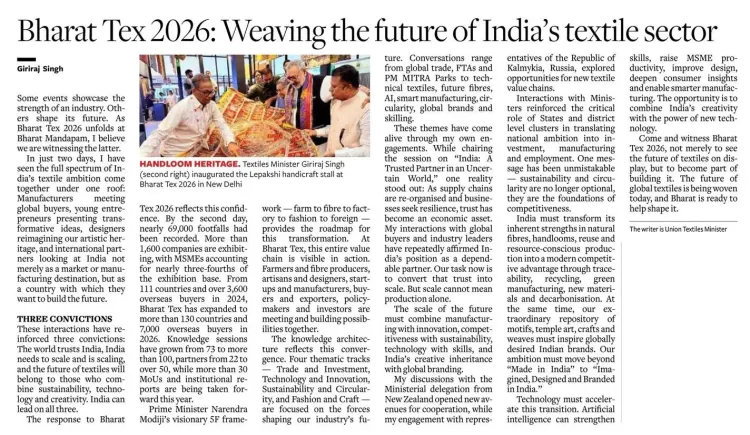
The minister also referenced a personal article in which he outlined his vision for the sector's next phase, centred on combining India's 'rich textile heritage with innovation, sustainability, AI, smart manufacturing, and globally admired Indian brands.'
Policy Backdrop
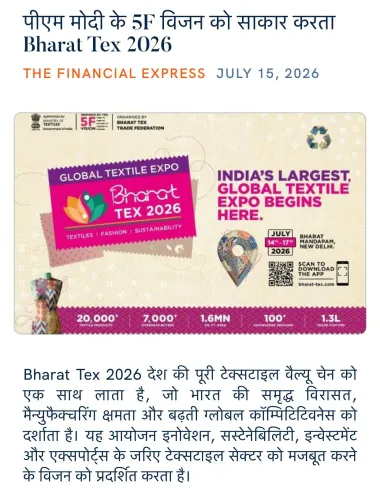
The post explicitly invokes Prime Minister Narendra Modi's 5F Vision — a strategic framework covering the full textile value chain from fibre to fabric, fashion, foreign markets, and ultimately global leadership. This framework has guided the ministry's policy direction, aligning with the broader Make in India campaign launched in 2014, which identified textiles as a priority sector for domestic value addition and export competitiveness.
The Production Linked Incentive (PLI) scheme for man-made fibre apparel and technical textiles, notified in 2021, has been a key instrument in this push — designed to attract fresh investment and shift India's export basket from raw fibre and yarn toward finished garments and higher-value technical textiles. The minister's emphasis on AI and smart manufacturing signals an intent to layer technology-driven productivity gains onto this existing foundation.
These efforts sit within the government's overarching Viksit Bharat 2047 goal — transforming India into a fully developed economy by the centenary of independence — in which manufacturing and export-led growth in labour-intensive sectors like textiles play a central role.
Stakeholders and Impact
The primary beneficiaries of the policy direction Minister Singh outlined are textile entrepreneurs, MSME exporters, and workers across the organised and decentralised segments of the sector. India's textile industry is one of the country's largest employers, and any sustained rise in global demand has direct implications for livelihoods across states including Gujarat, Tamil Nadu, Maharashtra, Uttar Pradesh, and West Bengal.
For global buyers attending Bharat Tex 2026, the minister's remarks signal a government committed to supply-chain reliability, sustainability standards, and brand-building — factors increasingly important to international sourcing decisions. The stress on 'globally admired Indian brands' points toward an ambition to move beyond contract manufacturing toward proprietary label creation, a shift that could meaningfully alter India's position in the value chain.
What's Next
Attention will now turn to whether the momentum from Bharat Tex 2026 translates into concrete policy announcements — including revised export targets and updated incentive guidelines under the 5F Vision framework — ahead of the next Union Budget. Parliamentary committee scrutiny of utilisation rates under existing textile schemes, including the PLI, will also be a key marker of how effectively current instruments are being deployed.
If the government follows through on the minister's articulated priorities — integrating AI, sustainability, and brand development into the 'Made in India' textile push — India could meaningfully close the gap with established textile export powerhouses, reshaping its role from a volume supplier to a value-driven global partner.
Point of View
He is tying near-term industry sentiment to a long-horizon national narrative — a pattern the BJP has used effectively across manufacturing sectors. The emphasis on AI, sustainability, and brand-building is notable: it suggests the ministry is aware that competing on cost alone is insufficient against rivals such as Bangladesh and Vietnam. Whether this vision translates into binding policy commitments — revised export targets, enhanced PLI tranches, or a new brand-development fund — will determine if Bharat Tex 2026 is remembered as a turning point or a well-attended showcase.
NationPress
14 Oct 2026
Frequently Asked Questions
What is Bharat Tex 2026?
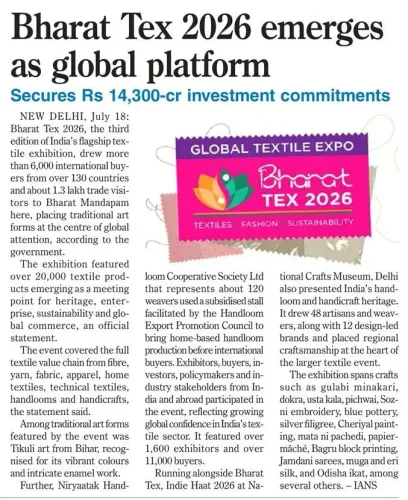
Bharat Tex 2026 is a major Indian textile industry event that brings together entrepreneurs, innovators, and international buyers to showcase India's textile capabilities and facilitate global partnerships.
What is PM Modi's 5F Vision for textiles?
The 5F Vision is a strategic framework promoted by Prime Minister Narendra Modi covering the full textile value chain: fibre, fabric, fashion, foreign markets, and global leadership, aimed at making India a dominant force in world textiles.
What did Giriraj Singh say about India's textile sector?
Union Textiles Minister Giriraj Singh said that Bharat Tex 2026 confirmed Indian products are witnessing growing global demand, and that India is now a trusted and preferred partner in the global textile value chain.
What is the PLI scheme for textiles in India?
The Production Linked Incentive (PLI) scheme for man-made fibre apparel and technical textiles was notified in 2021 to attract investment, boost domestic manufacturing, and shift India's textile exports toward higher-value finished products.
How does the textile sector connect to Viksit Bharat 2047?
Textiles is a key pillar of the Viksit Bharat 2047 goal, which aims to make India a fully developed economy by its centenary of independence; export-led growth and value-chain upgrading in labour-intensive sectors like textiles are central to achieving that target.