Shekhawat Hails India's Hypersonic, MIRV Missile Strides

Synopsis
Union Culture and Tourism Minister Gajendra Singh Shekhawat on 16 July 2026 shared a video report on X highlighting India's indigenous defence leaps — hypersonic scramjet propulsion, MIRV-capable Agni missiles — as evidence of the country's growing strategic autonomy under the Atmanirbhar Bharat framework.
Key Takeaways
Union Minister Gajendra Singh Shekhawat shared a detailed video report on 16 July 2026 praising India's advances in modern military technology.
The post highlights hypersonic scramjet propulsion and MIRV-equipped Agni missiles as landmark indigenous achievements.
India's missile programme traces its roots to the Integrated Guided Missile Development Programme launched in 1983 by DRDO .
The Atmanirbhar Bharat Abhiyan , announced in May 2020 , has driven defence indigenisation through import bans and enhanced domestic R&D budgets.
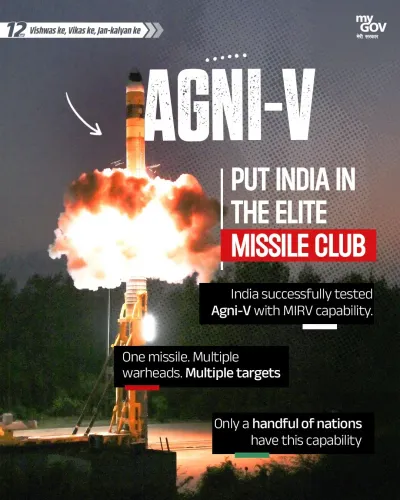
MIRV technology allows a single missile to carry multiple warheads targeting separate locations, placing India among a select group of nations with such capability.
Upcoming parliamentary disclosures on the defence R&D budget and induction timelines for advanced Agni variants will be key indicators of programme progress.
Union Culture and Tourism Minister Gajendra Singh Shekhawat on Thursday, 16 July 2026, shared a video report on X championing India's growing defence technology prowess, highlighting indigenous achievements in hypersonic scramjet propulsion, MIRV-equipped Agni missiles, and advanced smart weapon systems as proof of the country's rising strategic autonomy.
Context
Shekhawat's post, captioned 'Suraksha se samprabhuta tak: aadhunik sainya takneek mein Bharat ka shankhnaad' ('From security to sovereignty: India's clarion call in modern military technology'), accompanied a detailed video report. The minister framed India's defence advances as defining a new direction for future warfare, writing that indigenous achievements have 'proved India's strength in the global defence sector.'
Though Shekhawat heads the Culture and Tourism portfolio, senior BJP leaders routinely amplify the government's strategic and security messaging across social media, reflecting a coordinated communication approach on national security themes.
Policy Backdrop
The milestones cited in the post trace their lineage to the Integrated Guided Missile Development Programme (IGMDP), launched in 1983, which set India on the path toward self-sufficient missile design and production. The programme gave rise to the Agni series, developed by the Defence Research and Development Organisation (DRDO), with the first successful Agni-V test — demonstrating intercontinental-range capability — conducted in April 2012.
The Atmanirbhar Bharat Abhiyan, announced in May 2020, gave fresh institutional momentum to defence indigenisation, introducing dedicated import-ban lists and budget incentives to reduce reliance on foreign suppliers. India has since progressively raised domestic R&D allocations and restricted imports of selected weapons and platforms, pursuing strategic autonomy against the backdrop of active border tensions.
The pursuit of MIRV (Multiple Independently Targetable Re-entry Vehicle) technology — which allows a single missile to carry multiple warheads aimed at separate targets — and hypersonic scramjet propulsion places India in a select group of nations developing next-generation deterrence capabilities, mirroring similar programmes by peer competitors.
Stakeholders and Impact
The primary beneficiaries of this trajectory are India's armed forces, which gain credible deterrence tools, and the domestic defence industry, including public-sector undertakings and a growing private-sector ecosystem incentivised under Atmanirbhar Bharat. Reduced import dependence also has significant foreign-exchange implications for the defence budget.
For DRDO and associated laboratories, successful development of hypersonic and MIRV systems represents a generational leap in indigenous engineering capability, with potential spin-offs for the civilian aerospace and space sectors.
What's Next
Attention will now turn to parliamentary disclosures on the defence R&D budget and any officially announced user trials or induction timelines for MIRV-capable Agni variants. Progress on hypersonic scramjet test flights will also be closely watched as a benchmark of India's readiness to field such systems operationally.
As India continues to position itself as a net exporter of defence equipment — a stated government goal — the technologies highlighted in Shekhawat's post could form the centrepiece of future export diplomacy and strategic partnerships in the Indo-Pacific region.
Point of View
A pattern consistent with strategic signalling rather than routine announcements. The post also reflects the government's broader effort to build domestic public confidence in indigenous defence R&D, ahead of what could be significant budget and procurement decisions in the coming parliamentary session.
NationPress
16 Jul 2026
Frequently Asked Questions
What is MIRV technology and does India have it?
MIRV stands for Multiple Independently Targetable Re-entry Vehicle, a technology that allows one ballistic missile to carry several warheads, each guided to a different target. India has been developing MIRV capability for its Agni missile series through DRDO, joining a small group of nations with such advanced deterrence tools.
What is a hypersonic scramjet missile?
A hypersonic scramjet missile uses a supersonic combustion ramjet engine to travel at speeds exceeding Mach 5, making it extremely difficult to intercept. DRDO has been pursuing scramjet propulsion as part of India's next-generation missile development programme.
What is the Atmanirbhar Bharat Abhiyan in defence?
Atmanirbhar Bharat Abhiyan, launched in May 2020, is a self-reliance initiative that in the defence sector involves import bans on selected weapons, higher domestic R&D budgets, and incentives for Indian manufacturers to reduce dependence on foreign military equipment.
Why is a Culture Minister commenting on defence technology?
Senior BJP ministers routinely amplify the government's strategic and security messaging across social media as part of a coordinated communication approach, regardless of their specific portfolio. Gajendra Singh Shekhawat is a senior party leader and Lok Sabha MP from Jodhpur, Rajasthan.
What is the Agni missile series?
The Agni series is India's family of surface-to-surface ballistic missiles developed by DRDO since the 1980s under the Integrated Guided Missile Development Programme, with ranges spanning short to intercontinental distances. The Agni-V, first tested in April 2012, demonstrated ICBM-range capability.