Giriraj Singh flags Bharat Tex 2026 as textile export launchpad
Synopsis
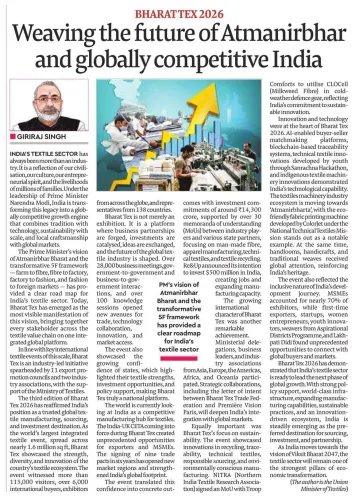
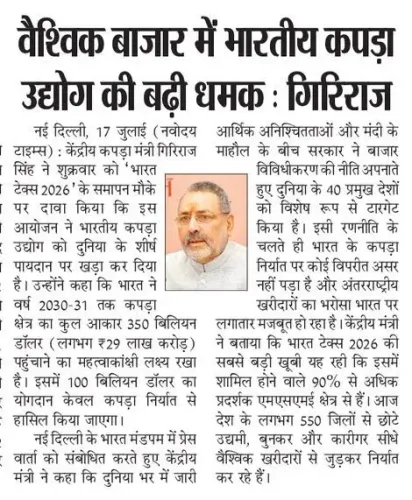
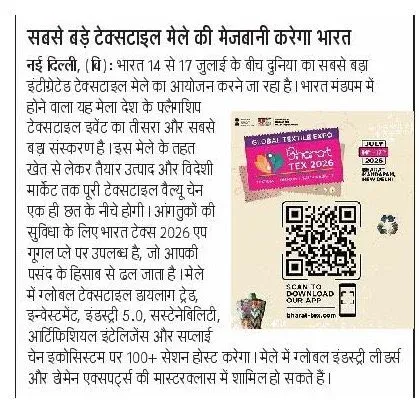
Union Textiles Minister Giriraj Singh on 1 June 2026 promoted Bharat Tex 2026, a four-day international textile event set for 14–17 July, as a key platform to expand India's textile, handloom, and handicraft exports and attract global investment under the Make in India banner.
Key Takeaways
Bharat Tex 2026 is scheduled for 14–17 July 2026 and is being positioned as India's flagship international textile showcase.
Union Textiles Minister Giriraj Singh described the event as a platform to take India's textile and apparel sector to 'new heights'.
The event targets export growth, foreign investment, and employment creation in the textile, handloom, and handicraft segments.
It is aligned with the government's Make in India and Vocal for Local campaigns, aiming to give these initiatives global visibility.
Key beneficiaries include textile exporters, handloom weavers, and MSME manufacturers who gain direct access to international buyers and investors.
The event follows the PLI Scheme for Textiles (2021) as part of a sustained policy push to integrate Indian textiles into global value chains.
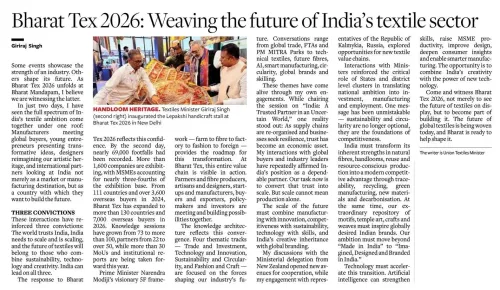
Union Textiles Minister Giriraj Singh on Monday, 1 June 2026 highlighted Bharat Tex 2026, scheduled for 14–17 July 2026, as a pivotal platform to elevate India's textile and apparel sector to new global heights. The minister described the event as a major step toward boosting exports, attracting investment, generating employment, and winning international recognition for the Make in India and Vocal for Local initiatives.
Context
Posting in Hindi on X, Singh wrote that Bharat Tex 2026 is 'देश के वस्त्र एवं परिधान क्षेत्र को नई ऊंचाइयों तक ले जाने का महत्वपूर्ण मंच' ('an important platform to take the country's textile and apparel sector to new heights'). He added that participation by buyers, investors, and industry experts from across the world is helping Indian textile, handloom, and handicraft products access new global markets.
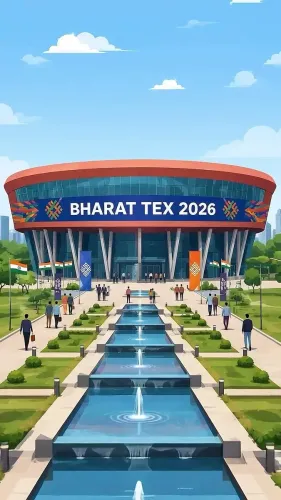
The four-day event is being positioned by the Ministry of Textiles as a flagship international showcase, bringing together the full value chain — from raw fibre and handloom to finished garments and technical textiles — under one roof for a global audience.
Policy Backdrop
India's textiles sector has been a sustained policy priority for successive central governments given its status as one of the country's largest employment-intensive industries. The Make in India initiative, launched in September 2014, set the foundation for attracting manufacturing investment, with textiles identified as a key sector from the outset.
The Production Linked Incentive (PLI) Scheme for Textiles, notified in 2021, further reinforced this focus by targeting man-made fibre apparel and technical textiles — segments where India has historically lagged behind competitors such as China, Bangladesh, and Vietnam. Bharat Tex 2026 fits into this broader arc of combining manufacturing incentives with export promotion and global branding.
The Vocal for Local campaign has added a demand-side dimension to this strategy, encouraging domestic and international buyers to recognise Indian-made handloom and handicraft products as premium, culturally distinctive offerings rather than low-cost commodities.
Stakeholders and Impact
The event is expected to be of direct consequence to textile exporters, handloom weavers, and MSME manufacturers across states including Gujarat, Tamil Nadu, Maharashtra, Uttar Pradesh, and West Bengal — India's major textile-producing hubs. For small weavers and artisans, international buyer access at a consolidated platform can translate into direct order flows that would otherwise require costly individual market-development efforts.
Global buyers and investors attending the event are anticipated to engage across product categories spanning cotton yarn, silk, technical textiles, and handcrafted fabrics. Singh's post underscores the government's intent to use Bharat Tex 2026 not merely as an exhibition but as a deal-making and investment-facilitation event that creates measurable employment outcomes downstream.
What's Next
With the event roughly six weeks away at the time of the minister's post, attention will turn to the logistics of participation, the scale of international delegations confirmed, and whether the government announces supplementary export targets or fresh incentive measures in the run-up to July 2026. Any revision to India's textile export targets or new buyer-country partnerships announced at the event will be closely watched by the industry as a gauge of the sector's post-pandemic recovery trajectory and its ability to capture global supply-chain shifts away from competing manufacturing hubs.
Point of View
Using the minister's social media reach to build international awareness and domestic confidence ahead of Bharat Tex 2026. The framing — linking a trade exhibition to Make in India, Vocal for Local, employment, and export growth simultaneously — reflects the government's standard playbook of bundling sectoral events into the larger nationalist-economic narrative. For the textiles ministry, Bharat Tex serves a dual purpose: it is both a commercial deal-making platform and a proof-of-concept for India's ambitions to capture global textile supply-chain shifts away from China and Bangladesh. The minister's emphasis on handloom and handicraft alongside industrial textiles signals a deliberate effort to present India's offering as culturally differentiated, not merely cost-competitive.
NationPress
17 Oct 2026
Frequently Asked Questions
What is Bharat Tex 2026 and when is it held?
Bharat Tex 2026 is an international textile and apparel exhibition organised by India's Ministry of Textiles, scheduled for 14–17 July 2026 . It brings together global buyers, investors, and industry experts to showcase Indian textile, handloom, and handicraft products.
What is Giriraj Singh's role in India's textile sector?
Giriraj Singh is the Union Minister of Textiles in the Government of India. He is a senior BJP leader and Lok Sabha MP from Begusarai, Bihar , and is responsible for policy, export promotion, and development of the textile, handloom, and handicraft sectors.
How does Bharat Tex 2026 relate to Make in India?
Bharat Tex 2026 is directly aligned with the Make in India initiative, which was launched in September 2014. The event is intended to attract foreign investment into Indian textile manufacturing and give global visibility to domestically produced goods.
Who benefits from Bharat Tex 2026?
The primary beneficiaries are textile exporters, handloom weavers, and MSME manufacturers across India's major textile-producing states. Small artisans and weavers in particular gain access to international buyers who would otherwise be difficult to reach independently.
What is the PLI Scheme for Textiles?
The Production Linked Incentive (PLI) Scheme for Textiles was notified in 2021 to support manufacturing of man-made fibre apparel and technical textiles in India. It forms part of the broader policy framework within which events like Bharat Tex 2026 are positioned.