Giriraj Singh hails BharatTex 2026 as global trade platform
Synopsis
Union Textiles Minister Giriraj Singh praised BharatTex 2026 on 17 July as a strong global trade platform for Indian textiles, saying rising confidence among worldwide buyers, entrepreneurs and industry proves the event is giving the sector a new identity and momentum.
Key Takeaways
Giriraj Singh on 17 July 2026 publicly endorsed BharatTex 2026 as a transformative global trade and opportunity platform for Indian textiles.
The minister highlighted the quality, innovation and diversity of Indian textile products as key factors drawing worldwide attention.
The PLI Scheme for Textiles , with an outlay of Rs 10,683 crore , and the RoSCTL scheme form the policy backbone supporting India's textile export push.
MSME exporters , textile clusters and handloom weavers are the primary stakeholders positioned to benefit from BharatTex 2026's global buyer access.
India is competing with Bangladesh and Vietnam for global textile market share, with events like BharatTex designed to leverage supply-chain diversification trends among global buyers.
Post-event order commitments and any new PM MITRA textile park announcements will be the next indicators of policy follow-through.
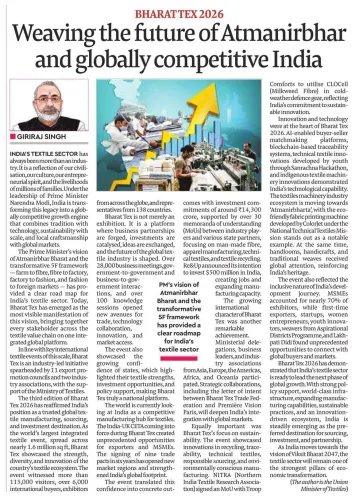
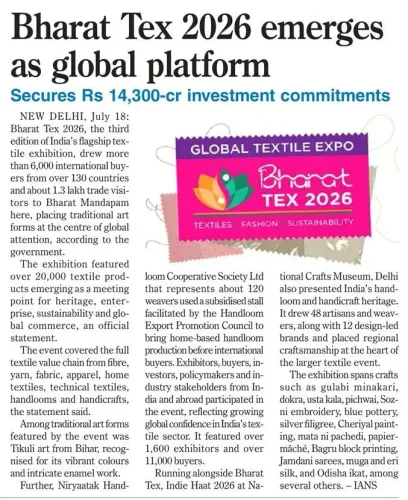
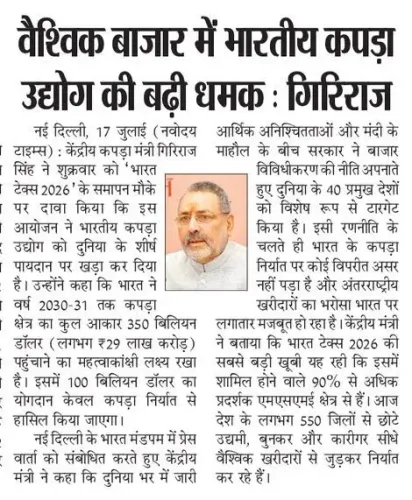
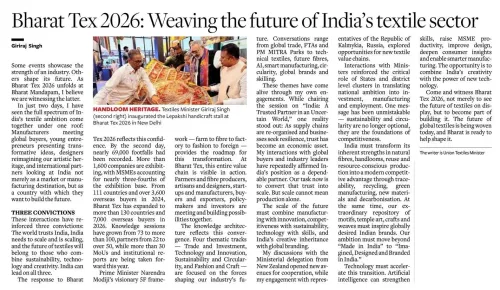
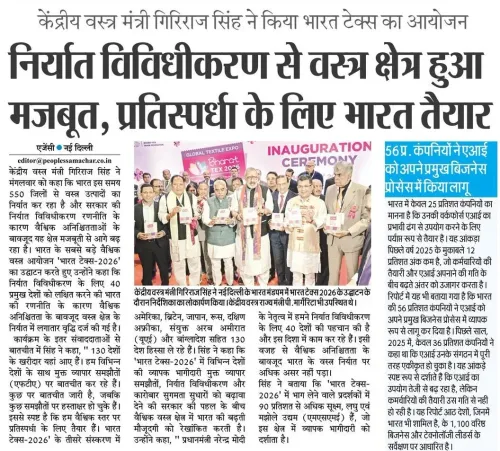
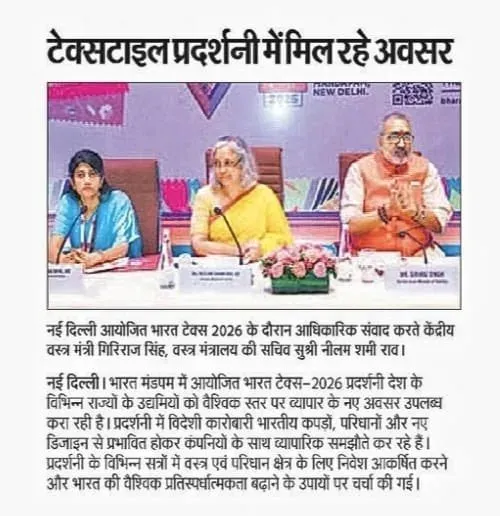
Union Textiles Minister Giriraj Singh on Friday, 17 July 2026, said that BharatTex 2026 has emerged as a powerful global platform for trade and new opportunities in India's textile sector, citing growing confidence among buyers, entrepreneurs and industry stakeholders from across the world.
Posting on X, the minister wrote: 'दुनिया भर के खरीदारों, उद्यमियों और उद्योग जगत का बढ़ता विश्वास इस बात का प्रमाण है कि भारत टेक्स 2026 भारतीय वस्त्र उद्योग के लिए वैश्विक व्यापार और नए अवसरों का सशक्त मंच बनकर उभरा है।' ('The growing confidence of buyers, entrepreneurs and the industry world over is proof that BharatTex 2026 has emerged as a strong platform of global trade and new opportunities for India's textile industry.') He added that the quality, innovation and diversity of Indian products are attracting attention worldwide, and that the event is becoming a vehicle for giving the Indian textile industry a new identity and new momentum.
Context
BharatTex 2026 is a flagship textile trade fair organised under the aegis of the Ministry of Textiles, designed to bring together domestic manufacturers, global buyers and investors on a single platform. The event builds on an earlier edition and is positioned as India's answer to international textile expos, showcasing the country's strengths across cotton, man-made fibres, handloom, silk, jute and technical textiles. Singh's post underscores the government's intent to use such platforms to amplify India's export narrative and attract foreign sourcing.
Policy Backdrop
The push behind BharatTex 2026 sits within a broader architecture of textile-sector incentives. The Production Linked Incentive (PLI) Scheme for Textiles, notified in 2021 with an outlay of Rs 10,683 crore, specifically targets man-made fibres and technical textiles — segments where India has historically lagged behind competitors such as Bangladesh and Vietnam. The RoSCTL scheme, introduced in 2019, rebates embedded state and central taxes and levies on apparel and made-up exports, directly improving price competitiveness for Indian exporters in global markets.
The Amended Technology Upgradation Fund Scheme (ATUFS), operationalised from 2016, provided capital subsidy for modernisation of textile units, laying the groundwork for the quality upgrades that Singh now highlights. Together, these schemes form the policy lineage that the ministry credits for India's improving position in global textile supply chains, aligned with the broader Make in India and Atmanirbhar Bharat frameworks.
Stakeholders and Impact
The primary beneficiaries of heightened global attention at BharatTex 2026 are MSME exporters, textile clusters and handloom weavers who gain direct access to international buyers — a channel that is otherwise difficult and expensive to establish independently. For small and medium units in clusters across Tamil Nadu, Gujarat, Maharashtra, Uttar Pradesh and West Bengal, participation in a credible national showcase can translate into long-term sourcing agreements. The minister's emphasis on 'quality, innovation and diversity' also signals that the government is steering the sector away from low-value commodity exports toward higher-margin, value-added products.
Global buyers, particularly from Europe, the United States and West Asia, have been actively seeking supply-chain diversification away from single-country dependence, creating a structural opening that events like BharatTex are designed to exploit.
What's Next
The outcomes of buyer-seller meets conducted during BharatTex 2026 — including order commitments and new sourcing partnerships — will be a key metric for assessing the event's tangible impact. Parliamentary scrutiny of the Ministry of Textiles budget allocations and any announcements regarding new PM MITRA textile parks in the upcoming session will indicate whether the political momentum generated by the event translates into fresh capital investment. Singh's public endorsement of the fair also sets expectations for a post-event report on participation numbers, buyer inquiries and projected export orders.
Point of View
Reinforcing the government's narrative that India is a credible alternative sourcing hub at a moment when global buyers are actively diversifying supply chains away from China and Bangladesh. By foregrounding 'confidence' of international stakeholders, the minister is implicitly making a competitiveness argument that goes beyond ceremonial fair-promotion. The timing aligns with the BJP's broader electoral messaging in manufacturing states, where textile employment is politically significant. Whether BharatTex 2026 delivers measurable export order growth will determine whether this optimism becomes a durable policy story or remains a promotional moment.
NationPress
15 Oct 2026
Frequently Asked Questions
What is BharatTex 2026?
BharatTex 2026 is a flagship national textile trade fair organised under the Ministry of Textiles, bringing together Indian manufacturers, global buyers, entrepreneurs and investors to showcase India's strengths across cotton, man-made fibres, handloom, silk, jute and technical textiles.
What did Giriraj Singh say about BharatTex 2026?
Union Textiles Minister Giriraj Singh said on 17 July 2026 that BharatTex 2026 has emerged as a strong platform for global trade and new opportunities, and that the quality, innovation and diversity of Indian products are attracting worldwide attention.
What government schemes support India's textile exports?
Key schemes include the PLI Scheme for Textiles with an outlay of Rs 10,683 crore (focused on man-made fibres and technical textiles), the RoSCTL scheme that rebates embedded taxes on apparel exports, and the ATUFS which provided capital subsidy for modernisation of textile units.
Who benefits from BharatTex 2026?
MSME exporters, textile clusters and handloom weavers are the primary beneficiaries, as the event gives them direct access to international buyers from Europe, the United States and West Asia who are seeking to diversify their sourcing away from single-country dependence.
How does India compete with Bangladesh and Vietnam in textiles?
India competes through fiscal incentives like RoSCTL and PLI, quality upgradation support via ATUFS, and trade promotion events like BharatTex, while leveraging its diversity across textile segments — cotton, silk, handloom and technical textiles — as a differentiator.