Giriraj Singh marks International Cooperative Day
Synopsis
Union Textiles Minister Giriraj Singh marked International Cooperative Day on 4 July 2026 by calling for collective effort, unity and self-reliance, echoing the government's broader Atmanirbhar Bharat agenda and its renewed focus on India's cooperative sector since 2021.
Key Takeaways
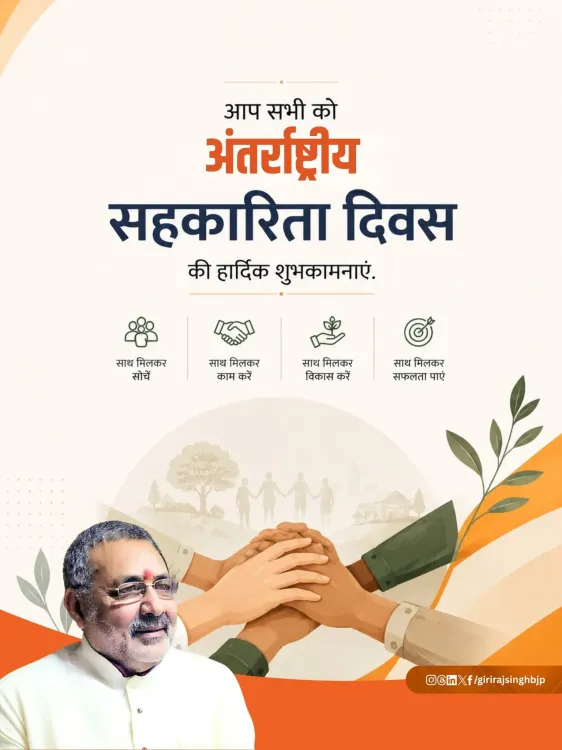
Giriraj Singh , Union Textiles Minister and BJP MP from Begusarai , extended greetings on International Cooperative Day, 4 July 2026 .
He called for thinking, working, growing and succeeding together — framing cooperatives as symbols of collective effort, unity and self-reliance.
International Cooperative Day is observed on the first Saturday of July each year to promote mutual aid and democratic economic participation.
The Ministry of Cooperation was created in July 2021 to give dedicated policy focus to India's cooperative sector.
The government has linked cooperatives to the Atmanirbhar Bharat agenda since 2020 , positioning them as tools for rural credit, marketing and value-addition.
Future policy moves may include amendments to multi-state cooperative laws and integration with schemes such as e-NAM and PM-KISAN .
Union Textiles Minister Giriraj Singh greeted citizens on International Cooperative Day on Saturday, 4 July 2026, calling for collective effort, unity and self-reliance as the foundations of national progress. In a post on X, the senior BJP leader and Lok Sabha MP from Begusarai, Bihar, urged every section of society to strengthen the cooperative spirit and contribute to the country's advancement.
Context
The minister's post opens with a guiding principle: 'साथ मिलकर सोचें, साथ मिलकर काम करें, साथ मिलकर विकास करें और साथ मिलकर सफलता पाएं' — 'Think together, work together, grow together, and achieve success together.' He described International Cooperative Day as a symbol of collective endeavour, unity and self-reliance (आत्मनिर्भरता), and called on people to deepen the cooperative spirit for the welfare of every segment of society and the nation's progress.
International Cooperative Day is observed globally on the first Saturday of July each year. It promotes the principles of mutual aid, democratic participation and shared economic benefit that underpin the cooperative movement worldwide.
Policy Backdrop
The message resonates with a significant structural shift in Indian governance: in July 2021, the central government created a dedicated Ministry of Cooperation to give renewed policy focus to India's vast cooperative sector — a move widely seen as an acknowledgement of cooperatives' role in rural credit, marketing and value-addition in agriculture and allied sectors.
Since 2020, the government has consistently linked the cooperative model to its Atmanirbhar Bharat (self-reliant India) agenda, treating cooperative societies as instruments for grassroots economic empowerment. The vocabulary in Singh's post — collective effort, unity, self-reliance — mirrors that broader policy narrative closely.
Stakeholders and Impact
India's cooperative sector spans dairy, credit, housing, sugar, fisheries and handloom segments, touching the lives of hundreds of millions of rural households. Cooperative societies serve as the primary institutional channel for agricultural credit and input supply in many states, making observances like this day politically and economically significant for rural communities.
For the textiles sector specifically, weaver cooperatives and handloom societies represent a critical link between artisan producers and national or export markets. A minister-level endorsement of cooperative values on this occasion reinforces the government's stated commitment to inclusive, bottom-up economic development.
What's Next
Observers of cooperative policy will watch for further amendments to multi-state cooperative laws and the possible integration of cooperative databases with central schemes such as e-NAM and PM-KISAN, which could deepen the sector's reach and efficiency. Singh's message, while ceremonial in tone, adds political weight to calls for a stronger cooperative framework as the government looks to channel rural enterprise into its broader growth agenda.
Point of View
He reinforces the BJP government's sustained effort to rebrand India's cooperative movement as a pillar of Atmanirbhar Bharat. The creation of a standalone Ministry of Cooperation in 2021 was a deliberate institutional bet on this sector, and ministerial messaging on symbolic occasions helps maintain political momentum for that agenda. For a Textiles Minister, the subtext is also relevant — weaver and handloom cooperatives remain a fragile but vital link in India's artisan economy, and visible support from senior ministers matters to those communities. The broader arc points toward deeper integration of cooperative infrastructure with digital public goods and central welfare schemes.
NationPress
2 Oct 2026
Frequently Asked Questions
What is International Cooperative Day and when is it celebrated?
International Cooperative Day is a global observance held on the first Saturday of July each year to promote the cooperative movement's principles of mutual aid, collective effort and democratic participation.
What did Giriraj Singh say on International Cooperative Day 2026?
Giriraj Singh posted a message urging citizens to 'think together, work together, grow together and achieve success together,' calling cooperatives symbols of collective effort, unity and self-reliance ( Atmanirbharta ).
What is India's Ministry of Cooperation?
The Ministry of Cooperation is a dedicated central government ministry created in July 2021 to give focused policy attention to India's cooperative sector, covering areas such as rural credit, dairy, sugar and marketing cooperatives.
How are cooperatives linked to Atmanirbhar Bharat?
Since 2020, the central government has positioned cooperative societies as grassroots instruments for the Atmanirbhar Bharat (self-reliant India) agenda, using them for agricultural credit, input supply and value-addition in rural economies.
What policy changes could affect India's cooperative sector next?
Possible upcoming changes include amendments to multi-state cooperative laws and integration of cooperative society databases with central schemes such as e-NAM and PM-KISAN to improve reach and efficiency.