Giriraj Singh flags cooperatives as key to Viksit Bharat
Synopsis
Union Textiles Minister Giriraj Singh on 6 July 2026 amplified the government's 'Sahkar se Samridhi' cooperative vision, linking rural cooperative growth to India's Viksit Bharat 2047 development goal. The post underscores the BJP government's sustained push to place cooperatives at the heart of rural economic policy.
Key Takeaways
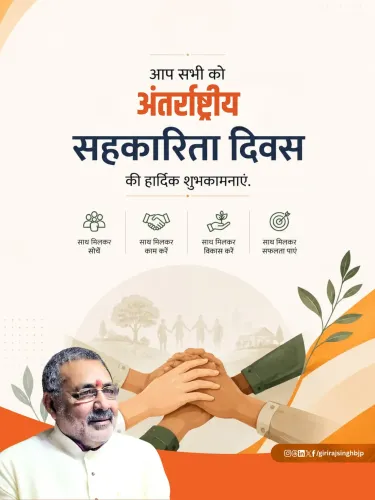
Giriraj Singh , Union Textiles Minister and BJP MP from Begusarai , shared the cooperative-economy article on 6 July 2026 via the NaMo App .
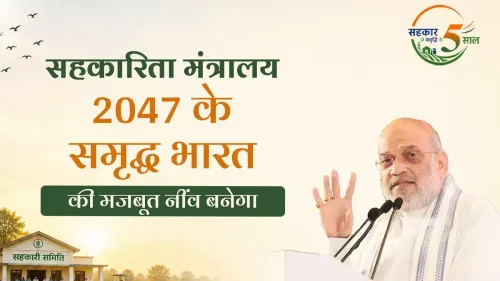
The post invokes 'Sahkar se Samridhi' — prosperity through cooperation — the central government's flagship cooperative slogan.
The Ministry of Cooperation was established in July 2021 as India's first dedicated Union-level cooperative ministry.
Policy reforms target Farmer Producer Organisations and Primary Agricultural Credit Societies as vehicles for rural income growth.
The cooperative agenda connects directly to Viksit Bharat 2047 , PM Modi 's vision for a fully developed India by independence's centenary.
Convergence between the textiles and cooperation ministries holds implications for handloom weavers and rural artisans across multiple states.
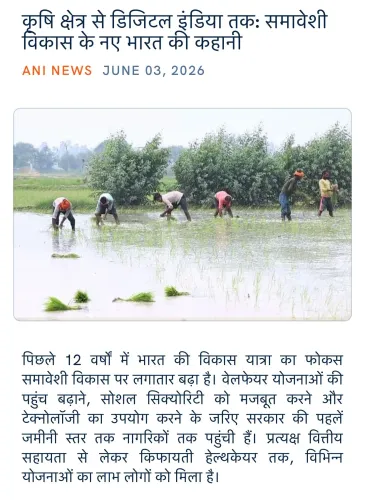
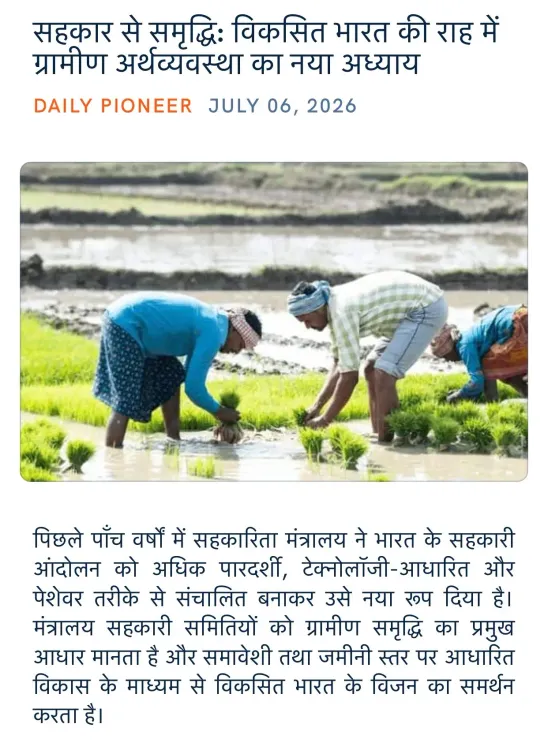
Union Textiles Minister Giriraj Singh on Monday, 6 July 2026, shared an article championing the cooperative movement as a new chapter in India's rural economy, framing it within the government's Viksit Bharat vision for a developed India by 2047. The post, shared via the NaMo App, carried the headline 'Sahkar se Samridhi: Viksit Bharat ki raah mein gramin arthvyavastha ka naya adhyay' — translating to 'Prosperity through cooperation: A new chapter of the rural economy on the road to a developed India.'
Context
The phrase 'Sahkar se Samridhi' — prosperity through cooperation — has become a defining slogan of the BJP-led government's cooperative policy push since 2021. Giriraj Singh, a senior BJP leader and Lok Sabha MP from Begusarai, Bihar, amplified the message through the party's official NaMo App, signalling alignment between the Ministry of Textiles and the broader cooperative agenda championed by the central government.
India's cooperative sector encompasses millions of rural households, from dairy and agriculture to weaving and handlooms — areas that intersect directly with the textiles portfolio that Singh oversees.
Policy Backdrop
The Ministry of Cooperation was carved out as a separate ministry in July 2021, the first such dedicated ministry at the Union level, to provide focused policy support to India's sprawling cooperative ecosystem. Prime Minister Narendra Modi has consistently positioned cooperatives as central to rural prosperity, invoking models such as Amul as proof of concept for farmer-led collective enterprise.
The government's broader reform push has targeted Farmer Producer Organisations (FPOs) and Primary Agricultural Credit Societies (PACS), seeking to modernise their governance and expand their economic footprint. These reforms feed directly into the Viksit Bharat 2047 framework, which envisions a fully developed India by the centenary of independence.
Stakeholders and Impact
Small and marginal farmers, rural artisans, and cooperative members stand at the centre of this policy conversation. For the textiles sector specifically, cooperative structures underpin large segments of the handloom and powerloom industries, particularly in states such as Bihar, Uttar Pradesh, Tamil Nadu, and West Bengal.
Strengthening rural cooperatives is also seen as a tool to reduce dependence on intermediaries, improve price realisation for producers, and channel institutional credit more effectively to the grassroots. The convergence of cooperative policy with the textiles ministry's mandate creates potential synergies for weavers' clusters and yarn-supply chains.
What's Next
Observers will watch for concrete policy measures flowing from this renewed emphasis — including possible budget allocations for cooperative infrastructure, amendments to cooperative laws in Parliament, and scheme-level convergence between the Ministry of Cooperation and the Ministry of Textiles. The government's ability to translate the 'Sahkar se Samridhi' slogan into measurable rural income gains will be a key benchmark as India advances toward its Viksit Bharat 2047 target.
Point of View
The subtext is significant: cooperative structures govern large swathes of handloom and artisan clusters, making the minister's endorsement a potential precursor to scheme-level convergence. The broader arc suggests the government is building a cross-ministerial institutional coalition around cooperatives as the primary vehicle for rural Viksit Bharat delivery.
NationPress
5 Oct 2026
Frequently Asked Questions
What is 'Sahkar se Samridhi' in India?
'Sahkar se Samridhi' means 'prosperity through cooperation' and is the BJP-led government's guiding slogan for using cooperative institutions to drive rural economic growth and farmer welfare.
What is the Ministry of Cooperation in India?
The Ministry of Cooperation was created in July 2021 as India's first dedicated Union-level ministry for the cooperative sector, tasked with strengthening cooperative institutions and expanding their reach in rural areas.
What is Viksit Bharat 2047?
Viksit Bharat 2047 is the Government of India's vision, championed by PM Narendra Modi , to make India a fully developed nation by 2047 — the centenary of independence — across economic, social, and infrastructure dimensions.
Why is Giriraj Singh promoting cooperatives as Textiles Minister?
The textiles sector has deep ties to cooperative structures, particularly in handloom and artisan clusters. As Union Textiles Minister, Giriraj Singh has an institutional interest in aligning cooperative policy with textile supply chains and weaver welfare.
What is the NaMo App used for?
The NaMo App is the official BJP mobile application used by party leaders and supporters to share government schemes, policy updates, and party communications with a wider audience.