Giriraj Singh hails Meghwal article on Constitution as compass
Synopsis
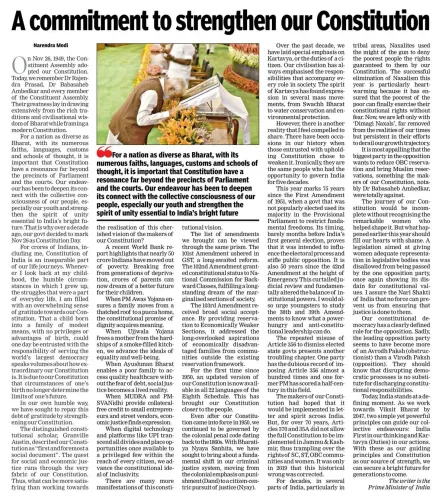
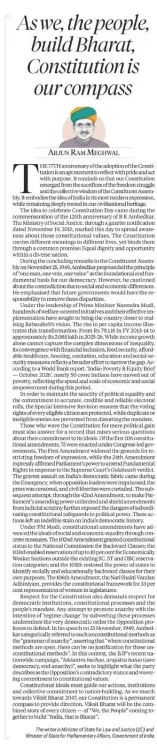
On Constitution Day, Union Textiles Minister Giriraj Singh highlighted Law Minister Arjun Ram Meghwal's article 'As We, the People, Build Bharat, Constitution is Our Compass', citing Ambedkar, reforms, and change under PM Modi.
Key Takeaways
Union Textiles Minister Giriraj Singh highlighted Law Minister Arjun Ram Meghwal's article on Constitution Day.
The essay is titled 'As We, the People, Build Bharat, Constitution is Our Compass'.
Singh said it underlines the Constitution's original spirit, democratic values, and role in nation-building.
As described, the article cites Dr B.R.
Ambedkar, constitutional reforms, and socio-economic change under PM Narendra Modi.
The Constitution was adopted on 26 November 1949 and came into force on 26 January 1950.
On Constitution Day, Union Textiles Minister Giriraj Singh put Law and Justice Minister Arjun Ram Meghwal's essay at the centre of India's civic calendar, framing the Constitution as the compass as the country builds Bharat. Singh said the article underlines the original spirit of the Constitution, democratic values, and its role in nation-building — and he posted on 26 November, the day the Constituent Assembly adopted the text in 1949.
Writing in Hindi, Singh described Meghwal — Minister of State for Law and Justice with independent charge — as the author of As We, the People, Build Bharat, Constitution is Our Compass. He said the piece marks the Constitution's mool bhavna (original spirit), democratic values, and its important part in nation-building.
The Textiles Minister added that the essay invokes the ideas of Dr. B.R. Ambedkar, constitutional reforms, and the socio-economic changes unfolding under Prime Minister Narendra Modi.
The essay Singh chose to amplify
Singh's post is an endorsement, not a line-by-line reading. What he chose to flag is a tight triad: Ambedkar's thought, the live agenda of constitutional reform, and the claim of social and economic transformation under the present government.
That pairing is pointed. Ambedkar chaired the Constituent Assembly's drafting committee. The Constitution was adopted on 26 November 1949 and came into force on 26 January 1950. Constitution Day, or Samvidhan Diwas, now returns every year as a moment when ministers, lawyers, and citizens argue over what the founding text still demands.
Ambedkar's draft and the reform pitch
Meghwal's title itself is a constitutional echo: 'We, the People' is the opening of the Preamble. Framing that phrase as a project to build Bharat turns a 1949 enactment into a present-tense brief — law as compass, not relic.
Union ministers have repeatedly linked Ambedkar's constitutional vision with contemporary policy outcomes. Singh's intervention sits in that pattern: invoke the architect, then point to reforms and socio-economic change. Citizens and the legal community are the implied audience — the people named in the Preamble, and the professionals who interpret the text.
Constitution Day as a working brief
The calendar does the rest. On the anniversary of adoption, a Law Minister's essay and a Cabinet colleague's amplification turn a founding document into a civic talking point. Further ministerial writing, or debate on constitutional reforms in upcoming parliamentary sessions, is the usual next stop for this argument.
On Constitution Day, ministers are treating the founding text as a working instrument — a compass, they say, still in the hands of We, the People.
Point of View
The government places Ambedkar's drafting legacy beside its own reform record and asks the public to read both as one story. That linkage is now a recurring ministerial move: the founding text as compass, contemporary change as destination. The contest over who speaks for Ambedkar does not end on 26 November; it simply finds a calendar.
NationPress
26 Nov 2026
Frequently Asked Questions
When is Constitution Day in India?
Constitution Day, or Samvidhan Diwas, is observed on 26 November, the date the Constituent Assembly adopted the Constitution in 1949. It came into force on 26 January 1950, which India marks as Republic Day.
Who is Arjun Ram Meghwal?
Arjun Ram Meghwal is Minister of State for Law and Justice with independent charge. Union Textiles Minister Giriraj Singh highlighted his article titled 'As We, the People, Build Bharat, Constitution is Our Compass'.
What did Giriraj Singh say about the article?
Singh said Meghwal's article underlines the original spirit of the Indian Constitution, democratic values, and its role in nation-building. He noted that it mentions Dr B.R. Ambedkar's thoughts, constitutional reforms, and socio-economic changes under Prime Minister Narendra Modi.
What was Dr B.R. Ambedkar's role in the Constitution?
Dr B.R. Ambedkar chaired the Constituent Assembly's drafting committee and is regarded as the principal architect of the Indian Constitution. Ministers frequently invoke his ideas on Constitution Day.
Why did Giriraj Singh post about the Constitution on 26 November?
26 November is Constitution Day in India, marking the adoption of the Constitution in 1949. Singh used the anniversary to draw attention to Meghwal's essay framing the Constitution as the compass for building Bharat.