Textiles Minister Giriraj Singh hails PM Constitution Day article
Synopsis
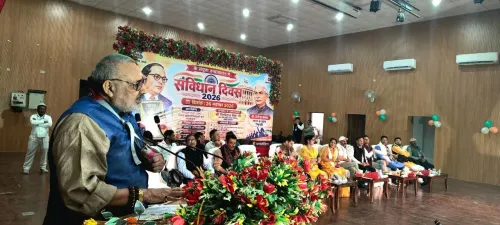
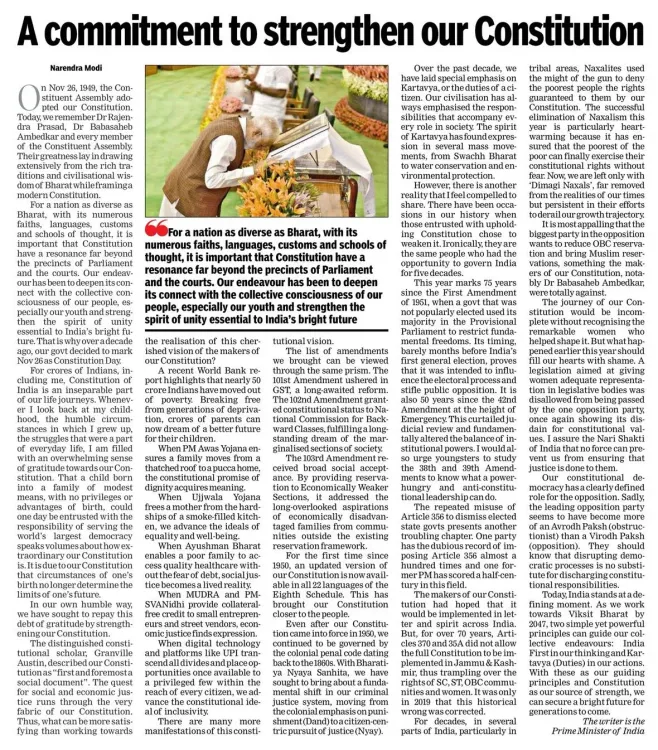
Union Textiles Minister Giriraj Singh marked Constitution Day by praising Prime Minister Narendra Modi's article on the Constitution's original spirit, rights and duties. He said work for the poor, women, youth and a digitally stronger India is fulfilling those ideals, with an India First push toward developed-nation status.
Key Takeaways
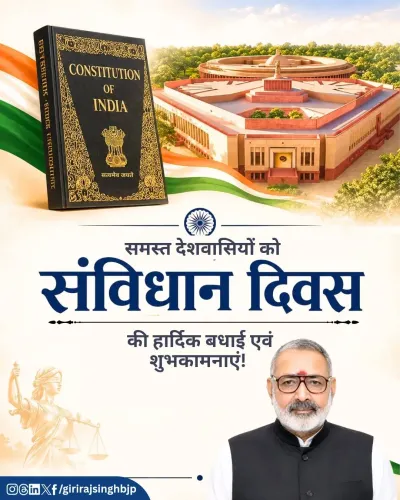
Union Textiles Minister Giriraj Singh posted on X on Thursday, 26 November 2026, Constitution Day.
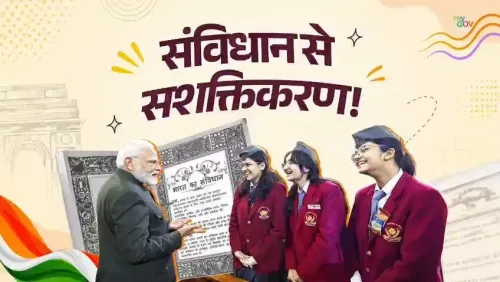
He said Prime Minister Narendra Modi's article underlined the Constitution's original spirit, citizens' rights and duties, and India's changing development journey.
Singh listed work for a dignified life for the poor, women's empowerment, youth opportunity, and digital and economic strength as realising constitutional ideals.
He tied that path to the spirit of India First and the goal of a developed nation.
The Constitution of India was adopted on 26 November 1949 and came into force on 26 January 1950.
On Constitution Day, Union Textiles Minister Giriraj Singh reached for the founding text to make a governing claim: that dignity for the poor, power for women, chance for youth, and a digitally stronger India are not extras — they are the Constitution being lived. On Thursday, 26 November 2026, the senior BJP leader and Lok Sabha MP from Begusarai said Prime Minister Narendra Modi's article had underlined the original spirit of the Constitution, citizens' rights and duties, and the country's changing development journey.
In a Hindi post on X, Singh said that on the occasion of Samvidhan Diwas (Constitution Day), the Prime Minister had, in his article, highlighted the Constitution's original spirit, the rights and duties of citizens, and India's shifting development path. Work in recent years to give the poor a life of dignity, to empower women, to open new opportunities for youth, and to make the country digitally and economically stronger is, he wrote, realising the Constitution's ideals.
With the power of the Constitution and the spirit of 'India First', Singh added, India is moving steadily toward becoming a developed nation.
Singh's reading of the Prime Minister's article
The date is not ceremonial accident. The Constitution of India was adopted on 26 November 1949 and came into force on 26 January 1950. It sets out fundamental rights, duties and directive principles aimed at social and economic justice. Singh treated the Prime Minister's piece as a bridge from that founding charter to present-day governance.
He did not quote the article at length. The political payload sat in his own line: recent work is the ideals being made real. That is a claim about ownership of the document, not only a tribute to it.
Poor, women, youth and a digitally stronger India
The people he named — the poor, women, youth — sit at the centre of the welfare compact that successive BJP governments have framed as constitutional justice, equality and fraternity. Since 2015, the Digital India programme has sought to expand digital infrastructure and the delivery of government services. The same year, Beti Bachao Beti Padhao was introduced to advance girls' education and gender equality.
Singh's post folds those strands — dignity, empowerment, opportunity, digital muscle, economic strength — into a single ledger. The argument is simple: if the Constitution promised a life of justice, this is what the promise looks like in policy.
'India First' and the developed-nation destination
The phrase 'India First' has been a consistent rhetorical device linking domestic policy to self-reliance and national development goals. Constitution Day messages from Union ministers routinely stitch current programmes back to the 1949 vision. Singh's close was destination, not nostalgia: a developed India, powered by constitutional authority and that national-first frame.
Any later parliamentary references or official publications that expand the Prime Minister's article will show how far that mapping is meant to travel. The calendar will bring another 26 November. The test Singh is putting on the table is whether the poor, women and youth can feel the document working — not merely hear it recited.
Point of View
Women's programmes, youth opportunity and Digital India are the Constitution being implemented, not a parallel political project. That mapping has been a consistent BJP-era frame, stitching 2015-era schemes to 1949 ideals and wrapping them in India First language. The political stake is ownership of the founding document as a living development charter. Watch whether the Prime Minister's article is amplified in Parliament or official publications as a policy text, not only a ceremonial one.
NationPress
26 Nov 2026
Frequently Asked Questions
When is Constitution Day observed in India?
Constitution Day is observed on 26 November each year, marking the adoption of the Constitution of India on 26 November 1949. The document came into force on 26 January 1950.
What did Giriraj Singh say about PM Modi's Constitution Day article?
Union Textiles Minister Giriraj Singh said the Prime Minister's article highlighted the Constitution's original spirit, citizens' rights and duties, and India's changing development journey. He added that recent work for the poor, women, youth and a digitally and economically stronger India is realising those ideals.
Who is Giriraj Singh?
Giriraj Singh is the Union Minister of Textiles, a senior BJP leader, and the Lok Sabha MP from Begusarai in Bihar. He posted the Constitution Day message on 26 November 2026.
What does India First mean in Giriraj Singh's Constitution Day post?
In Giriraj Singh's post, India First is the spirit he pairs with the power of the Constitution as India moves toward becoming a developed nation. The phrase has been used as a rhetorical link between domestic policy, self-reliance and national development goals.
Which programmes are linked to constitutional ideals here?
The post itself names outcomes — dignity for the poor, women's empowerment, youth opportunity, digital and economic strength — rather than scheme titles. Broader policy lineage includes Digital India and Beti Bachao Beti Padhao, both launched in 2015.