Giriraj Singh hails Modi's 4,399-day PM tenure
Synopsis
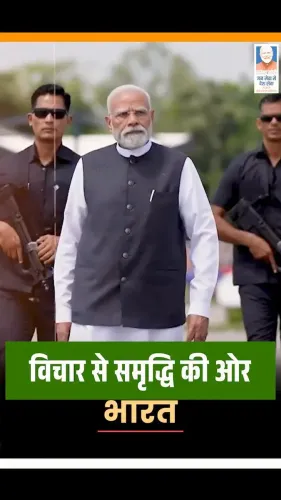
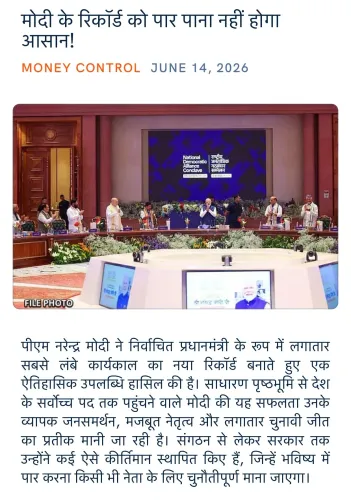
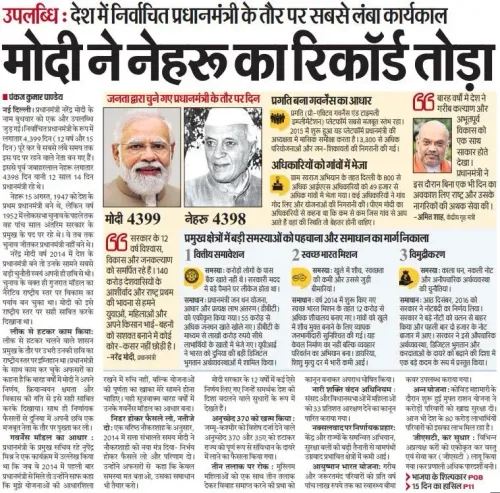
Union Textiles Minister Giriraj Singh on 10 June 2026 hailed PM Narendra Modi's 4,399-day uninterrupted elected tenure, calling it a journey of policy clarity, honest governance, and unwavering commitment to the Viksit Bharat 2047 vision.
Key Takeaways
Giriraj Singh posted a Hindi tribute on 10 June 2026 marking 4,399 days of PM Narendra Modi's continuous elected tenure.
The post carried the hashtag #LongestServingElectedPMModi , indicating coordinated BJP party messaging.
Modi has led three successive NDA governments since first being sworn in on 26 May 2014 .
Singh's tribute explicitly invokes Viksit Bharat , the government's vision to make India a developed economy by 2047 .
The BJP has consistently used governance-continuity messaging to contrast the current era with pre-2014 coalition-era leadership instability.
The textiles sector, Singh's portfolio, has benefited from multi-year scheme continuity including the PM MITRA parks programme.
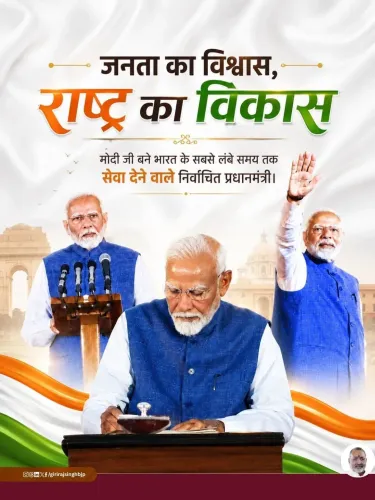
Union Textiles Minister Giriraj Singh on Wednesday, 10 June 2026 paid tribute to Prime Minister Narendra Modi, marking what he described as 4,399 days of uninterrupted elected leadership — framing the milestone as a chronicle of policy clarity, honest intent, and unwavering commitment to nation-building.
Context
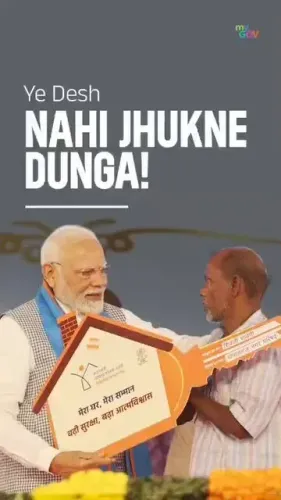
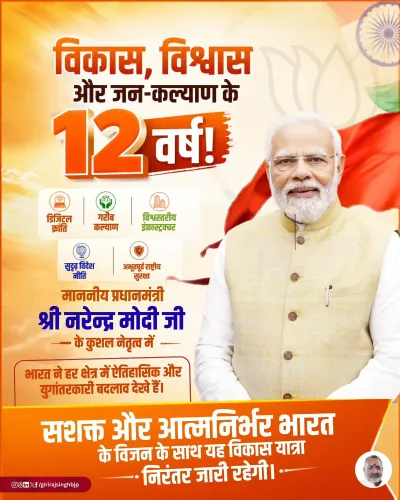
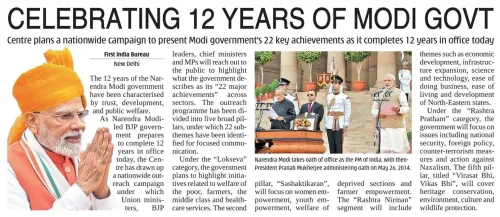
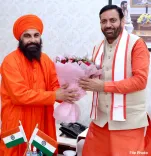
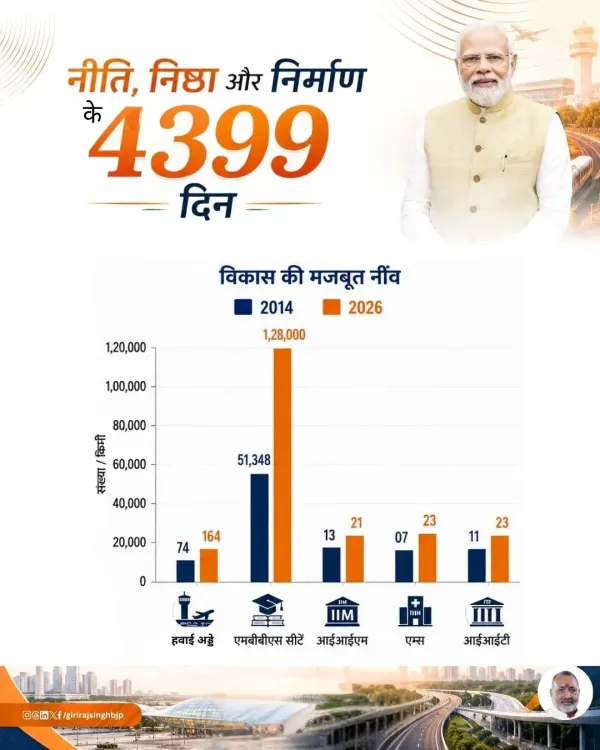
Singh's post, written in Hindi, reads: 'Neeti mein spashṭatā, niyyat mein īmāndārī aur rāshṭra nirmāṇ ke prati aḍig pratibaddhatā' — 'Clarity in policy, honesty in intent, and an unwavering commitment to nation-building — this journey of 4,399 days is the story of carrying the resolve of a Viksit Bharat to new heights.' The post was accompanied by two images and carried the hashtag #LongestServingElectedPMModi, signalling a coordinated BJP messaging effort around the tenure milestone.
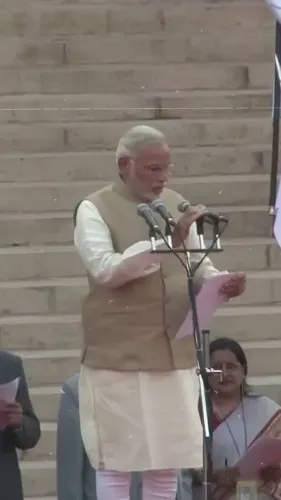
Narendra Modi was first sworn in as Prime Minister on 26 May 2014 after the BJP-led National Democratic Alliance secured a decisive majority in the general election. He was subsequently re-elected in 2019 and again in 2024, making him the longest continuously serving elected Prime Minister in India's post-Independence history.
Policy Backdrop
Singh's tribute centres on the phrase Viksit Bharat — the Modi government's official vision to transform India into a fully developed economy by 2047, the centenary of Independence. The concept has been embedded across Union Budgets, ministry-level targets, and flagship infrastructure programmes over successive terms.
The Make in India initiative, launched in September 2014, was among the earliest signals of the government's manufacturing-first economic posture. For Singh's own portfolio, the textiles sector has been positioned as a key pillar of this industrial ambition, with production-linked incentive schemes aimed at expanding India's share in global apparel and technical-textile markets.
The BJP's messaging around governance continuity has consistently contrasted the current era with the coalition-era leadership churn that preceded 2014, when no single party held a parliamentary majority on its own. Singh's language — 'clarity in policy, honesty in intent' — draws directly from that long-standing party narrative.
Stakeholders and Impact
The tribute reflects sentiment within the ruling party's senior leadership, which has used anniversary moments to reinforce the case for policy continuity. For ordinary citizens, the Viksit Bharat framing ties the longevity of the current government to a tangible, time-bound development promise: a fully developed India by 2047.
For the textile sector — Singh's direct remit — sustained government stability has translated into multi-year scheme cycles, including the PM MITRA (Mega Integrated Textile Region and Apparel) parks programme designed to create integrated manufacturing clusters. Industry stakeholders have generally welcomed the policy continuity argument, citing reduced uncertainty in long-horizon capital investment decisions.
What's Next
With the Viksit Bharat 2047 deadline still over two decades away, the BJP is expected to continue anchoring its political communication around measurable development milestones. Upcoming Union Budget deliberations and parliamentary sessions will be watched for fresh textile-sector incentives or broader manufacturing targets that give policy substance to the anniversary messaging.
State assembly elections on the horizon will also test whether the 'longest-serving' narrative translates into electoral momentum at the sub-national level, or whether regional issues dilute the central government's continuity argument.
Point of View
Converting a calendar milestone into a reaffirmation of the Viksit Bharat ideological project. By foregrounding 'clarity in policy' and 'honesty in intent,' the messaging implicitly relitigates the pre-2014 coalition era, a contrast the party has deployed consistently since its 2014 breakthrough. The coordinated hashtag suggests this was not an individual gesture but part of a wider party effort to cement Modi's historical stature ahead of future electoral cycles. For a senior minister like Singh, such public alignment also reinforces personal loyalty within the BJP's hierarchical culture.
NationPress
25 Oct 2026
Frequently Asked Questions
How many days has Narendra Modi served as Prime Minister of India?
As of the BJP's messaging on 10 June 2026 , Narendra Modi has served 4,399 days as Prime Minister, making him the longest continuously serving elected Prime Minister in post-Independence India.
When did Narendra Modi first become Prime Minister?
Narendra Modi was first sworn in as Prime Minister on 26 May 2014 after the BJP-led NDA won a decisive majority in the general election.
What is Viksit Bharat?
Viksit Bharat is the Modi government's official vision to transform India into a fully developed economy by 2047 , the centenary of India's Independence, and has been embedded across Union Budgets and flagship programmes.
Who is Giriraj Singh?
Giriraj Singh is the Union Minister of Textiles, a senior BJP leader, and a Lok Sabha Member of Parliament from Begusarai, Bihar .
What is the PM MITRA scheme?
PM MITRA (Mega Integrated Textile Region and Apparel) is a government programme to develop integrated textile manufacturing clusters across India, aimed at boosting the sector's global competitiveness under the Viksit Bharat framework.