Giriraj Singh Hails Modi Surpassing Nehru as Longest-Serving Elected PM
Synopsis
Union Textiles Minister Giriraj Singh on 14 June 2026 celebrated PM Narendra Modi surpassing Jawaharlal Nehru's tenure to become India's longest-serving elected Prime Minister, calling the record near-impossible to beat. The post reflects a broader BJP narrative contrasting Modi's political stability with earlier coalition-era fragmentation.
Key Takeaways
Giriraj Singh posted on 14 June 2026 marking PM Modi surpassing Jawaharlal Nehru as India's longest-serving elected Prime Minister.
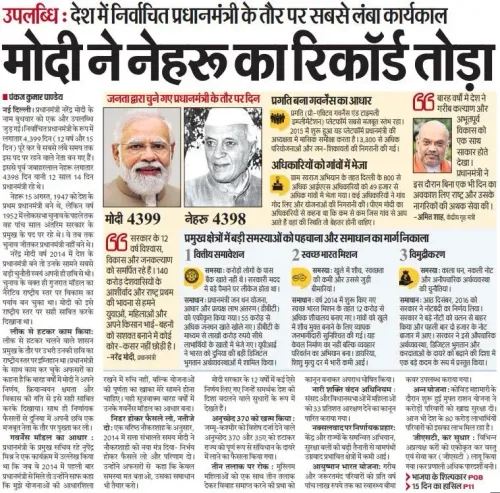
Nehru served as Prime Minister from 1947 to 1964 , a tenure of over 16 years — the previous benchmark.
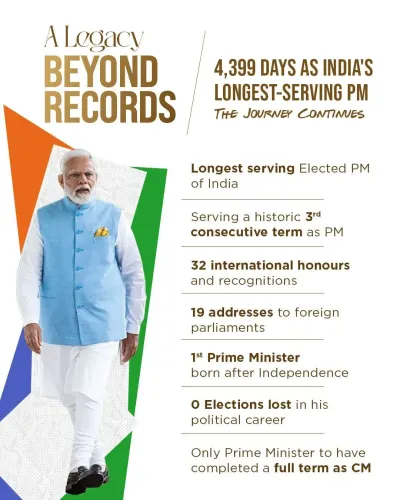
Modi has been in office continuously since May 2014 , spanning two full Lok Sabha terms and counting.
The post was shared via the NaMo App , the BJP's primary digital outreach platform, amplifying its party-wide reach.
The milestone is part of a recurring BJP messaging strategy contrasting the current government's stability with the fragmented coalition era of the late 1980s to 2014 .
Opposition parties, particularly the Indian National Congress , face a messaging challenge in responding to the record.
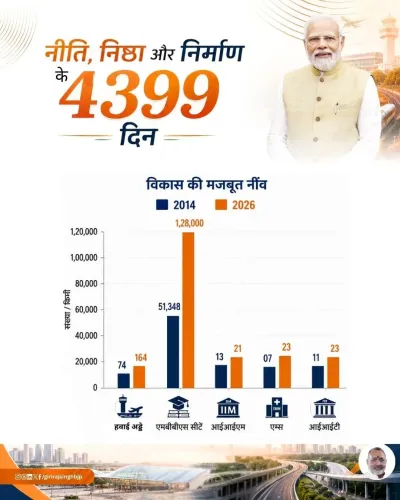
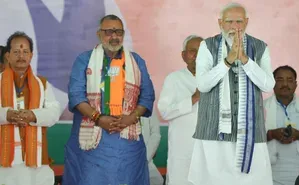
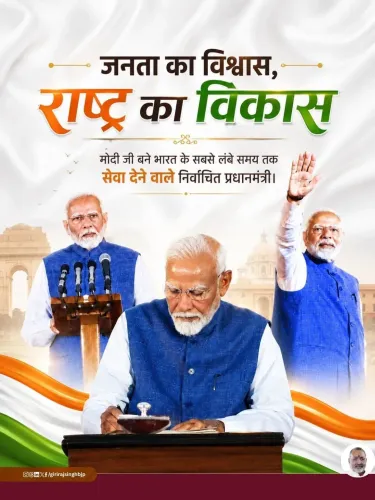
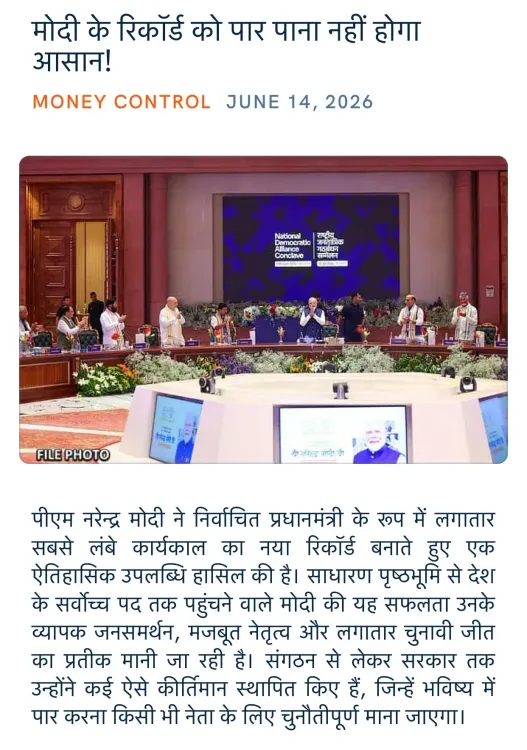
Union Textiles Minister Giriraj Singh on Sunday, 14 June 2026, took to X to mark what he described as a historic milestone — Prime Minister Narendra Modi surpassing Jawaharlal Nehru's record to become India's longest-serving elected Prime Minister. The post, shared via the NaMo App, carried a single line in Hindi that captured the sentiment: 'Modi ke record ko paar paana nahin hoga aasaan!' ('Breaking Modi's record will not be easy!').
Context
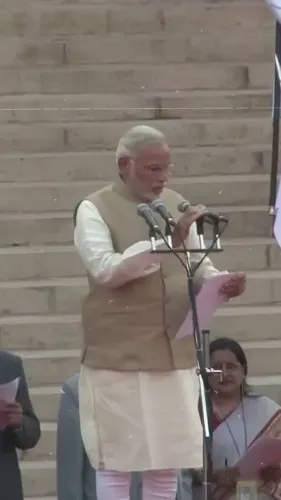
Jawaharlal Nehru, India's first Prime Minister, served continuously from 15 August 1947 until his death on 27 May 1964 — a tenure of over 16 years. Narendra Modi, sworn in for the first time in May 2014 after the BJP-led NDA secured a parliamentary majority, was re-elected for a second term in May 2019 and has continued in office through the current Lok Sabha term. By crossing the threshold of Nehru's uninterrupted tenure, Modi has set a new benchmark for longevity among India's elected heads of government.
Giriraj Singh's post frames the record not merely as a statistical fact but as a political statement — implying that the standard Modi has set will be difficult for any future leader to match. The brevity of the message was deliberate: a single declarative sentence designed to resonate with BJP supporters and the party's social-media ecosystem.
Policy Backdrop
Modi's decade-plus in office has coincided with a period of relative political stability at the Centre, a sharp contrast to the fragmented coalition governments that characterised much of the period from the late 1980s to 2014. During those years, no single Prime Minister completed even a full five-year term uninterrupted. The BJP has consistently used the contrast between that era of instability and the current government's continuity as a central plank of its political messaging.
The comparison with Nehru carries particular symbolic weight because Nehru's Congress-era dominance was long treated as the baseline of Indian democratic governance. For the BJP, situating Modi alongside — and now beyond — Nehru in terms of tenure length is part of a broader effort to reframe the historical narrative of independent India's political leadership.
Stakeholders and Impact
BJP workers and supporters across the country are expected to amplify the milestone on social media, with the NaMo App serving as the primary distribution channel for the party's messaging. Political commentators have noted that longevity in office, while not an end in itself, signals voter trust and organisational coherence that opposition parties have struggled to match in recent election cycles.
For opposition parties, particularly the Indian National Congress, the milestone presents a messaging challenge: acknowledging the record risks validating BJP's framing, while dismissing it may appear to minimise a factual democratic achievement. Statements from opposition leaders in the coming days will be closely watched.
What's Next
The BJP and its allied organisations are likely to mark the milestone through formal events and sustained digital campaigns in the days ahead. The record also sets the stage for a broader political conversation about governance continuity and electoral mandates as India moves deeper into the current Lok Sabha term. Any formal recognition of the milestone — whether at a party event or in Parliament — will add another layer to the BJP's narrative of Modi as a transformational leader in the country's post-independence history.
Point of View
' the message shifts from celebration to challenge, subtly casting doubt on the opposition's ability to match Modi's electoral durability. The Nehru comparison is strategically loaded: it places Modi in conversation with the founder of Congress's political dynasty, inverting the historical hierarchy that long defined Indian politics. As the current Lok Sabha term progresses, such messaging is likely to intensify, anchoring the BJP's 2029 campaign narrative around continuity and proven governance longevity.
NationPress
13 Sept 2026
Frequently Asked Questions
Has Narendra Modi become India's longest-serving Prime Minister?
Yes, Narendra Modi has surpassed Jawaharlal Nehru's tenure to become India's longest-serving elected Prime Minister, having been in office continuously since May 2014 .
How long did Jawaharlal Nehru serve as Prime Minister of India?
Jawaharlal Nehru served as India's first Prime Minister from 15 August 1947 until his death on 27 May 1964 , a continuous tenure of over 16 years .
What did Giriraj Singh say about Modi's Prime Minister record?
Giriraj Singh posted in Hindi — 'Modi ke record ko paar paana nahin hoga aasaan!' — meaning 'Breaking Modi's record will not be easy,' marking the milestone on 14 June 2026 .
When did Narendra Modi first become Prime Minister of India?
Narendra Modi was first sworn in as Prime Minister in May 2014 after the BJP-led NDA won a decisive majority in the general election.
Why is Modi's tenure record politically significant?
The record is significant because it surpasses Nehru's benchmark and comes after decades of coalition-era instability from the late 1980s to 2014 , when no Prime Minister completed a full uninterrupted term. The BJP uses this to argue for the current government's unique electoral and governance stability.