Giriraj Singh Hails National Highways as Engine of India's Growth
Synopsis
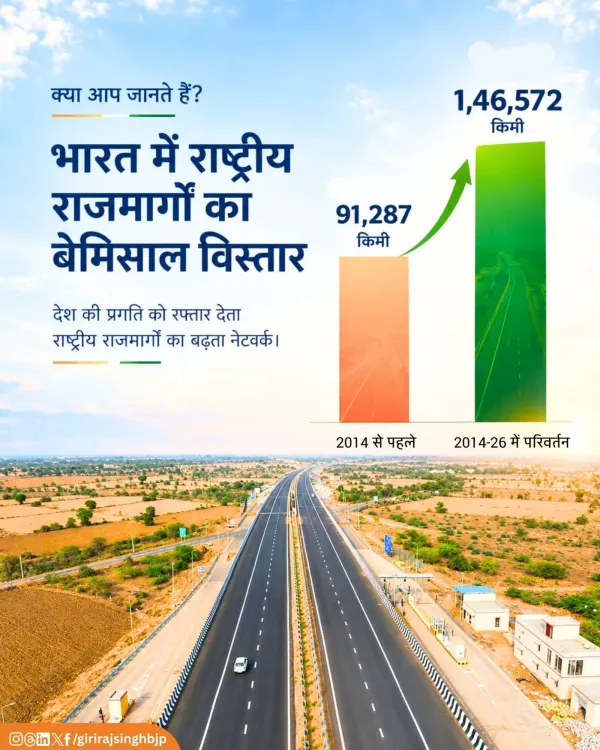
Union Textiles Minister Giriraj Singh highlighted India's expanding national highways network on 22 October 2026, saying improved connectivity is accelerating the country's development journey by boosting trade, industry, and tourism.
Key Takeaways
Giriraj Singh , Union Textiles Minister and BJP MP from Begusarai, Bihar , posted on 22 October 2026 praising India's growing national highways network.
He said the expanding network is giving 'new momentum to India's development journey' by boosting trade, industry, and tourism.
Bharatmala Pariyojana , approved in 2015 , is the flagship programme underpinning India's national highways expansion.
Traders, the tourism sector, and everyday commuters are the primary beneficiary groups highlighted in the government's connectivity narrative.
Singh's remarks come from a textiles portfolio, signalling that infrastructure confidence has become a whole-of-government messaging priority.
Roads are doing more than connecting cities — they are reshaping India's economic geography. On Thursday, 22 October 2026, Union Textiles Minister Giriraj Singh took to X to champion the expanding national highways network, calling it a force multiplying trade, industry, and tourism across the country.
Posting in Hindi, the senior BJP leader and Lok Sabha MP from Begusarai, Bihar wrote: 'देशभर में राष्ट्रीय राजमार्गों का बढ़ता नेटवर्क भारत की विकास यात्रा को नई गति दे रहा है' — 'The growing network of national highways across the country is giving new momentum to India's development journey.' He added that better connectivity is not only boosting trade and industry but also making travel easier for ordinary citizens.
Bharatmala at the Heart of the Highway Push
The backdrop to Singh's remarks is Bharatmala Pariyojana, the flagship national highways development programme approved in 2015 to systematically expand and upgrade road connectivity across India. The scheme was designed to close missing links, improve border and coastal connectivity, and bring economic corridors up to expressway standards.
India's national highways network has expanded steadily over the past decade, and the government's broad argument — that better roads unlock trade flows, attract industrial investment, and give tourism destinations their first viable access route — has become a central plank of infrastructure messaging across ministries.
Why a Textiles Minister Is Talking Roads
Singh's portfolio sits in textiles, not roads — yet the messaging here is deliberate. Textile clusters, logistics corridors, and export hubs all depend on road connectivity to move raw material and finished goods. When a minister in a manufacturing-adjacent portfolio highlights highway expansion, it signals that infrastructure confidence is now a whole-of-government talking point, not just a transport ministry brief.
Traders, the tourism sector, and daily commuters are the three groups the government consistently points to as direct beneficiaries of highway growth — and all three featured in Singh's framing today.
The real test of that narrative lies in the Ministry of Road Transport and Highways' annual construction targets and budget utilisation numbers — figures that will either vindicate or qualify the optimism Singh voiced today.
Point of View
The BJP has leaned on visible physical infrastructure as proof-of-governance, and highway kilometres are among the easiest metrics to showcase. The fact that a Textiles Minister is amplifying a roads narrative suggests the party is deploying every available platform to reinforce this story ahead of what is likely a politically active period. The true weight of the claim, however, will rest on whether construction targets and budget utilisation match the rhetoric — a verdict the annual roads ministry report will eventually deliver.
NationPress
22 Oct 2026
Frequently Asked Questions
What did Giriraj Singh say about national highways?
On 22 October 2026, Giriraj Singh said India's growing national highways network is giving new momentum to the country's development journey by boosting trade, industry, tourism, and making travel easier for citizens.
What is Bharatmala Pariyojana?
Bharatmala Pariyojana is India's flagship national highways development programme, approved in 2015, aimed at expanding and upgrading the road network to improve economic and logistical connectivity across the country.
Why is the Textiles Minister commenting on highways?
Textile manufacturing clusters and export hubs rely heavily on road logistics, making highway connectivity directly relevant to the textiles sector. Ministers across portfolios also routinely amplify the government's broader infrastructure narrative.
How has India's national highways network grown in recent years?
India has pursued steady expansion of its national highways over the past decade, driven primarily by Bharatmala Pariyojana, with a focus on economic corridors, missing links, and border connectivity. Specific current figures are tracked in the annual Ministry of Road Transport and Highways report.
Who benefits most from India's highway expansion?
The government consistently identifies traders, the tourism sector, and everyday commuters as the primary beneficiaries of improved national highway connectivity, with downstream gains for industry and logistics.