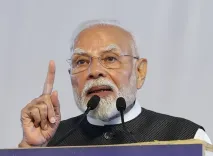
Giriraj Singh hails NMC adding 9,783 new PG medical seats

Synopsis
The National Medical Commission has added 9,783 new PG medical seats, raising India's total to 68,305. Union Textiles Minister Giriraj Singh called it a landmark achievement in medical education, crediting PM Modi's focus on health infrastructure expansion.
Key Takeaways
The National Medical Commission (NMC) has approved 9,783 new PG medical seats in one notification cycle.
India's total PG medical seat count has risen to 68,305 following the addition.
The NMC was established under the National Medical Commission Act, 2019 , replacing the Medical Council of India.
Union Textiles Minister Giriraj Singh highlighted the expansion as a milestone in medical education infrastructure.
PG seats are the primary pipeline for trained specialists in India's public health system.
Seat expansion at the PG level is expected to address long-standing specialist shortages in Tier-2 cities and rural districts.
India's postgraduate medical training capacity just got its biggest single-round boost in years — the National Medical Commission (NMC) has approved 9,783 new PG medical seats, pushing the national total to 68,305, a milestone Union Textiles Minister Giriraj Singh flagged on 18 November 2026 as a defining marker of health-infrastructure growth under the current government.
9,783 seats added: what the NMC notification means
The NMC, the statutory regulator that replaced the old Medical Council of India in 2020, is empowered to approve or expand postgraduate seats at medical colleges across the country each academic cycle. The addition of 9,783 seats in one notification is significant — PG seats have historically been the chokepoint in India's specialist pipeline, with far fewer slots available at the postgraduate level compared to MBBS intake. Reaching a national pool of 68,305 PG seats marks measurable headway on a gap that has taken decades to narrow.
Giriraj Singh, posting in Hindi, called it 'chikitsa shiksha ke kshetra mein ek mahatvapurna uplabdhi' — 'an important achievement in the field of medical education' — and credited the expansion to what he described as the 'visionary leadership' of Prime Minister Narendra Modi.
A decade of regulatory rewiring behind the numbers
The story behind this expansion starts with structural reform. The National Medical Commission Act, 2019 dismantled the Medical Council of India — long criticised for opacity and rent-seeking — and rebuilt regulation from scratch. The NMC brought clearer norms for college approvals and annual seat increases, creating the institutional plumbing through which additions like today's become possible.
Since 2014, the central government has repeatedly pointed to a rising count of medical colleges and seats — both MBBS and PG — as proof of a supply-side push on healthcare. The PG expansion is particularly consequential: every specialist a public hospital eventually fields traces back to a PG seat being available somewhere in the system.
Why specialists are the real bottleneck
India's doctor-to-population ratio has improved at the MBBS level, but specialists — cardiologists, oncologists, neurologists, anaesthesiologists — remain acutely scarce in Tier-2 cities and rural districts. PG seats in government colleges are the principal feeder for public-sector specialist posts. More seats today means more board-certified consultants in district hospitals roughly three to five years from now — the lag time it takes to complete a residency and join service.
That pipeline logic is exactly what makes seat-addition announcements matter beyond their headline number. Each additional slot is, in effect, a deferred appointment letter for a future specialist somewhere in the public health system.
With the NMC expected to continue annual reviews, the question now is whether seat growth translates into quality residency training — faculty-to-resident ratios, infrastructure, and clinical load per trainee will determine whether 68,305 becomes a benchmark or just a number on a notification.
Point of View
Amplifying the announcement from a non-health portfolio signals how central this metric has become to the party's governance record ahead of electoral cycles. The harder test, however, lies downstream: seat numbers are outputs of regulation, but specialist quality and geographic distribution are determined by how those seats are resourced, supervised, and deployed — a question the notification itself does not answer.
NationPress
18 Nov 2026
Frequently Asked Questions
How many PG medical seats are there in India now?
Following the latest NMC notification, India's total postgraduate medical seat count stands at 68,305 , after the addition of 9,783 new seats .
What is the National Medical Commission (NMC)?
The National Medical Commission is a statutory regulator established in 2020 under the NMC Act, 2019. It replaced the Medical Council of India and oversees standards in medical education and professional practice across India.
Why does India need more PG medical seats?
India faces a significant shortage of specialists — cardiologists, neurologists, oncologists and others. PG seats in medical colleges are the main pipeline feeding specialist positions in public hospitals, making their expansion critical to improving healthcare delivery.
What did Giriraj Singh say about PG medical seats?
Giriraj Singh described the NMC's addition of 9,783 new PG seats as 'an important achievement in the field of medical education' and credited PM Modi's leadership for the continuous expansion of health infrastructure in India.
When did the NMC replace the Medical Council of India?
The NMC Act was passed in 2019 and the commission became operational in 2020 , formally replacing the Medical Council of India which had been criticised for governance failures and lack of transparency.