HP CM Sukhu adds 320 PG medical seats across state colleges
Synopsis
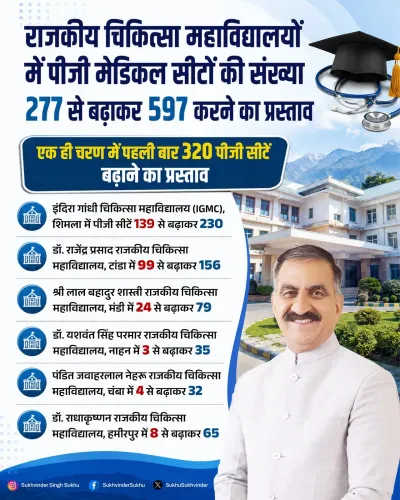
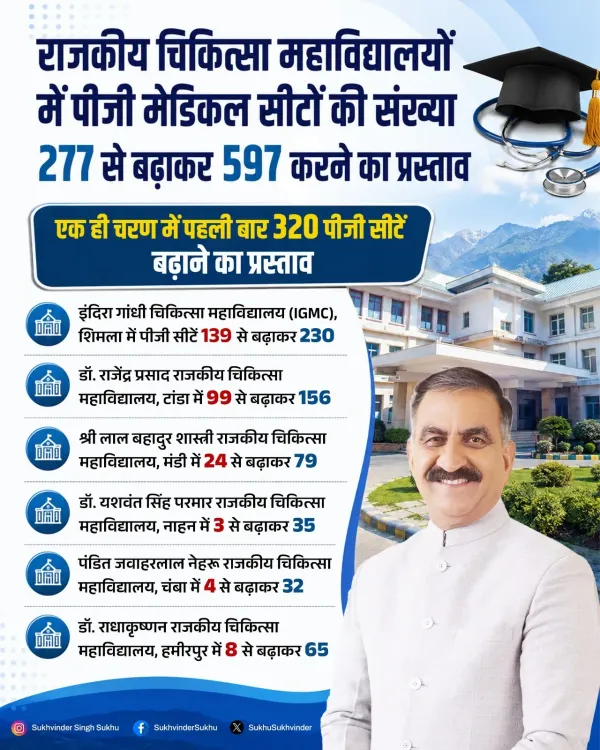
Chief Minister Sukhvinder Singh Sukhu has announced 320 new postgraduate medical seats across all Himachal Pradesh government medical colleges simultaneously — a first for the state — aimed at producing more specialists and improving healthcare access in hill districts.
Key Takeaways
320 new PG medical seats are being added across all government medical colleges in Himachal Pradesh simultaneously.
This is the first time such a state-wide simultaneous PG seat expansion has been undertaken in the state.
The move is intended to retain medical talent within the state and reduce out-migration of MBBS graduates seeking specialisation.
Formal approval from the National Medical Commission (NMC) is required before the seats can be filled through national counselling.
The expansion targets both medical education growth and long-term improvement in specialist availability for patients, especially in remote hill districts.
CM Sukhu has been in office since December 2022 and has consistently cited healthcare as a top governance priority.
Himachal Pradesh Chief Minister Sukhvinder Singh Sukhu announced on Friday, 17 July 2026 that the state government is adding 320 new postgraduate medical seats simultaneously across all government medical colleges in Himachal Pradesh — the first time such a simultaneous, state-wide expansion has been undertaken.
Posting in Hindi on X, CM Sukhu wrote: 'प्रदेश के सभी मेडिकल कॉलेजों में पहली बार एक साथ पीजी की 320 नई सीटें बढ़ाई जा रही हैं' — ('For the first time, 320 new PG seats are being added simultaneously across all medical colleges in the state'). He framed the move as part of a dual goal: expanding medical education and strengthening the state's future healthcare system.
Context
The announcement comes as Himachal Pradesh continues to grapple with a shortage of specialists, particularly in its remote hill districts where access to tertiary care remains limited. The state's existing network of government medical colleges — anchored by the Indira Gandhi Medical College, Shimla, the oldest such institution in the state — has historically struggled to produce enough postgraduate doctors to meet local demand.
CM Sukhu, who has been in office since December 2022, has repeatedly cited healthcare infrastructure and medical education as central pillars of his administration's agenda. This announcement represents one of the most concrete numerical commitments made under that agenda so far.
Policy Backdrop
The addition of 320 PG seats must be formally approved by the National Medical Commission (NMC), the statutory body that regulates postgraduate medical education standards and seat allocation across India. NMC approval is a prerequisite before seats can be filled through the national counselling process for MD and MS admissions.
Several Indian states have pursued similar simultaneous expansions in recent years to address specialist shortages and comply with evolving NMC norms. Himachal Pradesh's approach — expanding capacity within existing colleges rather than creating new institutions — aligns with this broader national pattern and is generally faster to implement.
The Chief Minister emphasised that the initiative would give the state's youth 'excellent opportunities within their own state' ('प्रदेश के युवाओं को उत्कृष्ट अवसर अपने ही राज्य में मिलें'), reducing the need for medical graduates to migrate to other states for specialisation.
Stakeholders and Impact
The most immediate beneficiaries are MBBS graduates from Himachal Pradesh who currently face limited PG seats in the state and must compete in a highly contested national pool. An addition of 320 seats represents a significant increase in local postgraduate capacity, though the exact distribution across individual colleges has not been disclosed.
For patients — especially those in remote hill districts — the downstream impact is an expected increase in the availability of specialists over the next several years as newly trained doctors complete their postgraduate programmes. CM Sukhu specifically committed to making quality healthcare 'accessible and trustworthy' ('गुणवत्तापूर्ण, सुलभ एवं भरोसेमंद') for the general population.
What's Next
The critical next step is formal clearance from the National Medical Commission, which will inspect facilities and faculty strength before approving the additional seats at each college. Once approved, the seats will enter the national counselling cycle for MD/MS admissions.
The state government has not yet announced a timeline for NMC inspection or the academic year in which the new seats will be filled. Stakeholders in the medical education sector will watch closely to see whether the expansion can be operationalised within the current or next admissions cycle.
Point of View
Quantifiable healthcare win ahead of any future electoral cycle. By framing it as both an education opportunity for local youth and a long-term fix for specialist shortages in hill districts, the announcement tries to speak to two distinct voter blocs — young aspirants and rural patients — at once. The real test, however, lies in National Medical Commission approval and actual operationalisation: states have previously announced seat expansions that stalled at the regulatory stage. If the seats are cleared and filled on schedule, it would mark a meaningful step in Himachal Pradesh's effort to build a self-sufficient medical education pipeline rather than depending on national seat pools.
NationPress
16 Oct 2026
Frequently Asked Questions
How many new PG medical seats is Himachal Pradesh adding?
Himachal Pradesh is adding 320 new postgraduate (PG) medical seats across all its government medical colleges simultaneously, as announced by Chief Minister Sukhvinder Singh Sukhu on 17 July 2026.
Who approves new PG medical seats in India?
The National Medical Commission (NMC) is the statutory regulator that must inspect and approve new postgraduate medical seats at any college in India before they can be offered to students through the national counselling process.
Which is the main government medical college in Himachal Pradesh?
The Indira Gandhi Medical College (IGMC), Shimla is the oldest and largest government medical college in Himachal Pradesh and serves as a major tertiary-care teaching hospital for the state.
Why is Himachal Pradesh expanding PG medical seats?
The expansion aims to address a shortage of medical specialists in the state, particularly in remote hill districts, and to provide MBBS graduates from Himachal Pradesh with postgraduate opportunities within the state rather than forcing them to compete for seats elsewhere.
When did Sukhvinder Singh Sukhu become Chief Minister of Himachal Pradesh?
Sukhvinder Singh Sukhu became Chief Minister of Himachal Pradesh in December 2022 after the Indian National Congress won the state assembly elections.