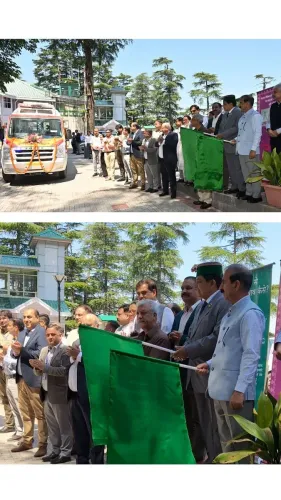
HP CM Sukhu Boosts Emergency Health Services in State

Synopsis
Chief Minister Thakur Sukhvinder Singh Sukhu announced measures to boost emergency health transport in Himachal Pradesh on June 8, 2026, pledging stronger speed, quality, and effectiveness in emergency medical services for the state's remote and hilly communities.
Key Takeaways
CM Thakur Sukhvinder Singh Sukhu announced an initiative to improve emergency health transport across Himachal Pradesh on June 8, 2026 .
The measures are described as aimed at strengthening the 'speed, quality, and effectiveness' of emergency health services.
The initiative is intended to help get patients to hospital faster, addressing a critical gap in the state's mountainous terrain.
Himachal Pradesh has historically relied on the 108 ambulance service under the National Health Mission to bridge emergency transport gaps.
Residents of remote hilly districts and emergency patients stand to benefit most directly from the improvements.
Future steps to watch include budget allocations for new ambulances and potential integration with the national 112 emergency response system .
The Chief Minister's Office of Himachal Pradesh on Monday, June 8, 2026, shared a statement from Chief Minister Thakur Sukhvinder Singh Sukhu announcing measures aimed at strengthening emergency health transport across the state, with a focus on improving the speed, quality, and effectiveness of emergency medical services.
Context
In the post, CM Sukhu stated — 'इससे आपातकालीन स्वास्थ्य सेवाओं की गति, गुणवत्ता और प्रभावशीलता को और अधिक मजबूती मिलेगी' — ('This will further strengthen the speed, quality, and effectiveness of emergency health services') — and described the initiative as one that will 'prove helpful in getting patients to hospital.' The statement signals a fresh push by the state government to address long-standing gaps in emergency medical response across Himachal Pradesh's mountainous terrain.
Policy Backdrop
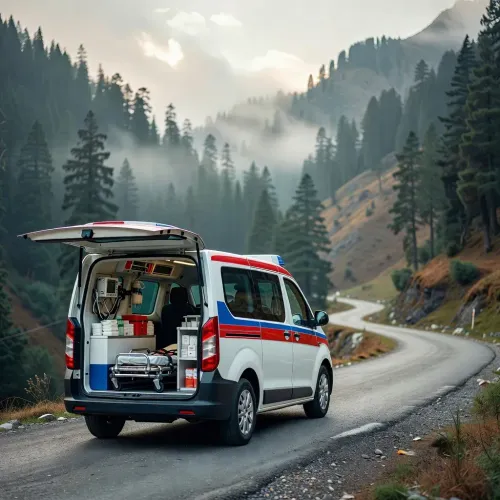
Himachal Pradesh has historically faced acute challenges in emergency healthcare delivery owing to its difficult topography, dispersed population, and limited road connectivity in higher-altitude regions. Successive state governments have sought to address this through periodic upgrades to ambulance fleets and emergency transport infrastructure under the National Health Mission (NHM). The 108 emergency ambulance service, introduced and expanded across the state during the 2010s, remains the backbone of pre-hospital emergency care, linking remote villages to district hospitals and medical colleges.
The Himachal Pradesh Health Department, which administers public hospitals, emergency transport, and NHM implementation, has consistently cited response-time metrics as a key benchmark for service improvement. Any expansion of ambulance coverage or introduction of advanced emergency vehicles directly affects outcomes for residents of remote hilly areas who face the longest transit times to tertiary care facilities.
Stakeholders and Impact
The primary beneficiaries of improved emergency health transport are residents of Himachal Pradesh's remote and hilly districts, where a medical emergency can mean hours of travel over winding mountain roads before a patient reaches a hospital. Emergency patients, particularly those suffering cardiac events, trauma, or obstetric emergencies, stand to gain most directly from faster and better-equipped response systems.
The state's health infrastructure has seen sustained investment under CM Sukhu's administration since December 2022, with a stated public focus on expanding facilities and improving last-mile connectivity in healthcare. Strengthening emergency transport is seen as a critical complement to hospital-based investments, since outcomes in time-sensitive conditions depend heavily on pre-hospital response.
What's Next
Observers will watch for specific budgetary allocations tied to this initiative, including the number of additional ambulances to be deployed, coverage of underserved districts, and any potential integration with the national 112 emergency response system. There has also been ongoing discussion at the state level about the feasibility of air ambulance pilots for the most inaccessible regions, which could represent a significant escalation in emergency care capability.
If the measures announced translate into measurable reductions in emergency response times, they could set a benchmark for other hill states grappling with similar geographic and infrastructural constraints in public health delivery.
Point of View
Particularly in a state where geography makes emergency response a perennial political and administrative challenge. Framing emergency transport improvements as a quality-of-life intervention for remote communities is a well-worn but effective political signal ahead of any electoral cycle. The broader policy arc connects to the Centre's push for integrated emergency response under the 112 platform, and Himachal's ability to align state schemes with national frameworks will determine how much central funding it can leverage. The real test will be whether the announcement is backed by concrete fleet additions and measurable response-time data.
NationPress
22 Sept 2026
Frequently Asked Questions
What did CM Sukhu announce about emergency health services in Himachal Pradesh?
Chief Minister Thakur Sukhvinder Singh Sukhu announced measures to improve emergency health transport in Himachal Pradesh, stating the initiative will strengthen the speed, quality, and effectiveness of emergency medical services and help patients reach hospitals faster.
How does Himachal Pradesh handle emergency ambulance services?
Himachal Pradesh operates the 108 emergency ambulance service under the National Health Mission, which has been periodically expanded to serve the state's remote and hilly areas where travel times to hospitals can be very long.
Why is emergency health transport a challenge in Himachal Pradesh?
The state's mountainous terrain, dispersed population, and limited road connectivity in higher-altitude areas mean emergency patients can face hours of travel before reaching a hospital, making fast ambulance response critical.
Who benefits from improved emergency health services in Himachal Pradesh?
Residents of remote hilly districts benefit most, particularly those facing time-sensitive emergencies such as cardiac events, trauma, or obstetric emergencies where rapid transport to hospital is essential for survival.
What is the 112 emergency response system and how does it relate to Himachal Pradesh?
The 112 emergency response system is a national integrated platform for police, fire, and medical emergencies. Himachal Pradesh's emergency health upgrades could potentially be integrated with this system to improve coordination and response times.