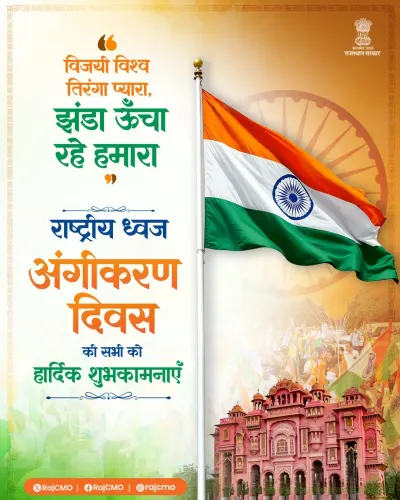
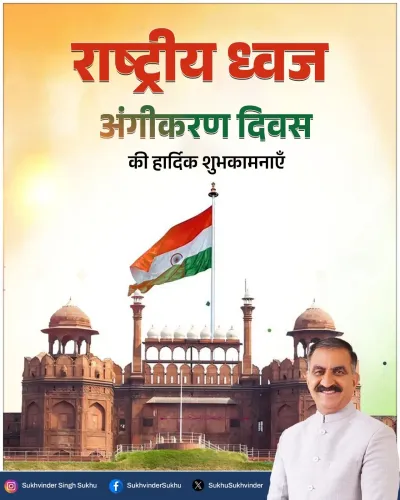
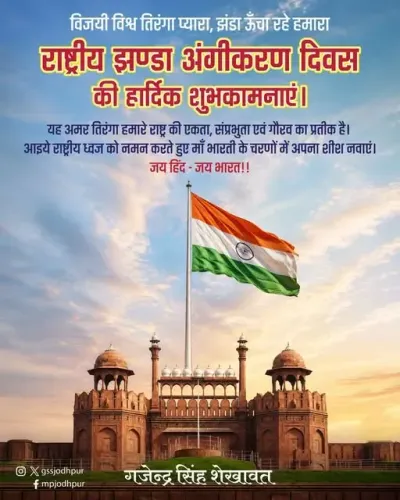
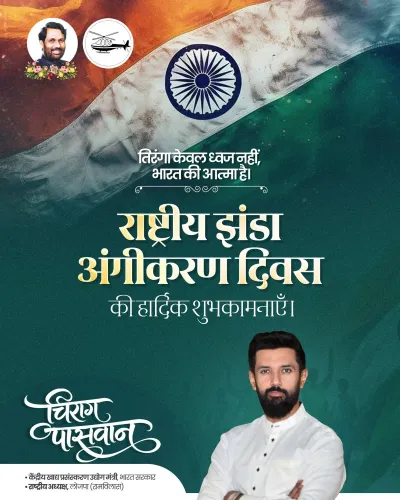
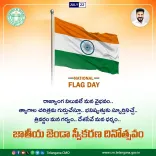
Giriraj Singh marks National Flag Adoption Day, 22 July
Synopsis
Union Textiles Minister Giriraj Singh marked National Flag Adoption Day on 22 July 2026, recalling that the Constituent Assembly adopted the tricolour on this date in 1947. The occasion links national symbolism to his ministry's mandate, as the Flag Code requires the national flag to be made exclusively from khadi.
Key Takeaways
Union Textiles Minister Giriraj Singh posted greetings on 22 July 2026 to mark National Flag Adoption Day .
The Constituent Assembly adopted the tricolour as India's national flag on 22 July 1947 , three weeks before independence.
The flag's design is credited to Pingali Venkayya , whose layout was formally approved by the Assembly.
The Flag Code of India mandates that the national flag be made exclusively from khadi , linking the commemoration to the Textiles Ministry's mandate.
Khadi weavers and handloom cooperatives are the primary beneficiaries of flag production, with demand peaking ahead of Independence Day on 15 August .
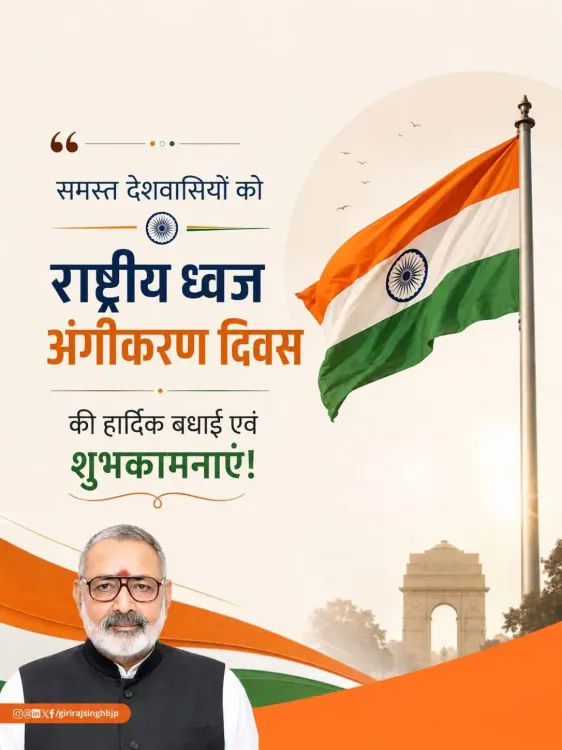
Union Textiles Minister Giriraj Singh on Wednesday, 22 July 2026 marked National Flag Adoption Day, recalling that the Constituent Assembly adopted the tricolour as India's national flag on this day in 1947 — three weeks before independence.
Posting in Hindi on X, Singh wrote: 'आज ही के दिन, 22 जुलाई 1947 को संविधान सभा ने हमारे प्यारे तिरंगे को भारत के राष्ट्रीय ध्वज के रूप में अपनाया था' ('On this very day, 22 July 1947, the Constituent Assembly adopted our beloved tricolour as the National Flag of India'). He extended greetings to all citizens and signed off with 'Jai Hind.'
Context
On 22 July 1947, the Constituent Assembly passed a resolution formally adopting the saffron, white, and green tricolour bearing the Ashoka Chakra as India's national flag. The decision came 24 days before independence, signalling the new nation's intent to carry its own emblem into freedom. The flag's layout was designed by Pingali Venkayya, whose work was endorsed by the Assembly that day.
Policy Backdrop
The occasion carries particular resonance for the Textiles Ministry: the Flag Code of India mandates that the national flag be manufactured exclusively from khadi — hand-spun and hand-woven cloth — placing its production squarely within the ministry's regulatory domain. Singh's portfolio therefore connects cultural commemoration directly to the handloom sector he oversees. Union ministers across parties routinely mark constitutional and independence-era anniversaries on social media, but for the Textiles Minister the tricolour is also a matter of industrial policy.
Stakeholders and Impact
The statutory khadi requirement makes khadi weavers and handloom cooperatives the primary commercial beneficiaries of flag production, especially in the weeks approaching Independence Day on 15 August. Demand for the national flag typically peaks during this period, and any procurement guidelines or quality circulars issued by the ministry carry direct economic impact for these artisans. For ordinary citizens, the day is an occasion to reflect on the constitutional foundations of the tricolour's authority as a national symbol.
What's Next
Observers will watch for any fresh khadi procurement or flag-manufacturing guidelines from the Textiles Ministry ahead of 15 August 2026. References to the Flag Code of India in parliamentary proceedings, and ministry-level outreach to khadi institutions around Independence Day, are also worth tracking as indicators of how the government plans to reinforce the handloom sector's role in national symbolism.
Point of View
But it carries an institutional subtext that sets it apart from similar messages by other ministers. As the Textiles Minister, his invocation of the tricolour is inseparable from the Flag Code's khadi mandate — a statutory link that positions his ministry as a custodian of national symbolism, not merely a trade regulator. The timing, weeks before Independence Day, is consistent with a broader government pattern of using constitutional anniversaries to reinforce the cultural and economic case for handloom industries. Whether the social media gesture translates into concrete procurement or outreach action for khadi weavers is the more substantive question to watch.
NationPress
22 Jul 2026
Frequently Asked Questions
When was India's national flag adopted?
India's national flag, the tricolour, was formally adopted by the Constituent Assembly on 22 July 1947 , twenty-four days before independence.
Who designed the Indian national flag?
The layout of the Indian national flag is credited to Pingali Venkayya , whose design — featuring saffron, white, and green bands with the Ashoka Chakra at the centre — was approved by the Constituent Assembly in 1947.
What is National Flag Adoption Day in India?
National Flag Adoption Day is observed on 22 July each year to commemorate the Constituent Assembly's 1947 resolution adopting the tricolour as India's official national flag.
Why must the Indian flag be made of khadi?
The Flag Code of India mandates that the national flag be manufactured exclusively from khadi — hand-spun and hand-woven cloth — a provision that supports the country's handloom weavers and connects the flag to India's independence movement.
What did Giriraj Singh say about National Flag Adoption Day?
Union Textiles Minister Giriraj Singh posted on X on 22 July 2026 , recalling that the Constituent Assembly adopted the tricolour on this date in 1947 and extending greetings to all citizens, describing the flag as a symbol of India's freedom, integrity, and sovereignty.