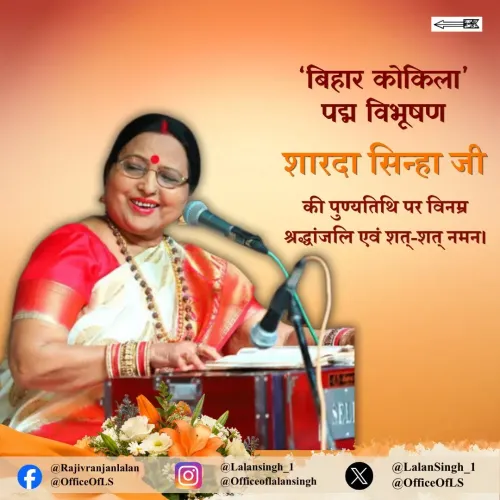
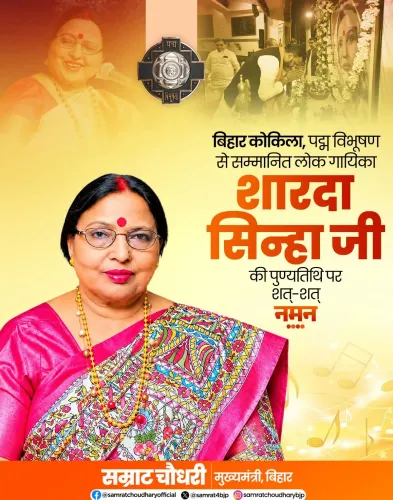
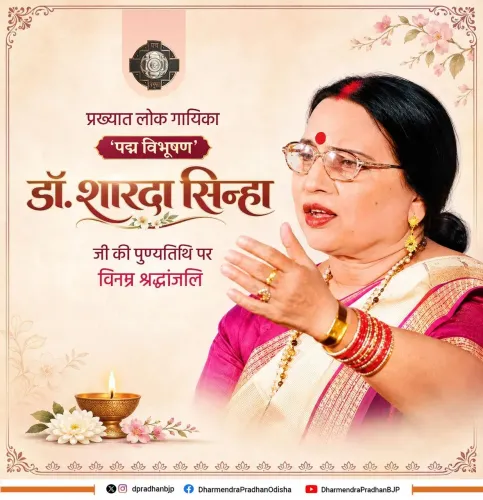
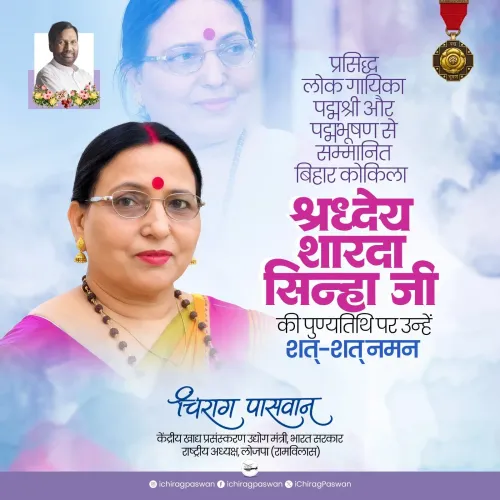
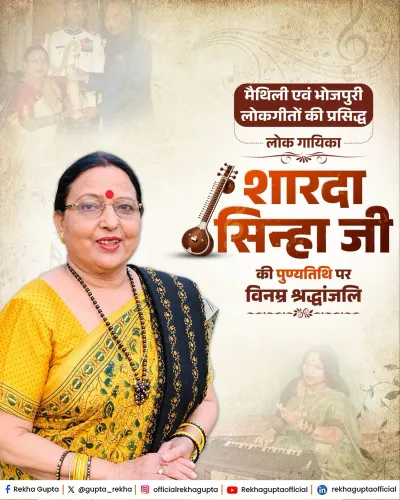
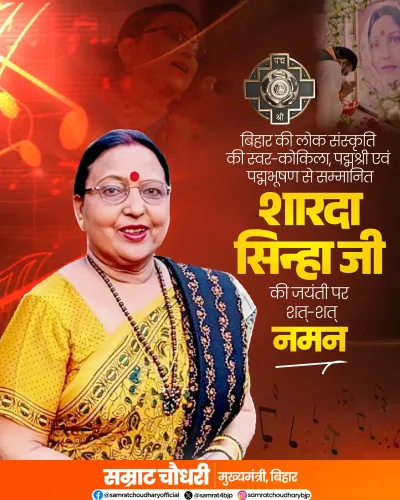
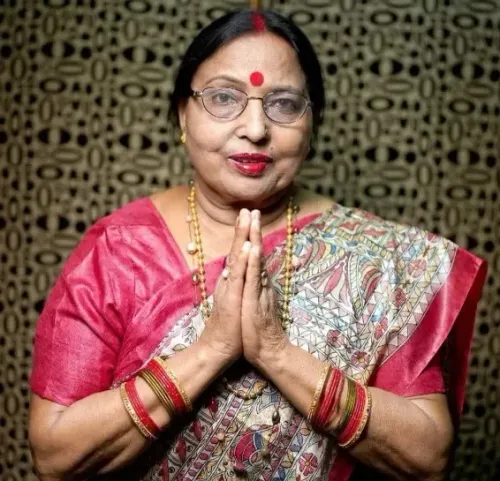
Giriraj Singh pays tribute to Bihar Kokila Sharda Sinha
Synopsis
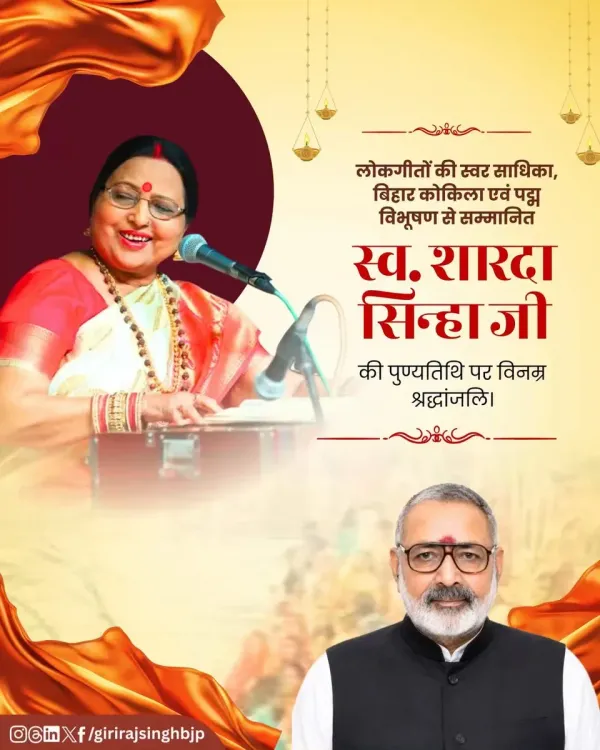
Union Textiles Minister Giriraj Singh paid his respects to late folk legend Sharda Sinha on her death anniversary, calling her contribution to Bihar's folk culture and music eternally memorable. Known as Bihar Kokila, Sinha was a Padma Shri recipient celebrated for Maithili, Bhojpuri and Magahi traditions.
Key Takeaways
Union Textiles Minister Giriraj Singh posted a tribute to Bihar Kokila Sharda Sinha on her death anniversary on November 5, 2026 .
Sinha was celebrated for giving Bihar's folk culture a 'distinctive national identity' through her voice, in Singh's own words.
She specialised in Maithili, Bhojpuri, and Magahi folk traditions and was honoured with the Padma Shri .
Her chhath puja songs became a cultural touchstone for the Bihari diaspora across India and abroad.
Singh is a senior BJP leader and Lok Sabha MP from Begusarai, Bihar , making the tribute a marker of regional cultural pride as well.
A voice that carried the heartbeat of Bihar's villages into living rooms across India fell silent — but on her death anniversary, Union Textiles Minister Giriraj Singh ensured the memory of Bihar Kokila Sharda Sinha rang out once more, this time from Parliament's corridors to every corner of X.
Posting on Thursday, November 5, 2026, Singh wrote in Hindi: 'Bihar ki lokasanskrti aur lokasamgit ko apni madhur aawaz se deshbhar mein vishisht pahchan dilaane waali Bihar Kokila Sv. Sharda Sinha ji ka yogdan sadaiv smaraniy rahega.' — 'The contribution of Bihar Kokila, the late Sharda Sinha ji, who gave Bihar's folk culture and folk music a distinctive national identity through her melodious voice, will always be remembered. On her death anniversary, a humble tribute to her.'
The voice that made Maithili and Bhojpuri travel
Sharda Sinha was no ordinary regional artist. Rooted in the Maithili, Bhojpuri, and Magahi traditions of Bihar, she transformed what was once considered hyperlocal folk repertoire into a cultural force recognised far beyond the state's borders. The title Bihar Kokila — Bihar's Nightingale — was not a ceremonial honour; it was an earned description, bestowed by the millions who grew up hearing her renditions of chhath songs, wedding melodies, and seasonal folk compositions. The Government of India recognised her with the Padma Shri, one of the country's highest civilian awards for contributions to art and culture.
Her music occupied a unique space: it was simultaneously intimate and monumental. Her chhath puja songs in particular became near-inseparable from the festival itself — played on riverbanks and rooftops from Patna to Delhi to Mauritius wherever Bihari diaspora gathered to greet the rising sun.
Why political leaders keep this flame lit
Singh's tribute sits within a well-established tradition of Indian political leaders marking the death anniversaries of regional cultural icons. For a senior BJP leader and Lok Sabha MP from Begusarai, Bihar, honouring Sharda Sinha is also a statement of regional pride — an acknowledgement that Bihar's identity is not purely defined by politics or economics, but by an extraordinarily rich vein of intangible cultural heritage that artists like her kept alive.
Bihar's folk traditions — spread across its three major linguistic zones of Maithili, Bhojpuri, and Magahi — represent one of the subcontinent's densest living archives of oral culture. Sharda Sinha was arguably their most visible ambassador to the national mainstream.
Her legacy continues to shape how younger artists from the region position themselves — and each anniversary becomes a fresh occasion for Bihar to remind the country of what it has given to India's sonic landscape.
Point of View
Acknowledging icons of Maithili and Bhojpuri culture is both a genuine act of regional pride and a soft-power signal to a diaspora that spans urban India and beyond. The tribute also highlights a broader national pattern: as regional languages and folk traditions gain renewed institutional attention, the death anniversaries of their standard-bearers become annual moments of cultural reckoning. Sharda Sinha's enduring association with chhath puja gives that reckoning a particularly wide emotional reach.
NationPress
5 Nov 2026
Frequently Asked Questions
Who was Sharda Sinha and why is she called Bihar Kokila?
Sharda Sinha was a celebrated Indian folk singer known for her work in Maithili, Bhojpuri and Magahi traditions. She earned the title Bihar Kokila — meaning Bihar's Nightingale — for her melodious voice and her role in bringing Bihar's regional folk music to national prominence. She was awarded the Padma Shri by the Government of India.
What did Giriraj Singh say about Sharda Sinha on her death anniversary?
Union Textiles Minister Giriraj Singh posted a tribute in Hindi stating that Sharda Sinha's contribution in giving Bihar's folk culture and music a distinctive national identity through her voice would always be remembered, and offered her a humble homage on her death anniversary.
What awards did Sharda Sinha receive?
Sharda Sinha was honoured with the Padma Shri, one of India's highest civilian awards, in recognition of her contributions to folk music and regional cultural heritage.
Why are Sharda Sinha's chhath puja songs so famous?
Sharda Sinha's renditions of chhath puja songs became deeply associated with the festival itself, played by Bihari communities across India and in the diaspora worldwide. Her voice gave these devotional folk compositions a universal reach far beyond Bihar.
Which folk music traditions did Sharda Sinha represent?
Sharda Sinha specialised in three major folk traditions rooted in Bihar — Maithili, Bhojpuri and Magahi — representing the state's rich and diverse oral cultural heritage.