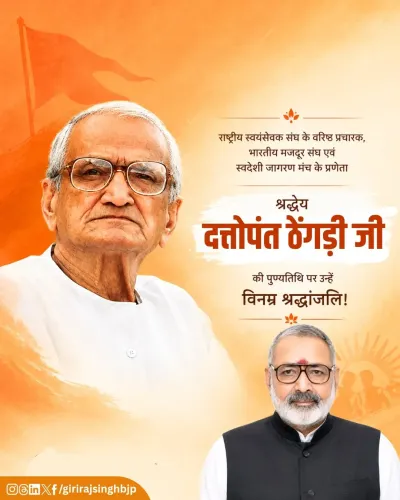
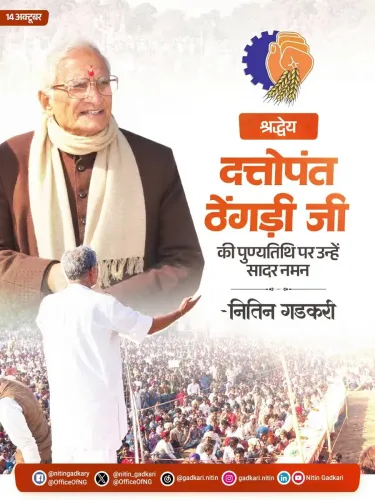
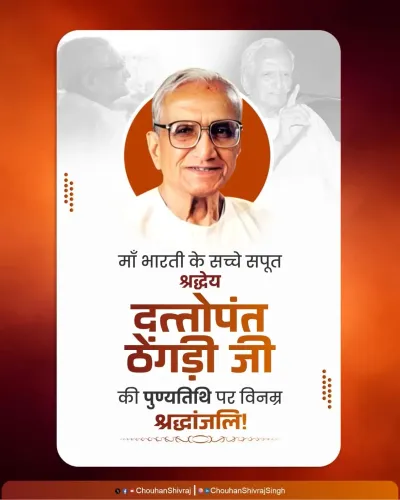
Giriraj Singh Pays Tribute to RSS Pracharak Dattopant Thengadi
Synopsis
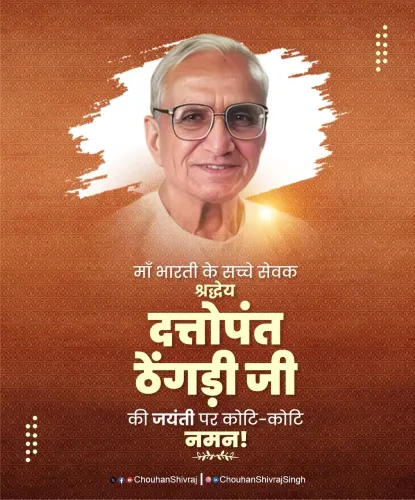
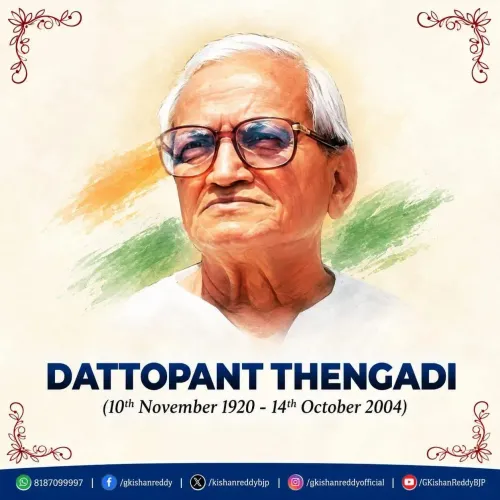
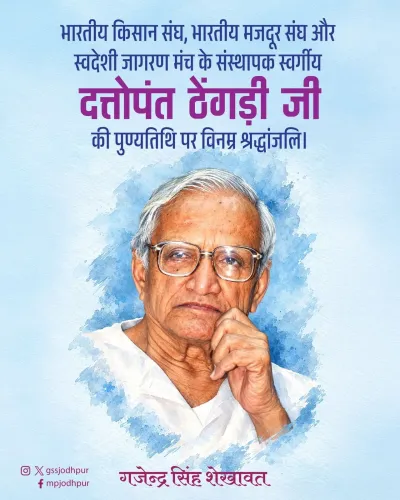
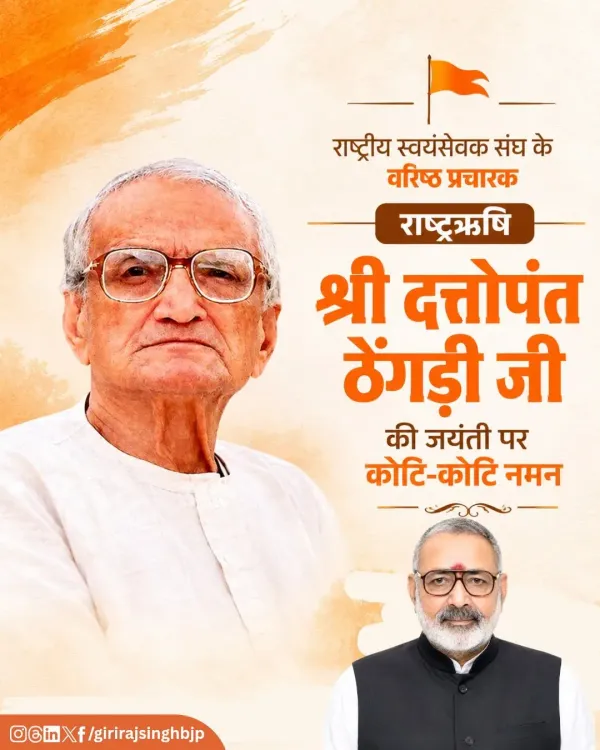
Union Textiles Minister Giriraj Singh on 10 November 2026 paid homage to Dattopant Thengadi on his birth anniversary, crediting the senior RSS pracharak with founding the Bharatiya Mazdoor Sangh, Bharatiya Kisan Sangh and Swadeshi Jagran Manch to advance labour welfare, agrarian self-reliance and economic nationalism.
Key Takeaways
Giriraj Singh posted a tribute to Dattopant Thengadi on his birth anniversary on 10 November 2026 .
Thengadi founded the Bharatiya Mazdoor Sangh in 1955 , which became India's largest trade union.
He established the Bharatiya Kisan Sangh in 1978 to promote rural self-reliance within a nationalist framework.
The Swadeshi Jagran Manch was launched in 1991 to advocate indigenous industry and critique aspects of economic liberalisation.
BJP leaders regularly mark Thengadi's jayanti, reflecting the party's deep organisational and ideological ties to the Sangh Parivar's socio-economic affiliates.
Three organisations, one lifetime of conviction — on the birth anniversary of Dattopant Thengadi, Union Textiles Minister Giriraj Singh offered a public tribute on Tuesday, 10 November 2026, honouring the senior RSS pracharak whose institutional legacy continues to shape India's labour, agrarian, and economic-nationalist movements.
Singh's post, written in Hindi, reads: 'Rashtriya Swayamsevak Sangh ke varishtha pracharak shraddhey Dattopant Thengadi ji ki jayanti par unhe koti-koti naman!' — 'Crores of salutations to revered Dattopant Thengadi ji, senior pracharak of the Rashtriya Swayamsevak Sangh, on his birth anniversary.' He went on to note that by founding organisations such as the Bharatiya Kisan Sangh, the Bharatiya Mazdoor Sangh, and the Swadeshi Jagran Manch, Thengadi gave new direction to national interest, Swadeshi thought, and worker welfare — and that his thoughtful life and dedication to national service would remain a source of inspiration for all.
The Man Who Built Three Pillars of the Sangh Parivar
Dattopant Thengadi was no armchair ideologue. He founded the Bharatiya Mazdoor Sangh (BMS) in 1955 — which went on to become India's largest trade union — on a philosophy that rejected class struggle in favour of labour welfare aligned with national priorities. A decade-long gap, then in 1978 came the Bharatiya Kisan Sangh (BKS), designed to anchor the rural farmer within a framework of self-reliance rather than state dependency. And as India threw open its economy to global forces, Thengadi answered in 1991 with the Swadeshi Jagran Manch (SJM) — a platform built to promote indigenous industry and question the terms of liberalisation.
Three decades, three institutions. Each targeted a different constituency — the factory floor, the farm, the marketplace — but all threaded together by a single conviction: that economic activity in India must serve Indian interest first.
Why BJP Leaders Mark This Day Every Year
Senior BJP leaders and ministers routinely pay public tribute on the birth anniversaries of RSS pracharaks who built parallel socio-economic structures, and Thengadi's jayanti is among the most observed. The pattern is not incidental. The BMS, BKS, and SJM together represent millions of members — workers, farmers, and small-industry advocates — who form a significant slice of the BJP's support architecture.
For a minister like Giriraj Singh — a Lok Sabha MP from Begusarai, Bihar and one of the BJP's most prominent faces — such commemorations are both ideological affirmation and political signalling. His Textiles portfolio carries direct resonance with both organised labour and the domestic manufacturing advocacy that Thengadi championed throughout his life.
Thengadi's ideas on Swadeshi economics found renewed currency in government policy long after his death — from 'Make in India' to the Production Linked Incentive (PLI) framework in textiles. The minister paying tribute today stewards a ministry whose very mandate echoes the pracharak's foundational argument: that India's economic sovereignty begins at the loom, the farm, and the factory.
Point of View
Invoking Thengadi carries added weight: the pracharak's Swadeshi philosophy underpins the domestic manufacturing push that defines current industrial policy. The tribute is therefore both commemoration and policy positioning, reminding the BMS, BKS, and SJM constituencies of the government's shared ideological inheritance. It signals that the ruling party regards Thengadi's economic nationalism not as archival legacy but as living doctrine.
NationPress
10 Nov 2026
Frequently Asked Questions
Who was Dattopant Thengadi?
Dattopant Thengadi was a senior RSS pracharak who founded three major organisations: the Bharatiya Mazdoor Sangh in 1955, the Bharatiya Kisan Sangh in 1978, and the Swadeshi Jagran Manch in 1991, dedicating his life to labour welfare, agrarian self-reliance, and economic nationalism.
What did Dattopant Thengadi found?
Thengadi founded the Bharatiya Mazdoor Sangh (India's largest trade union), the Bharatiya Kisan Sangh (a nationalist farmers' body), and the Swadeshi Jagran Manch (an economic nationalism platform opposing unchecked liberalisation).
What is Bharatiya Mazdoor Sangh?
The Bharatiya Mazdoor Sangh (BMS) is India's largest trade union, founded by Dattopant Thengadi in 1955 as an RSS affiliate that prioritises labour welfare aligned with national interest over class struggle.
What is Swadeshi Jagran Manch and why was it founded?
The Swadeshi Jagran Manch was founded in 1991 by Dattopant Thengadi to promote indigenous industry and economic self-reliance in India, and to critique the terms of economic liberalisation introduced that year.
Why do BJP leaders pay tribute to Dattopant Thengadi every year?
BJP leaders commemorate Thengadi's birth anniversary because he built key Sangh Parivar affiliates — BMS, BKS, and SJM — that represent millions of workers, farmers, and small-industry advocates closely aligned with the party's support base and ideological framework.