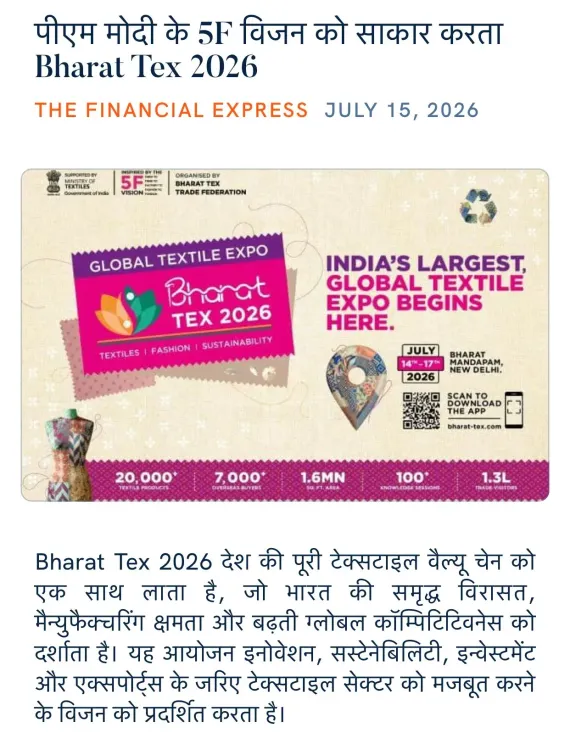
Giriraj Singh says Bharat Tex 2026 realises PM Modi's 5F vision
Synopsis
Union Textiles Minister Giriraj Singh has amplified the narrative around Bharat Tex 2026, framing the mega textile exposition as a live demonstration of PM Modi's 5F — Farm to Fibre to Factory to Fashion to Foreign — vision for building an end-to-end domestic textile value chain and achieving a $100 billion export target by 2030.
Key Takeaways
Union Textiles Minister Giriraj Singh shared content on 15 July 2026 positioning Bharat Tex 2026 as the realisation of PM Modi's 5F vision .
The 5F framework stands for Farm, Fibre, Factory, Fashion and Foreign — an integrated textile value chain policy.
The PLI Scheme for Textiles , notified in 2021 with an outlay of Rs 10,683 crore , is a key financial instrument underpinning this strategy.
India has set a $100 billion textile export target by 2030 under the Atmanirbhar Bharat agenda.
Key beneficiaries include textile exporters, MSME manufacturers, cotton farmers and handloom weavers .
The post was shared via the NaMo App , signalling coordinated political messaging around the textile sector's global ambitions.
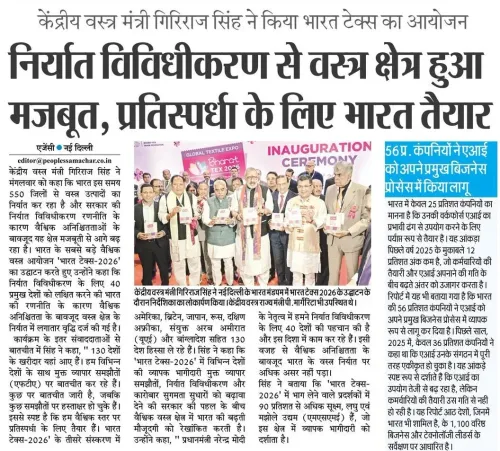
Union Textiles Minister Giriraj Singh on Wednesday, 15 July 2026 shared an opinion piece arguing that Bharat Tex 2026 is translating Prime Minister Narendra Modi's '5F vision' for the textile sector into concrete policy reality, calling the mega textile exposition a milestone in India's manufacturing ambitions.
Context
Singh posted on X with the caption 'पीएम मोदी के 5F विजन को साकार करता Bharat Tex 2026' — meaning 'Bharat Tex 2026 realising PM Modi's 5F vision' — linking to an opinion article and sharing it via the NaMo App. The post signals the Ministry of Textiles' intent to position Bharat Tex 2026 as a flagship showcase of the government's integrated textile strategy.
The 5F framework — Farm to Fibre to Factory to Fashion to Foreign — is the conceptual spine of India's textile policy under the Modi government. It envisions a seamless domestic value chain from raw cotton cultivation all the way to finished garment exports, reducing dependence on imports at every intermediate stage.
Policy Backdrop
The Ministry of Textiles has been pursuing this end-to-end value chain approach through a suite of targeted interventions. The Production Linked Incentive (PLI) Scheme for Textiles, notified in 2021 with an outlay of Rs 10,683 crore, was designed to attract investment specifically in man-made fibre and technical textiles — segments where India has historically lagged global competitors.
The government has set an ambitious $100 billion textile export target by 2030, articulated as part of the broader Atmanirbhar Bharat agenda. Bharat Tex, conceived as a world-scale textile trade exposition, is intended to accelerate that trajectory by bringing together buyers, investors and manufacturers under one platform. Singh's amplification of the 5F narrative ahead of the 2026 edition suggests the ministry is building momentum for the event.
The approach mirrors strategies deployed in other labour-intensive sectors — electronics, pharmaceuticals, auto components — where a combination of incentive schemes and large promotional events has been used to attract foreign investment and technology transfer. Textiles carry particular policy weight because of their employment multiplier effect across rural and semi-urban belts in cotton-growing states.
Stakeholders and Impact
Textile exporters, MSME manufacturers, cotton farmers and handloom weavers are the primary constituencies the 5F framework is designed to benefit. A successful Bharat Tex 2026 could catalyse fresh buyer-supplier linkages and attract investment commitments that feed directly into PLI disbursements and export order books.
For cotton farmers at the Farm end of the chain, stronger downstream demand signals translate into more stable procurement prices. For garment exporters at the Fashion and Foreign end, a high-profile global event offers visibility with international retail chains and sourcing companies at a time when several global buyers are diversifying supply chains away from single-country dependence.
What's Next
Attention will now turn to the scale, format and state-level participation in Bharat Tex 2026, along with any mid-term review of PLI disbursements. Budget session discussions and any new textile policy announcements will be watched closely by industry stakeholders as indicators of whether the 5F vision is being backed by fresh fiscal commitments.
Singh's post, amplified through the NaMo App ecosystem, underlines that the ruling party sees the textile sector's global ambitions as a politically salient narrative heading into the second half of 2026.
Point of View
Linking farm incomes to export growth in a single, accessible formulation. By amplifying this framing at ministerial level, the government is signalling that Bharat Tex 2026 will be deployed as a showcase event — part trade expo, part political proof point — for the Atmanirbhar Bharat agenda. The timing also suggests the ministry may be laying groundwork for fresh policy or budgetary announcements tied to the event.
NationPress
15 Jul 2026
Frequently Asked Questions
What is PM Modi's 5F vision for textiles?
PM Modi's 5F vision refers to an integrated textile value chain framework covering Farm, Fibre, Factory, Fashion and Foreign — meaning the policy aims to link raw cotton cultivation all the way through to finished garment exports within India, reducing import dependence at every stage.
What is Bharat Tex 2026?
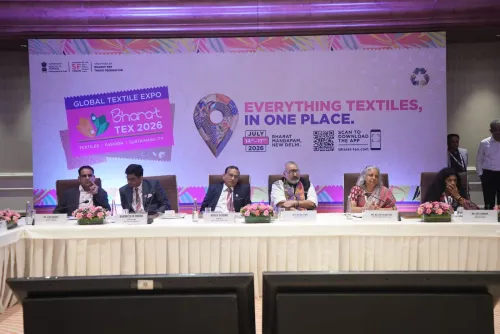
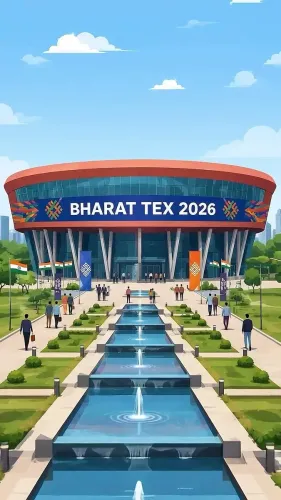
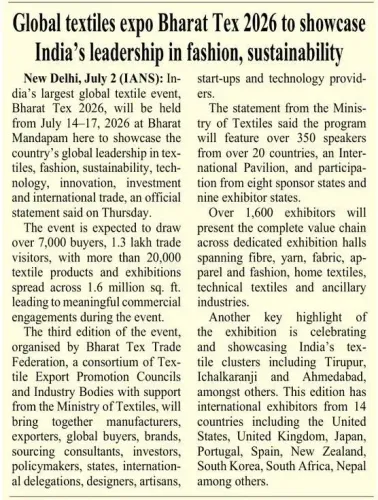
Bharat Tex 2026 is a large-scale textile trade exposition organised by the Indian government to showcase the country's textile manufacturing capabilities, attract investment and connect domestic producers with global buyers, in line with the $100 billion export target by 2030.
What is the PLI Scheme for Textiles?
The Production Linked Incentive Scheme for Textiles was notified in 2021 with a government outlay of Rs 10,683 crore, aimed at boosting domestic manufacturing in man-made fibre and technical textiles segments and increasing India's share of global textile exports.
What is India's textile export target?
India has set a target of $100 billion in textile exports by 2030, announced as part of the Atmanirbhar Bharat manufacturing push, with schemes like PLI and events like Bharat Tex designed to accelerate progress toward that goal.
Who is Giriraj Singh and what is his role in textiles?
Giriraj Singh is a senior BJP leader and Lok Sabha MP from Begusarai, Bihar, currently serving as Union Minister of Textiles. He has been overseeing the ministry's policy implementation — including PLI disbursements and export promotion — since 2024.