Giriraj Singh targets Gandhi family, invokes 1975 Emergency
Synopsis
Union Textiles Minister Giriraj Singh launched a stinging attack on the Gandhi family on X, alleging generational electoral fraud and calling the 1975 Emergency a cover-up for Indira Gandhi's Allahabad High Court election defeat. He called the family 'traitors to the nation.'
Key Takeaways
Giriraj Singh posted a sharp Hindi attack on the Gandhi family on 25 September 2026 , calling them 'traitors to the nation.' He alleged the family's 'grandmother' — a reference to Indira Gandhi — was 'India's biggest vote-thief' who imposed the Emergency when her election was invalidated.
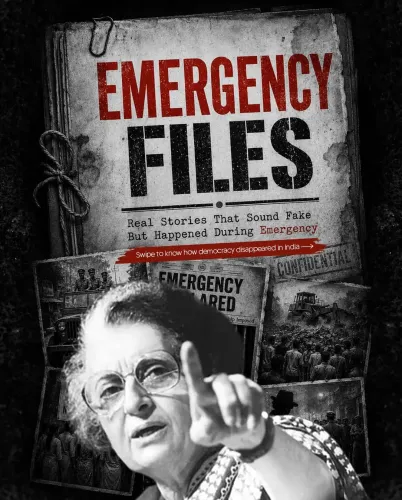
The Allahabad High Court did invalidate Indira Gandhi's 1975 Lok Sabha election on grounds of corrupt practices, triggering the 21-month Emergency .
Singh's post extends BJP's standard political line linking Congress dynastic politics to democratic subversion.
The 'deshdrohi' (traitor) label from a sitting Union Minister is likely to prompt formal Congress rebuttals and possible parliamentary action.
A senior Union Minister has levelled some of the sharpest language in recent political memory at a rival dynasty — and the charge-sheet stretches back half a century. Union Textiles Minister Giriraj Singh, posting on X on Friday, 25 September 2026, attacked what he described as a political family whose record on democracy ranges from electoral fraud to the suspension of civil liberties itself.
Writing in Hindi, Singh charged that 'India's public has seen through this joker' — a reference widely understood in the context of BJP's long-running campaign against the Nehru-Gandhi family and the Indian National Congress. He alleged that the subject's mother 'votes first and becomes a voter later,' and escalated further: 'their grandmother was India's biggest vote-thief; when she was caught, she imposed the Emergency.'
The 1975 Emergency and the Allahabad High Court ruling
Singh's reference to being 'caught' points to a specific and documented episode in Indian constitutional history. In June 1975, the Allahabad High Court set aside Indira Gandhi's Lok Sabha election victory on grounds of corrupt electoral practices — a judgment that struck at the very basis of her parliamentary seat and, by extension, her Prime Ministership.
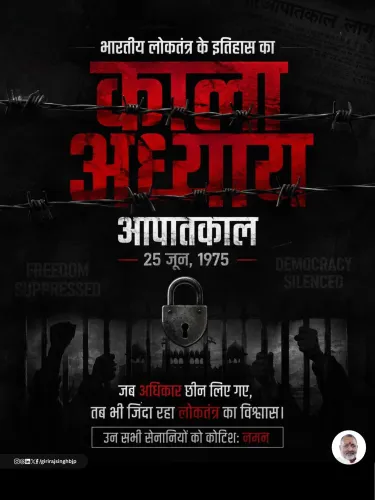
Within days of the ruling, Gandhi declared a national Emergency — a 21-month period from June 1975 to March 1977 during which fundamental rights were suspended, opposition leaders were imprisoned en masse, and press freedom was effectively extinguished. It remains the most contested chapter in post-Independence Indian democratic history, and BJP leaders have consistently deployed it as the definitive proof of Congress's authoritarian instincts.
BJP's Emergency playbook and dynastic targeting
Singh's post is the latest and most pointed iteration of a well-worn but politically potent BJP attack line. The party has, across election cycles and parliamentary sessions, returned repeatedly to 1975 as a shorthand for what it frames as Congress's willingness to subvert democracy when power is threatened. The dynastic angle — alleging that electoral irregularities run across generations — sharpens that framing into a personal indictment.
The closing line of Singh's post — 'yah parivaar deshadrohibon ka parivaar hai' ('this family is a family of traitors to the nation') — represents an escalation in register that is certain to draw formal responses from Congress leadership. Such language, from a sitting Union Minister, carries political and potentially legal weight.
What Congress is likely to say next
Congress spokespersons have historically answered Emergency critiques by pointing to BJP's own record on press freedom, institutional independence, and electoral integrity. Expect that rebuttal template to be deployed swiftly — and expect the exchange to spill into the next parliamentary session, where opposition benches have used such ministerial remarks as grounds for adjournment motions in the past.
India's democratic argument with itself over 1975 is never really about 1975. It is always about now — about who controls the narrative of what it means to be a legitimate heir to the republic. Giriraj Singh just turned the volume up.
Point of View
The party converts a historical grievance into a live electoral charge. The 'deshdrohi' (traitor) label from a sitting Union Minister raises the stakes beyond rhetoric — it invites a legal and parliamentary counter-offensive from Congress. The exchange reflects a wider BJP strategy of keeping the Gandhi family's dynastic legitimacy permanently on trial, especially as election cycles approach.
NationPress
25 Sept 2026
Frequently Asked Questions
Why did Giriraj Singh mention the Emergency in his post?
Singh invoked the 1975 Emergency to argue that the Gandhi family imposed it to escape accountability after the Allahabad High Court invalidated Indira Gandhi's election on grounds of corrupt practices — framing it as a historical precedent for what he calls the family's anti-democratic behaviour.
What was the Allahabad High Court ruling against Indira Gandhi?
In June 1975 , the Allahabad High Court set aside Indira Gandhi's Lok Sabha election victory from Rae Bareli , finding her guilty of corrupt electoral practices. Within days, she declared the national Emergency .
How long did the 1975 Emergency last?
The Emergency lasted 21 months , from June 1975 to March 1977 , during which civil liberties were suspended, opposition leaders were jailed, and press freedom was curtailed.
What does 'deshdrohi' mean and why is Giriraj Singh using it?
Deshdrohi means 'traitor to the nation' in Hindi. Singh's use of the term against the Gandhi family is a significant escalation — from political criticism to a charge that strikes at national loyalty — and is likely to draw legal and parliamentary responses from Congress .
How has BJP used the Emergency as a political tool?
BJP has consistently invoked the 1975 Emergency across election cycles to argue that Congress is willing to subvert democratic institutions when its power is threatened. It forms a central plank of the party's anti-Congress narrative on democratic credentials.