CM Yogi invokes Antyodaya and Integral Humanism for Naya UP
Synopsis
Uttar Pradesh Chief Minister Yogi Adityanath has reaffirmed the state's 'Naya Uttar Pradesh' vision, anchoring his government's development agenda in Deendayal Upadhyay's Antyodaya and Integral Humanism philosophies, with a promise of inclusive growth and entrepreneurship under the BJP's double-engine governance model.
Key Takeaways
CM Yogi Adityanath posted on 25 September 2026 reaffirming 'Naya Uttar Pradesh' as a mission of inclusive development and entrepreneurship.
The post explicitly invokes Antyodaya (welfare of the last person) and Ekatma Manavvad (Integral Humanism), the twin philosophical pillars articulated by Deendayal Upadhyay in 1965 .
The 'double engine government' framing underlines political alignment between BJP governments in Lucknow and New Delhi since 2014 .
Uttar Pradesh has been under BJP rule since 2017 , with governance consistently branded under the 'Naya Uttar Pradesh' narrative.
The post signals continued focus on both welfare outreach and entrepreneurship as complementary priorities for the state.
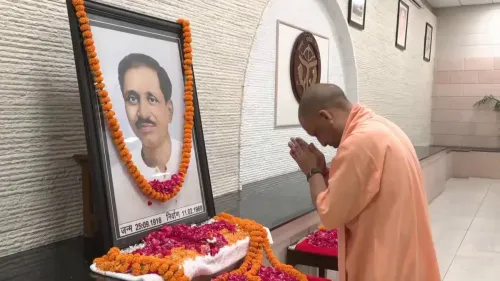
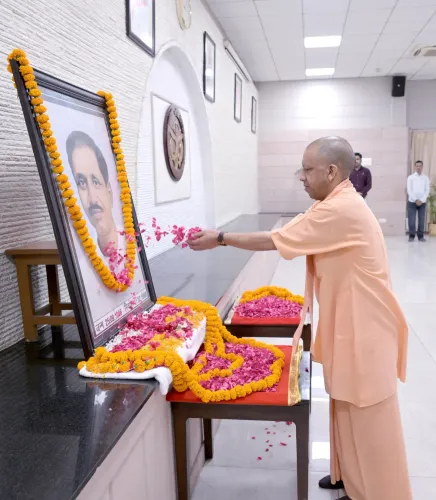
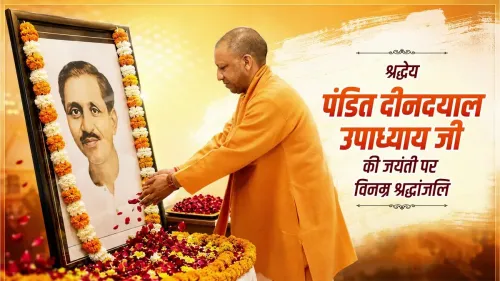
Guided by the twin pillars of Antyodaya — uplift of the last person in line — and Ekatma Manavvad (Integral Humanism), Uttar Pradesh Chief Minister Yogi Adityanath on Friday, 25 September 2026 renewed his government's commitment to what he calls 'Naya Uttar Pradesh': a state marching steadily toward all-inclusive development, entrepreneurship, and progress.
Posting in Hindi on X, CM Yogi wrote: 'Antyodaya ki bhavna aur Ekatma Manavvad ke vicharom se prerit Naya Uttar Pradesh, double engine sarkar ke netritva mein sarvasamaveshi vikas, udyamita aur pragati ki nayi raah par nirantar agrassar hai...' — 'Inspired by the spirit of Antyodaya and the ideas of Integral Humanism, a New Uttar Pradesh, under the leadership of the double-engine government, continues to advance on a new path of all-inclusive development, entrepreneurship and progress.'Deendayal Upadhyay's ideas at the centre of BJP's UP narrative
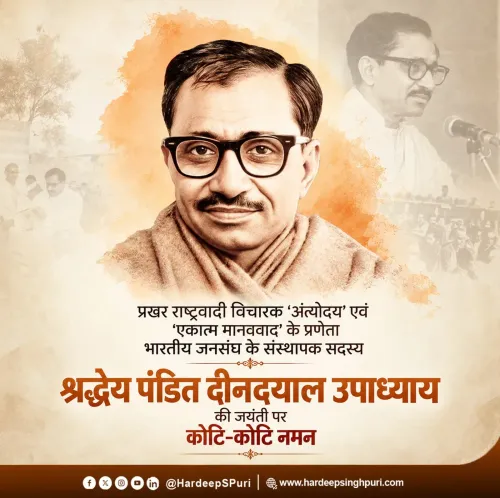
The philosophical anchors CM Yogi invokes are not abstract. Deendayal Upadhyay, the RSS ideologue, presented Ekatma Manavvad in 1965 as a distinctly Indian alternative to both Western capitalism and Soviet socialism — a framework that places the last, most marginalised citizen at the centre of state action. The BJP has made these ideas a recurring thread in its governance vocabulary, from welfare schemes to industrial policy.
For Uttar Pradesh, India's most populous state, the framing carries particular weight. Since the BJP came to power in the state in 2017, successive campaigns and budget cycles have been pitched under the 'Naya Uttar Pradesh' banner — positioning the state's trajectory as a break from earlier decades of governance paralysis.
The 'double engine' argument and what it means on the ground
The 'double engine government' phrase — central to CM Yogi's messaging — refers to the political alignment between a BJP-led government in Lucknow and the BJP-led central government in New Delhi. The argument, deployed consistently since 2014, is that policy implementation accelerates when both engines pull in the same direction: central funds flow faster, clearances move quicker, and flagship schemes dovetail with state priorities.
The emphasis on udyamita (entrepreneurship) alongside welfare signals an attempt to hold two audiences simultaneously — small-business aspirants hungry for ease-of-doing-business reform, and the rural and semi-urban poor who are Antyodaya's intended beneficiaries. Whether that balance delivers is the core question that the next Uttar Pradesh budget session and any fresh industrial policy announcement will have to answer.
Point of View
His government keeps its welfare and development agenda tethered to the BJP's foundational Deendayal Upadhyay heritage rather than presenting it as mere administrative performance. The 'double engine' framing is equally strategic — it ties state achievements to the central government and reinforces a united-front argument ahead of any budgetary or electoral cycle. The pairing of welfare philosophy with entrepreneurship language is a conscious bid to hold both the rural-poor constituency and the aspirational middle class within a single ideological canopy. How far actual policy delivery matches the philosophical ambition remains the stress test that critics and voters will apply.
NationPress
25 Sept 2026
Frequently Asked Questions
What is 'Naya Uttar Pradesh'?
'Naya Uttar Pradesh' (New Uttar Pradesh) is the BJP government's branding for the state's development trajectory since 2017 , emphasising improved law and order, infrastructure investment, and inclusive growth as a departure from earlier governance challenges.
What does Antyodaya mean in Indian politics?
Antyodaya literally means 'rise of the last person' and refers to the principle, articulated by Deendayal Upadhyay , that the success of governance should be measured by how much it lifts the most marginalised citizens. The BJP has adopted it as a core welfare philosophy.
What is Ekatma Manavvad (Integral Humanism)?
Ekatma Manavvad , or Integral Humanism, is a political philosophy presented by Deendayal Upadhyay in 1965 as an Indian alternative to both capitalism and socialism, emphasising holistic human development rooted in Indian cultural traditions.
What is the 'double engine government' the BJP talks about?
The 'double engine government' phrase describes the alignment between BJP -ruled state governments and the BJP -led central government, with the argument that coordinated rule accelerates the flow of funds and implementation of national schemes at the state level.
Who was Deendayal Upadhyay?
Deendayal Upadhyay was an RSS ideologue and one of the founding architects of the Bharatiya Janata Party 's predecessor organisation, best known for formulating Integral Humanism and the Antyodaya principle in the 1960s .