Giriraj Singh targets 'tilachatta group' over selective silence on youth rights
Synopsis
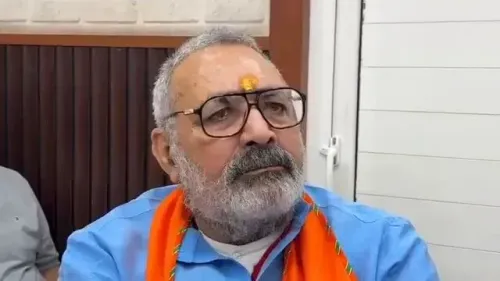
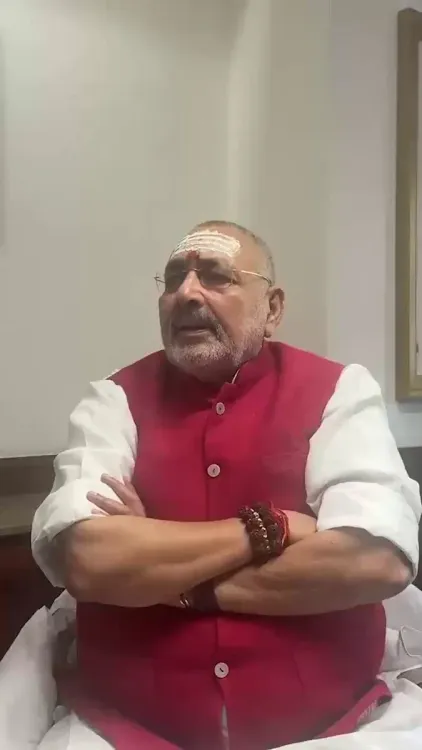
Union Textiles Minister Giriraj Singh backed Maharashtra CM Devendra Fadnavis on X, accusing a so-called 'tilachatta group' of conspiring to spread anarchy and targeting opposition parties for staying silent on youth rights in Jharkhand, Punjab and Karnataka.
Key Takeaways
Union Textiles Minister Giriraj Singh posted on X on Monday, 10 August 2026 backing Maharashtra CM Devendra Fadnavis .
Singh accused a group he labelled the 'tilachatta group' (cockroach group) of conspiring to spread anarchy in India.
He specifically named Jharkhand , Punjab , and Karnataka — all opposition-governed states — as places where youth rights are being ignored.
Singh called the opposition's approach 'selective politics and arrogance' and predicted it would not sustain.
He invoked India's 'aware youth' ( jagruk yuva ) as the democratic force that will deliver a 'fitting reply' at the ballot box.
The specific statement by Fadnavis that triggered Singh's post has not been independently verified.
A sharp political broadside landed on Monday afternoon when Union Textiles Minister Giriraj Singh took to X to back Maharashtra Chief Minister Devendra Fadnavis — and in the same breath, called out what he described as the 'tilachatta group's' campaign to spread anarchy across India.
Addressing Fadnavis directly, Singh wrote: 'Devendra ji, aapne jis loktantrik tarike se apni awaaz uthayi hai' — 'Devendra ji, the democratic manner in which you have raised your voice has exposed the true face of the supporters of the 'cockroach group' that is conspiring to spread anarchy in the country.'
The 'selective politics' charge against Jharkhand, Punjab and Karnataka
The minister's sharpest jab was directed at those he accused of staying silent on the rights of young people in Jharkhand, Punjab, and Karnataka — three states currently governed by opposition parties. Singh called this pattern 'selective politics and arrogance' and warned it would not last much longer. The framing is a well-worn but potent one in Indian political combat: accuse your opponents of speaking up for youth only when it suits them, while ignoring identical grievances in states they govern. By naming three specific opposition-ruled states, Singh sharpened the contrast and gave the charge geographic weight.Youth as the democratic reckoning Singh is betting on
Singh's closing line carried the real political punch. He wrote that the country's 'aware youth' (jagruk yuva) is watching this double standard — and will deliver a 'fitting democratic reply' when the time comes. The message is unmistakably electoral: a signal that the BJP intends to mobilise young voters around this perceived hypocrisy in the states named. This fits a broader pattern in which senior BJP leaders use social media to set a national narrative ahead of state-level contests, framing local governance failures as evidence of a systemic opposition blind spot. The specific trigger for Fadnavis's statement that prompted Singh's post, and the precise identity of the 'tilachatta group' being referenced, have not been independently established. What is clear is that Singh chose a combative, colloquial label — 'cockroaches' — to describe a political adversary, a rhetorical escalation that itself is likely to draw responses from opposition benches in Maharashtra, Jharkhand, Punjab, and Karnataka.Point of View
Then close with an electoral warning to youth. The naming of Jharkhand, Punjab and Karnataka is deliberate — each state represents a different opposition formation, and bundling them together reinforces the 'pan-opposition double standard' narrative the BJP has been building. The 'tilachatta' label, while vivid, is also a liability — it is precisely the kind of language opposition parties will quote back to argue the BJP has normalised dehumanising political rhetoric. Watch whether Fadnavis himself amplifies or distances from this framing.
NationPress
10 Aug 2026
Frequently Asked Questions
What did Giriraj Singh say about the 'tilachatta group'?
Giriraj Singh used the term 'tilachatta group' (cockroach group) to describe what he called a faction conspiring to spread anarchy in India, claiming that Devendra Fadnavis's democratic response had exposed their supporters' true face.
Why did Giriraj Singh mention Jharkhand, Punjab and Karnataka?
Singh accused those in power or with influence in these three opposition-governed states of staying silent on the rights of local youth, using it as evidence of what he called 'selective politics.'
Who is Devendra Fadnavis and why is he mentioned?
Devendra Fadnavis is the Chief Minister of Maharashtra and a senior BJP leader. Singh praised him for raising his voice in what he described as a democratic manner, using Fadnavis's action as the launchpad for his broader attack.
What did Giriraj Singh mean by 'aware youth will give a fitting reply'?
Singh was signalling an electoral warning — that young voters in the states named are watching the opposition's double standards and will vote against them when elections come.
Is the 'tilachatta group' an official organisation?
No. The term appears to be a colloquial political label used by Singh to describe a group of political opponents or activists; it does not refer to any formally registered organisation based on available information.