Giriraj Singh Vows Justice in Bharat Tiwari Murder Case
Synopsis
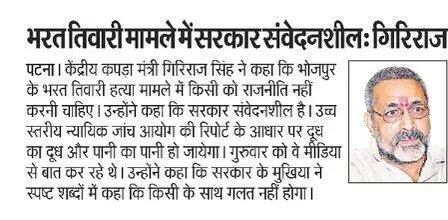
Union Textiles Minister Giriraj Singh on 26 June 2026 called the Bharat Tiwari murder case 'extremely tragic', assured that a high-level judicial inquiry commission will establish the truth, and warned of strict legal action against anyone found guilty.
Key Takeaways
Giriraj Singh , Union Textiles Minister and BJP MP from Begusarai, Bihar , issued a public statement on the Bharat Tiwari murder case on 26 June 2026 .
He described the case as 'extremely tragic' and said the government is acting with 'full sensitivity and seriousness'.
A high-level judicial inquiry commission has been constituted; its report will determine the next steps.
The minister explicitly promised 'strict action as per law' against anyone the commission finds guilty.
The case has drawn attention at the Union government level, reflecting its political and social significance in Bihar .
Key milestones to watch: publication of the commission's report and any subsequent arrests or prosecutions.
Union Textiles Minister Giriraj Singh on Friday, 26 June 2026, issued a public statement on the Bharat Tiwari murder case, calling it 'extremely tragic' and assuring that a high-level judicial inquiry commission would bring the truth to light and that strict action would follow against anyone found guilty.
Context
Posting on X, Giriraj Singh wrote in Hindi: 'भरत तिवारी हत्याकांड अत्यंत दुखद है' ('The Bharat Tiwari murder case is extremely tragic'). He added that the government is working 'with full sensitivity and seriousness', and that truth will emerge on the basis of the report of a high-level judicial inquiry commission.
The minister further stated that if anyone is found guilty, 'strict action as per law will be ensured against them' — a formulation that signals the matter has drawn attention at the level of Union government leadership.
Policy Backdrop
The constitution of judicial inquiry commissions to examine high-profile criminal or custodial incidents has been a recurring instrument of Indian governance at both the state and central levels. Such commissions, set up under the Commissions of Inquiry Act, 1952, are empowered to summon witnesses, examine records, and submit findings to the government.
Central ministers from Bihar — a state that has historically seen political sensitivity around law-and-order cases — frequently issue public assurances on local criminal incidents, reflecting the dual accountability these leaders carry as both national ministers and regional political figures. Giriraj Singh, a Lok Sabha MP from Begusarai, has a long-standing political base in the state.
Stakeholders and Impact
The family of Bharat Tiwari and residents of the affected locality are the most immediate stakeholders, awaiting the commission's findings and any subsequent legal proceedings. The assurance of 'strict action as per law' — referencing applicable provisions of the criminal code — is directed at this constituency as much as at a broader public audience.
Bihar's political landscape, where law-and-order perception directly shapes electoral outcomes, means that the government's visible engagement with the case carries weight beyond the immediate legal process. Civil society groups and victim-rights advocates will likely monitor whether the commission's report is made public and whether prosecutions follow.
What's Next
The critical milestone now is the submission and publication of the high-level judicial inquiry commission's report. Any arrests or prosecutions under relevant sections of criminal law that follow from the commission's findings will be the measure of the government's stated commitment to accountability.
Political observers will also watch whether the state government in Bihar coordinates closely with the Union minister's office on the case's progress, and whether the matter is raised in Parliament during the upcoming session.
Point of View
Reinforcing their regional accountability even while holding national portfolios. The explicit reference to a 'high-level judicial inquiry commission' is significant: it signals institutional process is already in motion, not merely being promised. However, the credibility of such assurances will ultimately rest on the commission's independence, the timeliness of its report, and whether prosecutions actually follow — all areas where India's track record with inquiry commissions has been uneven. For a senior BJP leader from Bihar, where the 2025 state assembly cycle has heightened political stakes, visible engagement on law-and-order cases is also a strategic electoral signal.
NationPress
25 Sept 2026
Frequently Asked Questions
Who is Bharat Tiwari and what happened in the murder case?
The specific details of the Bharat Tiwari murder case have not been officially disclosed in the public domain as of the minister's statement on 26 June 2026. A high-level judicial inquiry commission has been constituted to investigate the matter and its report is awaited.
What did Giriraj Singh say about the Bharat Tiwari murder case?
Giriraj Singh called the case 'extremely tragic', said the government is working with 'full sensitivity and seriousness', and assured that the report of a high-level judicial inquiry commission will bring the truth to light, with strict legal action against anyone found guilty.
What is a high-level judicial inquiry commission in India?
A judicial inquiry commission in India is typically constituted under the Commissions of Inquiry Act, 1952. It is empowered to summon witnesses, examine documents, and submit findings to the government, which then decides on follow-up action including prosecution.
Is the Bharat Tiwari murder case a Bihar matter or a central government matter?
Law and order is primarily a state subject under the Indian Constitution, so Bihar's state government holds primary jurisdiction. However, Union ministers from Bihar, like Giriraj Singh, often issue statements on significant local incidents given their political accountability to the state's electorate.
What action can be taken after the judicial commission submits its report?
Once the commission submits its report, the government can initiate prosecutions against those named as guilty under applicable sections of criminal law. The report can also recommend systemic reforms or administrative action against officials found negligent.