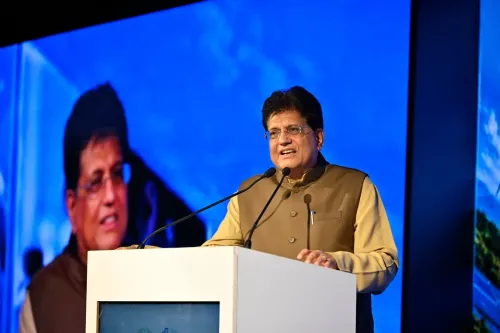
Goyal Urges Indian Industries to Boost Agri Investment

Synopsis
Commerce Minister Piyush Goyal on 19 November 2026 urged Indian industries to increase investment in the agricultural sector, reinforcing the government's long-standing push for private capital to modernise farm supply chains, post-harvest infrastructure, and agri-processing capacity.
Key Takeaways
Piyush Goyal , Union Commerce and Industry Minister, posted on 19 November 2026 urging Indian industries to boost investment in agriculture.
The appeal aligns with the Agricultural Infrastructure Fund launched in 2020 to attract private capital into post-harvest and value-chain infrastructure.
The Commerce and Industry ministry links agricultural modernisation directly to manufacturing competitiveness and export growth.
Goyal controls key policy levers — FDI norms, production-linked incentives, and export facilitation — that can back his public call with action.
Follow-up announcements on investment incentives or agri-processing clusters in budget or trade policy reviews will indicate how the appeal converts into policy.
India's farm sector needs private capital — and Union Commerce and Industry Minister Piyush Goyal is making the ask directly. On Thursday, 19 November 2026, Goyal posted a pointed appeal on X, calling on Indian industries to step up their investment in the country's agricultural sector.
In his post, the Minister stated in Hindi: 'मैं आपसे आग्रह करूंगा कि हमारी इंडस्ट्रीज, भारत के कृषि क्षेत्र में अपना निवेश बढ़ाएं' — 'I would urge our industries to increase their investment in India's agricultural sector.' The appeal is brief, but the ask is significant: private capital into a sector that still employs a majority of India's workforce yet remains chronically under-invested.
Why Private Capital in Agriculture Is a Long-Running Priority
Successive Indian governments have sought greater private-sector participation in agriculture to fix broken supply chains, build processing capacity, and accelerate technology adoption — all while targeting higher rural incomes. The Commerce and Industry ministry has consistently linked manufacturing competitiveness and export growth to modernising the upstream agricultural base that feeds both raw material pipelines and consumer demand.
A concrete policy anchor already exists: the Agricultural Infrastructure Fund, launched in 2020, was designed precisely to draw private and institutional capital into post-harvest infrastructure and value chains — cold storage, sorting facilities, agri-logistics, and processing hubs. Goyal's call aligns with that existing architecture, reinforcing the government's intent to deepen industry participation rather than rely solely on public expenditure.
What Industries Stand to Gain — and What Farmers Need
For Indian conglomerates and mid-sized agri-businesses, the pitch is an alignment of incentives: a vast, under-served domestic market, government policy tailwinds, and growing export demand for processed food and agricultural commodities. For farmers, greater industry investment translates into better price realisation, reduced post-harvest losses, and access to formal credit and technology — gaps that have persisted despite decades of subsidy-led policy.
Goyal, as Leader of the House in the Rajya Sabha and the minister responsible for trade and investment promotion, carries direct authority over the policy levers — FDI norms, production-linked incentives, and export facilitation — that can make industry investment more attractive. His public nudge signals that such conversations are live at the top of government.
Watch for follow-up moves in upcoming budget discussions or trade policy reviews: investment incentives for agri-processing clusters or fresh FDI tweaks could soon give this appeal a sharper policy edge.
Point of View
The Commerce Ministry is recasting the sector's narrative for corporate India. The linkage between agri-investment and export competitiveness is a signal that agri-processing clusters or fresh FDI relaxations could be on the near-term policy menu. The ask also carries political weight: mobilising private capital into rural supply chains has the dual advantage of economic modernisation and rural income optics ahead of state election cycles.
NationPress
19 Nov 2026
Frequently Asked Questions
What did Piyush Goyal say about agriculture investment?
On 19 November 2026, Goyal urged Indian industries to increase their investment in India's agricultural sector, calling it a direct appeal in a post on X.
What is the Agricultural Infrastructure Fund?
The Agricultural Infrastructure Fund is a government scheme launched in 2020 to attract private and institutional investment into post-harvest infrastructure and agricultural value chains such as cold storage and processing facilities.
Why is private investment important for Indian agriculture?
Private investment can build processing capacity, improve supply chains, reduce post-harvest losses, and raise farmer incomes — gaps that public spending alone has not been able to close.
What policy tools does the Commerce Ministry have to support agri investment?
The ministry oversees FDI norms, production-linked incentive schemes, export facilitation, and investment promotion — all of which can be calibrated to make agri-sector investment more attractive for industry.
What should we watch for after Goyal's agriculture investment appeal?
Watch for follow-up policy moves such as investment incentives for agri-processing clusters, FDI policy tweaks, or new schemes announced in upcoming budgets or trade policy reviews.