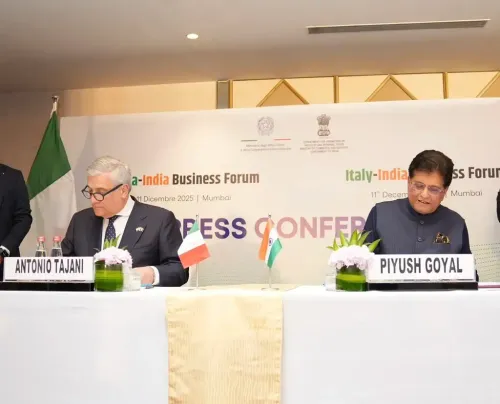
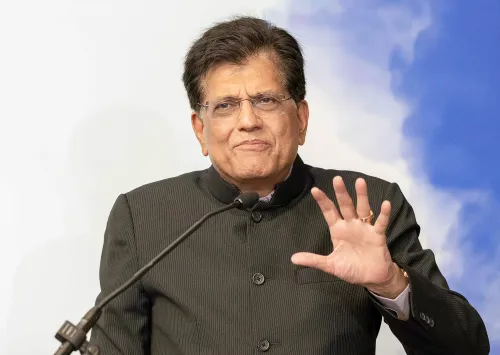
Goyal meets Italy's Tajani, eyes €20 bn trade target by 2029
Synopsis
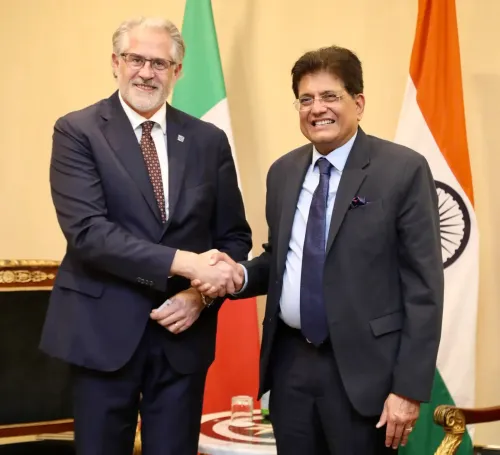
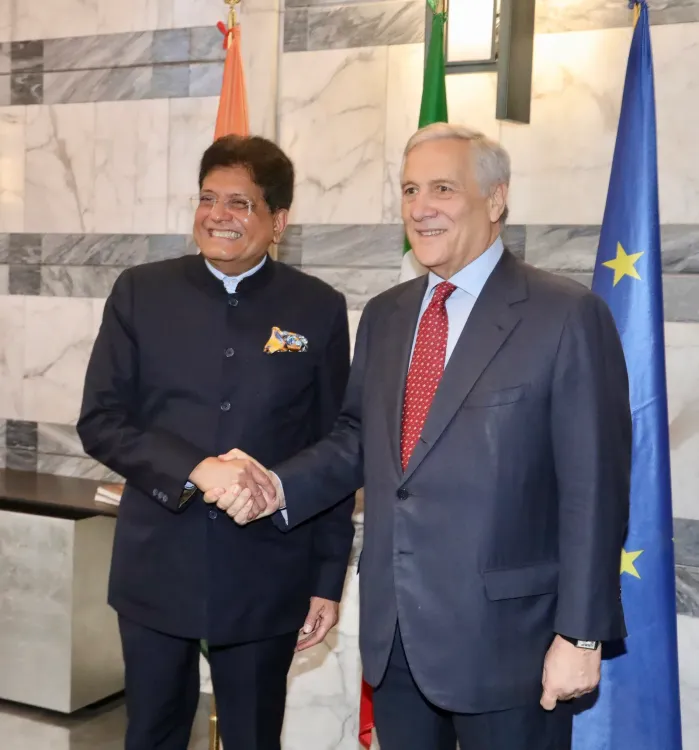
Commerce Minister Piyush Goyal met Italian Deputy PM Antonio Tajani on 18 November 2026, holding talks on trade, advanced manufacturing and clean energy under the India-Italy Special Strategic Partnership, with both sides reaffirming a €20 billion bilateral trade target by 2029.
Key Takeaways
Piyush Goyal met Italy's Deputy Prime Minister Antonio Tajani on 18 November 2026 for bilateral talks.
Discussions covered bilateral trade and investment , industrial cooperation , and technology and clean energy .
Both sides reaffirmed a €20 billion bilateral trade target by 2029 .
The meeting is anchored in the India-Italy Special Strategic Partnership framework established in 2023 .
India's engagement reflects its broader strategy of deepening economic ties with European Union partners through multi-alignment.
Follow-up through joint working groups and future EU-India or bilateral summits will determine real-world progress on the trade target.
A bilateral trade ambition worth €20 billion by 2029 was squarely on the table on Wednesday, 18 November 2026, when Union Commerce and Industry Minister Piyush Goyal sat down with Italy's Deputy Prime Minister and Foreign Affairs Minister Antonio Tajani — a meeting that signals both nations are ready to move the India-Italy Special Strategic Partnership from declaration to delivery.
What the two sides put on the table
Goyal described the conversation as 'very productive', with talks spanning bilateral trade and investment, industrial cooperation and advanced manufacturing, and a third pillar covering technology, clean energy and innovation. The breadth of the agenda reflects how far the relationship has travelled since the two countries elevated ties to a Special Strategic Partnership framework — a step formalised during high-level engagements in 2023, including a visit by Italian Prime Minister Giorgia Meloni.
The centrepiece number — a €20 billion bilateral trade target by 2029 — gives the partnership a concrete scoreboard. It also sets a ticking clock: five years from the original upgrade to show measurable results in trade flows.
India's European pivot and why Italy fits
Italy is one of the European Union's largest economies and a manufacturing powerhouse, particularly in precision engineering, aerospace components, luxury goods, and green energy equipment — sectors that dovetail neatly with India's own industrial ambitions. New Delhi's broader strategy of multi-alignment — deepening economic ties across Europe rather than depending on any single bloc or partner — makes Italy a natural node in a diversified supply-chain architecture.
Clean energy cooperation is especially timely. Both governments have committed to aggressive decarbonisation targets, and Italian firms have established expertise in solar, wind, and energy-efficiency technologies that Indian industry is actively seeking. Advanced manufacturing, meanwhile, ties directly to India's push to position itself as a global production alternative.
From partnership language to working numbers
Goyal's post used the word 'reaffirmed' — signalling this was not a first conversation but a check-in on a running commitment. The real test, as analysts and industry watchers will note, lies in the follow-through: joint working groups, investment facilitation mechanisms, and whether the two sides synchronise timelines at upcoming EU-India or bilateral intergovernmental meetings. With a hard 2029 trade-target deadline now publicly restated by a Cabinet minister, the accountability is built in.
India's exporters — particularly in pharmaceuticals, textiles, engineering goods, and IT services — and Italian manufacturers eyeing India as a production and consumer market are the immediate beneficiaries if the momentum holds.
Point of View
Not diplomatic decoration — the publicly restated €20 billion trade target adds a measurable accountability layer that is unusual in bilateral diplomacy. Coming as India intensifies its multi-alignment posture, the Italy engagement also hedges against supply-chain concentration risk, particularly in advanced manufacturing and clean energy. The clean-energy and technology pillars are strategically smart: they position the partnership within the EU's own industrial priorities, making Italy a potential gateway for broader India-EU convergence. The harder question is execution — joint working groups and investment facilitation frameworks will reveal whether the ambition outlasts the press release.
NationPress
18 Nov 2026
Frequently Asked Questions
What is the India-Italy bilateral trade target?
India and Italy have set a bilateral trade target of €20 billion by 2029 , reaffirmed during Commerce Minister Piyush Goyal's meeting with Italian Deputy PM Antonio Tajani on 18 November 2026 .
What is the India-Italy Special Strategic Partnership?
The India-Italy Special Strategic Partnership is a bilateral framework that elevates cooperation across trade, defence, technology, and clean energy. The two countries upgraded their ties to this level during high-level engagements in 2023 , including a visit by Italian Prime Minister Giorgia Meloni.
Who is Antonio Tajani?
Antonio Tajani is Italy's Deputy Prime Minister and Minister of Foreign Affairs and International Cooperation , and one of the most senior figures in the Italian government.
Why is India strengthening ties with Italy?
India is deepening partnerships with European nations as part of a multi-alignment strategy to diversify supply chains and secure access to advanced manufacturing, clean energy technology, and new investment sources. Italy's industrial base in precision engineering and green energy makes it a key partner.
What sectors are covered in India-Italy cooperation talks?
The latest talks covered three broad pillars: bilateral trade and investment , industrial cooperation and advanced manufacturing , and technology, clean energy and innovation .