Goyal targets Rahul Gandhi, INDIA bloc over 'false propaganda'

Synopsis
Commerce Minister Piyush Goyal accused the Congress and INDIA alliance of spreading 'false propaganda' that harms all sections of society, singling out Rahul Gandhi and calling such forces 'anti-national' — a continuation of BJP's sustained counter-messaging against the opposition coalition.
Key Takeaways
Commerce Minister Piyush Goyal posted a sharp attack on the Congress and INDIA alliance on October 17, 2026 .
He called the Congress 'power-hungry' and accused the full opposition, including Rahul Gandhi , of running 'false propaganda.' Goyal claimed the opposition's actions harm every class of Indian society.
He asserted that India's public would never support what he called 'anti-national' elements.
The INDIA alliance was formed in July 2023 to coordinate strategy against the BJP-led NDA.
The attack follows an established BJP pattern of targeting opposition credibility on social media ahead of electoral cycles.
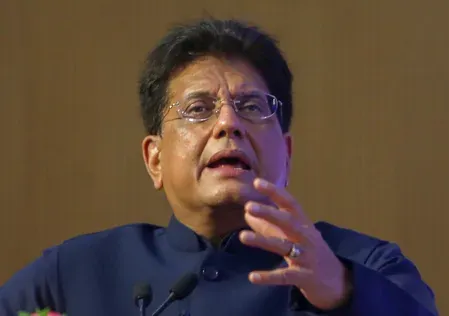
Turning up the heat on the opposition ahead of electoral cycles, Union Commerce and Industry Minister Piyush Goyal on Saturday, October 17, 2026, launched a sharp broadside against the Indian National Congress and the INDIA alliance, accusing them of running a campaign of falsehoods that harms every section of Indian society.
Posting in Hindi on X, Goyal wrote: 'सत्तालोभी कांग्रेस और INDI गठबंधन की करतूतों से जनता परेशान' — 'The public is troubled by the misdeeds of a power-hungry Congress and the INDI alliance.' He went further, asserting that Rahul Gandhi and the entire opposition were, through their 'false propaganda', causing harm to every section of society — and that India's people would never support such 'anti-national elements.'
The charge sheet against the INDIA bloc
Goyal's language was deliberately pointed. The phrase 'satta-lobhi' — power-hungry — frames the opposition not as a legitimate electoral challenger but as a faction driven purely by ambition. The accusation that their propaganda 'harms every class' is a sweeping claim designed to cut across caste, region, and income — the standard vocabulary of BJP's counter-messaging against Congress.
The INDIA alliance, formally launched in July 2023, was assembled to consolidate opposition votes against the BJP-led NDA government ahead of the 2024 Lok Sabha elections. It brought together Congress, regional heavyweights, and Left parties under one umbrella. Goyal's post suggests the ruling party views the coalition — or what remains of its coherence — as a continuing political threat worth attacking publicly.
Rahul Gandhi singled out by name
Naming Rahul Gandhi specifically, rather than referring only to 'the opposition,' is a deliberate choice. As Congress's most prominent face and former party president, Gandhi has been the BJP's primary rhetorical target for years. By calling him out alongside the broader alliance, Goyal keeps the focus squarely on the Congress's national leadership rather than allowing the INDIA bloc's regional partners to distance themselves from the critique.
This kind of direct, named attack on the Leader of Opposition via social media is now a routine feature of Indian political discourse — senior ministers using their personal X accounts to set the day's political narrative, bypassing traditional press conferences entirely.
BJP's 'anti-national propaganda' playbook
Branding opposition rhetoric as 'desh-virodhi' — anti-national — is a recurring motif in BJP communications. The framing serves a dual purpose: it questions the opposition's patriotic credentials while also positioning the ruling party as the sole guardian of national interest. Goyal, as Leader of the House in the Rajya Sabha and one of the BJP's most senior economic voices, carries institutional weight that amplifies such statements beyond ordinary political noise.
Whether the opposition fires back — and how — will set the tone for the next phase of this political exchange. In Indian politics, the war of social media narratives rarely pauses.
Point of View
Name-specific, and calibrated to dominate news cycles without requiring a press conference. Labelling the entire opposition 'anti-national' is a rhetorical escalation that goes beyond policy disagreement and is designed to delegitimise rather than debate. As Leader of the House in the Rajya Sabha, Goyal's voice carries parliamentary weight, making such posts more than personal opinion — they signal the party's approved attack line. The sustained targeting of Rahul Gandhi personally also reflects the BJP's strategic judgment that weakening Congress's national face remains its most effective electoral lever.
NationPress
17 Oct 2026
Frequently Asked Questions
What did Piyush Goyal say about Rahul Gandhi?
Goyal accused Rahul Gandhi and the entire opposition of spreading 'false propaganda' that harms every section of Indian society, calling them 'anti-national' elements whose support the Indian public would never endorse.
What is the INDIA alliance?
The INDIA alliance is a coalition of opposition parties, including Congress and several regional parties, formally launched in July 2023 to coordinate their strategy against the BJP-led NDA government in national elections.
Why is Piyush Goyal attacking the INDIA bloc?
Goyal's attack follows an established BJP pattern of countering opposition messaging on social media. He argues the Congress and INDIA alliance are driven by power hunger and use false narratives to harm public interest.
What does 'satta-lobhi' mean in Goyal's post?
'Satta-lobhi' is a Hindi phrase meaning 'power-hungry.' Goyal used it to characterise Congress's motivations as purely driven by the ambition to return to government rather than genuine public interest.
Has the opposition responded to Goyal's statement?
No formal opposition response to this specific post has been reported yet. Such exchanges between BJP leaders and Congress typically prompt counter-statements from party spokespersons.