Gujarat CM Bhupendra Patel hails PM Modi's 25 years in public service
Synopsis
Gujarat Chief Minister Bhupendra Patel used PM Modi's 25-year public service milestone to argue that India's biggest welfare schemes — from Ayushman Bharat to Swachh Bharat — trace their origins to Gujarat. It's a deliberate political framing: the state as incubator, and Modi as the man who took its model national.
Key Takeaways
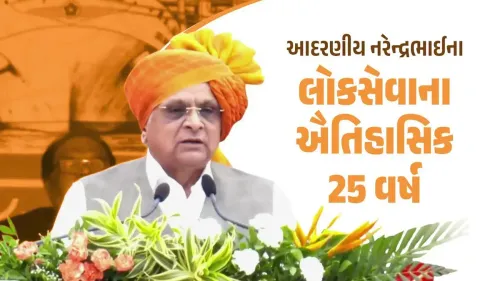
Gujarat CM Bhupendra Patel congratulated PM Narendra Modi on 25 years in public service at a press conference in Gandhinagar on 10 October 2025 .
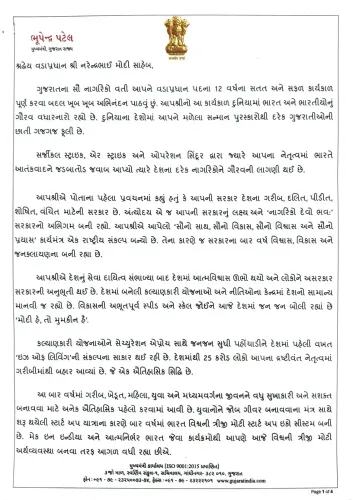
Patel drew direct parallels between Gujarat-origin schemes and national programmes, including MA Amrutam → Ayushman Bharat , Jyotigram → Deen Dayal Upadhyaya Gram Jyoti Yojana , and Nirmal Gujarat → Swachh Bharat Mission .
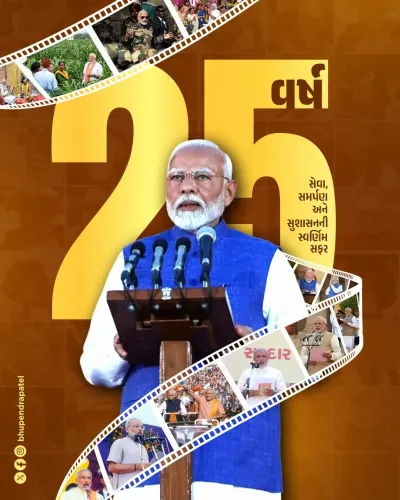
Modi's political journey began on 7 October 2001 when he took charge as Gujarat Chief Minister .
Gujarat has six semiconductor projects under the Semiconductor Mission , with ambitions to become a major semiconductor hub.
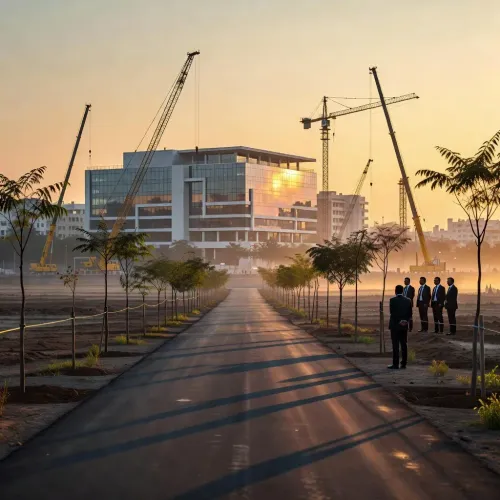
Patel highlighted GIFT City , the Ahmedabad-Dholera corridor , and the Khavda renewable energy park as pillars of Gujarat's future growth.
The remarks align with the BJP 's broader 'Gujarat model' political narrative ahead of continued third-term governance.
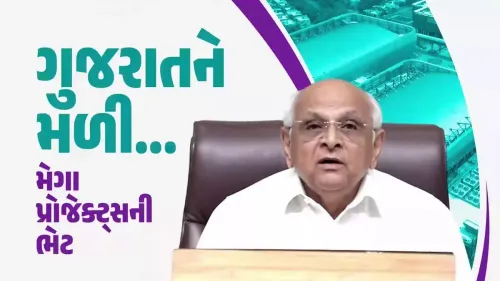
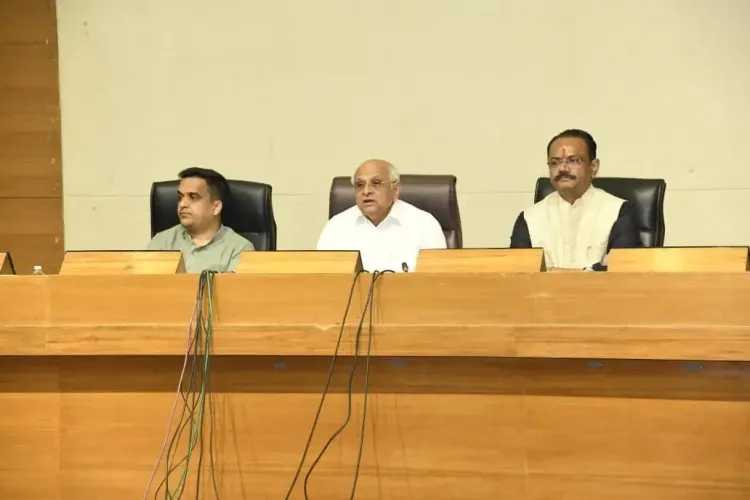
Gujarat Chief Minister Bhupendra Patel on Friday, 10 October 2025, congratulated Prime Minister Narendra Modi on completing 25 years in public service, asserting that several development initiatives first piloted in Gujarat under Modi's leadership had subsequently been scaled into flagship national programmes. Patel made the remarks at a press conference in Gandhinagar, flanked by Deputy Chief Minister Harsh Sanghavi and government spokesperson Minister Jitu Vaghani.
A Journey Rooted in 'Service, Not Power'
Patel traced Modi's public service career to 7 October 2001, when the Prime Minister assumed office as Gujarat Chief Minister. He said the journey had been defined by the guiding principles of 'Service, Not Power' and 'Nation First'. 'PM Modi had introduced a new approach to governance based on development and performance, with the mantra of Reform, Perform, Transform, and had sought to turn challenges into opportunities through a clear vision and decisive leadership,' Patel said.
He credited Modi's track record in Gujarat with giving him the national mandate in the 2014 Lok Sabha elections, arguing that the state's development model served as a template for governance at the Centre. As Prime Minister, Patel said, Modi had continued to function as the country's 'Pradhan Sevak', ushering in what he described as an era of performance-driven politics.
Gujarat Schemes That Became National Programmes
Drawing explicit parallels between state-level experiments and Union government schemes, Patel cited a string of examples. The MA Amrutam health scheme was expanded into Ayushman Bharat; Jyotigram Yojana — which improved electricity supply to villages — evolved into the Deen Dayal Upadhyaya Gram Jyoti Yojana; and Nirmal Gujarat became the foundation for the Swachh Bharat Mission.
He also pointed to Jal Mandir scaling into Amrit Sarovar, Kanya Kelavani expanding into Beti Bachao, Beti Padhao, and Khel Mahakumbh in Gujarat giving rise to the nationwide Khelo India programme. The Vibrant Gujarat Global Investment Summit, launched in 2003, was cited as a precursor to India's broader investor-outreach strategy.
Patel said Modi's development agenda extended well beyond physical infrastructure, encompassing housing, sanitation, financial inclusion, healthcare security and Garib Kalyan Melas — all aimed at delivering welfare benefits directly to citizens. He specifically highlighted PM-KISAN, the promotion of natural farming, the Ujjwala Yojana and efforts to increase women's participation in decision-making.
Gujarat's Infrastructure and Industrial Ambitions
Turning to future-facing projects, Patel underlined several large-scale initiatives expected to drive Gujarat's economic growth. These include the Ahmedabad-Dholera rail and expressway corridor, the Western Dedicated Freight Corridor, a railway locomotive manufacturing unit in Dahod and defence aircraft manufacturing in Vadodara.
He also highlighted the International Financial Services Centres Authority (IFSCA) and the India International Bullion Exchange at GIFT City. 'The hybrid renewable energy park at Khavda in Kutch, the CNG terminal in Bhavnagar and the expansion of the semiconductor sector are positioning Gujarat for growth in clean energy, advanced technology and manufacturing,' Patel said. He added that six semiconductor projects under the Semiconductor Mission were part of the state's efforts to emerge as a major semiconductor hub.
Global Responsibility and Viksit Bharat 2047
Patel also invoked India's response to the Covid-19 pandemic, saying Modi had demonstrated global responsibility by promoting indigenous vaccine development and supplying vaccines to other countries. He cited the principle of 'Vasudhaiva Kutumbakam' — the world as one family — as the philosophical underpinning of India's strengthened international standing under Modi.
Looking ahead, Patel said the Prime Minister's emphasis on self-reliance, innovation and skill development was creating opportunities for young people and contributing to the goal of 'Viksit Bharat-2047'. As the Modi government enters the next phase of its third term, the Gujarat model — and its claimed lineage to national policy — will continue to be a political reference point for the ruling Bharatiya Janata Party (BJP).
Point of View
With Modi as the connective tissue. The 'Gujarat model as national template' argument has been a cornerstone of BJP electoral messaging since 2014, and dusting it off at the 25-year mark reinforces the party's governance identity narrative ahead of state polls. What the framing elides is the independent policy evolution at the Centre and the contributions of other institutions. Still, the roll call of infrastructure bets — GIFT City, Dholera, Khavda, semiconductor clusters — signals that Gujarat's growth story is being actively curated as evidence of Viksit Bharat 2047 in action.
NationPress
10 Oct 2026
Frequently Asked Questions
Why is PM Modi's 25-year public service milestone significant?
PM Modi completed 25 years in public service, having first taken charge as Gujarat Chief Minister on 7 October 2001. The milestone marks a quarter-century of uninterrupted leadership — from state to national governance — making it a significant political and institutional reference point for the ruling BJP.
Which Gujarat schemes did Patel say were expanded into national programmes?
Patel cited MA Amrutam expanding into Ayushman Bharat, Jyotigram into the Deen Dayal Upadhyaya Gram Jyoti Yojana, Nirmal Gujarat into Swachh Bharat Mission, Jal Mandir into Amrit Sarovar, Kanya Kelavani into Beti Bachao Beti Padhao, and Khel Mahakumbh into the Khelo India programme.
What infrastructure projects did Gujarat CM highlight for the state's future growth?
Patel highlighted the Ahmedabad-Dholera rail and expressway corridor, the Western Dedicated Freight Corridor, a locomotive manufacturing unit in Dahod, defence aircraft manufacturing in Vadodara, GIFT City's IFSCA and India International Bullion Exchange, the Khavda hybrid renewable energy park in Kutch, a CNG terminal in Bhavnagar, and six semiconductor projects under the Semiconductor Mission.
What is the 'Gujarat model' that Patel referred to?
The 'Gujarat model' refers to a governance approach centred on infrastructure development, investor outreach — exemplified by the Vibrant Gujarat Global Investment Summit launched in 2003 — welfare delivery and performance-driven administration that Gujarat pursued under Modi's tenure as Chief Minister. Patel argued this model provided the blueprint for several national schemes after Modi became Prime Minister in 2014.
Who accompanied Gujarat CM Patel at the Gandhinagar press conference?
Deputy Chief Minister Harsh Sanghavi and government spokesperson Minister Jitu Vaghani were present alongside Chief Minister Bhupendra Patel at the press conference held in Gandhinagar on 10 October 2025.