Gujarat CMO Spotlights Natural Farming Push Under CM Bhupendra Patel
Synopsis
The Chief Minister's Office of Gujarat has spotlighted the state's natural farming drive under CM Bhupendra Patel, framing the shift away from chemical inputs as a public-health gift to citizens. The June 3, 2026 post, tagged #અગ્રેસર_ગુજરાત, ties farmer livelihoods to consumer well-being and signals continued policy emphasis on sustainable agriculture.
Key Takeaways
The Chief Minister's Office of Gujarat posted on June 3, 2026, highlighting natural farming under CM Bhupendra Patel.
The message frames encouragement of chemical-free cultivation as a public-health intervention for citizens.
Gujarat has implemented the central Paramparagat Krishi Vikas Yojana, launched in 2015, to build organic farming clusters.
Similar natural farming programmes have scaled in Andhra Pradesh and Madhya Pradesh.
Bhupendra Patel has led Gujarat as Chief Minister since September 2021.
Expansion of clusters, training camps and budget allocations are key indicators to watch.
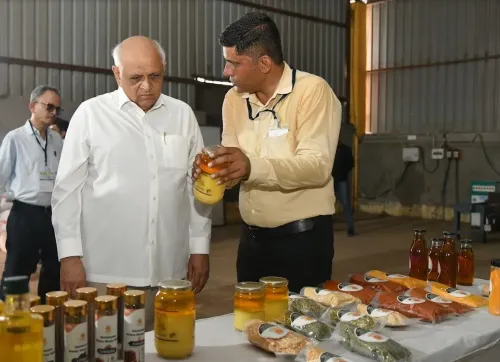
The Chief Minister's Office of Gujarat on June 3, 2026 highlighted the state's expanding natural farming drive, crediting Chief Minister Bhupendra Patel with steering a programme that encourages cultivators to shift away from chemical inputs. In a post on X under the hashtag #અગ્રેસર_ગુજરાત (Agresar Gujarat, or 'Gujarat Always Ahead'), the office framed the initiative as a public-health intervention as much as an agricultural one.
The post, accompanied by a video, declared 'Sada Agresar Gujarat' ('Always Ahead, Gujarat') and invited citizens to 'learn about Gujarat news where, under the leadership of Chief Minister Shri Bhupendrabhai Patel, farmers are being encouraged towards natural farming, gifting citizens a healthier life.'
Context
Natural farming — a low-input model that eschews synthetic fertilisers and pesticides in favour of cow-derived preparations, mulching and crop diversity — has been a recurring theme in Gujarat's agricultural messaging over the past several years. The state has hosted farmer training camps and cluster-based pilots intended to lower cultivation costs and improve soil health.
The latest communication from the CMO positions these efforts as a continuum rather than a single announcement, tying farmer livelihoods to consumer well-being. By foregrounding 'healthier living' for citizens, the office signals that the policy is being pitched to urban and rural audiences alike.
Policy backdrop
India's policy turn toward chemical-free cultivation gained formal traction with the Paramparagat Krishi Vikas Yojana, launched in 2015 to organise organic farming clusters and reduce dependence on synthetic fertilisers. Gujarat has been among the states implementing this scheme alongside its own outreach to cultivators.
The broader national arc has seen states such as Andhra Pradesh and Madhya Pradesh scale community-managed natural farming under central guidelines. Gujarat's framing — that encouraging farmers to adopt these methods is itself a delivery of public health — aligns with that pattern, where soil restoration, lower input costs and safer produce are presented as a single package.
Stakeholders and impact
The immediate stakeholders are Gujarat's farming households, for whom natural farming promises reduced spending on fertilisers and pesticides, though typically with a transition period during which yields may dip before stabilising. Extension services, training infrastructure and access to bio-inputs are the practical levers that determine how widely the model spreads.
For consumers, the pitch is access to produce grown without synthetic chemicals — a claim that depends on certification systems and supply-chain traceability to be credible at scale. Rural development agencies, agricultural universities and self-help groups typically form the connective tissue between policy intent and on-ground adoption.
For CM Bhupendra Patel, who has led the state government since September 2021, the natural farming theme dovetails with a wider portfolio of rural and agricultural messaging the administration has cultivated.
What's next
Observers will watch for the next round of cluster expansion, farmer training schedules and any fresh budgetary commitments in Gujarat's agricultural plan. Coordination with central schemes — and the degree to which natural farming graduates from pilot clusters to mainstream extension — will determine whether the messaging translates into measurable shifts in cropping practice.
The CMO's framing also suggests the state will continue to weave agriculture into a broader narrative of citizen welfare, blurring the traditional line between farm policy and public-health policy. How that narrative is backed by data on adoption, yields and consumer outcomes will shape its political and policy durability.
Point of View
As always, lies in extension capacity, certification credibility and whether transition-period yield risks are cushioned. Until adoption data and price-realisation outcomes surface, the messaging remains aspirational rather than evidentiary.
NationPress
17 Oct 2026
Frequently Asked Questions
What did the Gujarat CMO say about natural farming?
The Chief Minister's Office of Gujarat said that under CM Bhupendra Patel's leadership, farmers are being encouraged to adopt natural farming, framing this as a way of gifting citizens a healthier life. The post was shared on June 3, 2026, with the hashtag #અગ્રેસર_ગુજરાત.
What is natural farming and how is it different from organic farming?
Natural farming is a low-input cultivation model that avoids synthetic fertilisers and pesticides, relying instead on locally available inputs such as cow-derived preparations, mulching and crop diversity. While it overlaps with organic farming, it typically emphasises near-zero external inputs and lower cultivation costs.
Who is Bhupendra Patel?
Bhupendra Patel is the Chief Minister of Gujarat, in office since September 2021. He oversees the state's agricultural, rural development and broader governance policies.
What is the Paramparagat Krishi Vikas Yojana?
The Paramparagat Krishi Vikas Yojana is a central scheme launched in 2015 to promote organic farming through cluster-based development, with the aim of reducing chemical fertiliser use and improving soil health. Gujarat is among the states implementing it.
Which other Indian states promote natural farming?
Andhra Pradesh and Madhya Pradesh are among the states that have significantly scaled community-managed natural farming programmes under central guidelines, alongside Gujarat's own efforts.