Gujarat CMO Marks Yoga Day, Urges 'Way of Life' Pledge
Synopsis
The Chief Minister's Office of Gujarat marked International Day of Yoga on 21 June 2026, urging citizens to adopt yoga as a 'way of life' and crediting PM Modi's leadership for the practice's global recognition. The message tied individual wellness to state and national development goals.
Key Takeaways
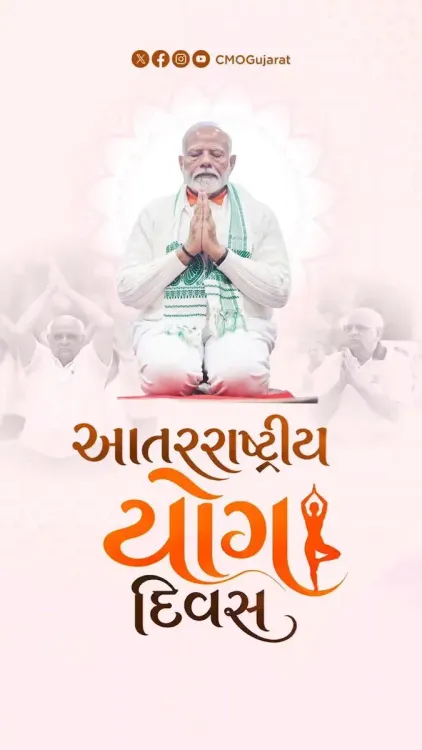
The Chief Minister's Office of Gujarat posted a Gujarati-language message on 21 June 2026 for International Day of Yoga .
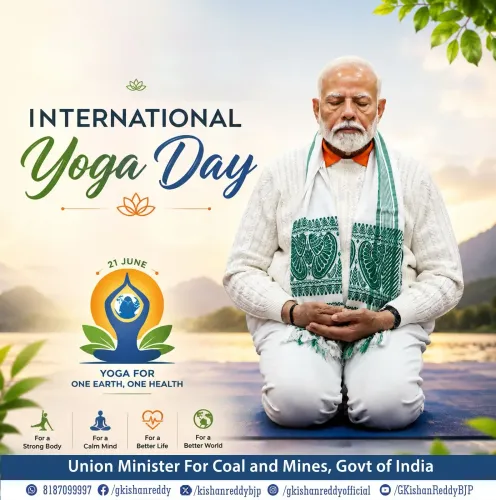
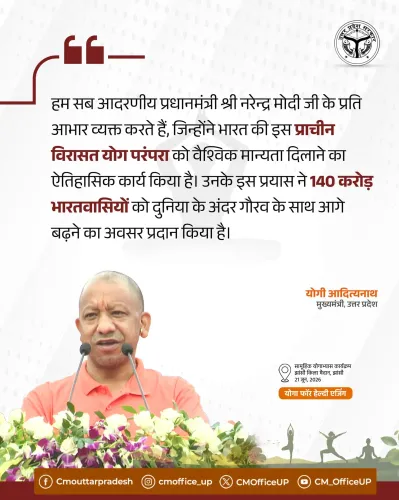
The post credited Prime Minister Narendra Modi for yoga's worldwide acceptance through his leadership since 2014 .
Citizens were urged to make yoga a 'way of life' for a healthy individual, a disease-free Gujarat , and a strong India .
PM Modi moved the UN General Assembly resolution in 2014 establishing 21 June as the International Day of Yoga.
The message reflects a broader central and state-government pattern of integrating yoga into public-health and soft-power policy.
The Chief Minister's Office of Gujarat marked International Day of Yoga on Sunday, 21 June 2026, calling on citizens to adopt yoga as a 'way of life' and contribute to building a healthy individual, a disease-free Gujarat, and a strong India.
Posting in Gujarati on the occasion, the CMO wrote: 'સૂર્યોદયના પ્રથમ કિરણ સાથે જ્યારે પ્રકૃતિની નવચેતના પ્રકાશિત થાય છે' — 'When nature's new consciousness illuminates with the first rays of sunrise, India's thousands-of-years-old yoga tradition fills our lives with new energy, light, and positivity.'
Context
The post directly credited Prime Minister Narendra Modi for yoga's global acceptance, stating that through his 'capable leadership and meaningful efforts,' the world now 'respectfully accepts this yoga practice that balances body, mind, and soul.' The message closed with a collective resolve: to make yoga a 'way of life' and contribute to 'સ્વસ્થ વ્યક્તિ, નિરોગી ગુજરાત અને સશક્ત ભારત' — 'a healthy individual, a disease-free Gujarat, and a strong India.'
Policy Backdrop
The observance traces directly to a 2014 initiative by Prime Minister Modi, who moved a resolution at the United Nations General Assembly to declare 21 June as International Day of Yoga. The resolution was adopted with record co-sponsorship, and the first global observance was held in 2015. Since then, the central government has woven yoga into both public-health messaging and international diplomacy, positioning the ancient practice as a pillar of India's soft-power outreach.
State governments across India have followed this lead, using the annual observance to reinforce preventive-health and wellness narratives at the grassroots level. Gujarat, as the home state of Prime Minister Modi, has historically been an active participant in national yoga campaigns.
Stakeholders and Impact
The message is directed at Gujarat's residents and the broader yoga-practising community. By framing yoga not merely as exercise but as a 'way of life,' the CMO's communication aligns with the central government's long-standing effort to integrate traditional Indian wellness practices into contemporary public-health goals. The emphasis on a 'disease-free Gujarat' signals continued state-level interest in preventive healthcare as a policy priority.
Yoga practitioners, school students, and health-centre users in the state stand to be the primary beneficiaries if the messaging translates into programmatic rollouts — such as structured yoga modules in schools or community health centres.
What's Next
The broader pattern suggests that state-level participation figures, ministerial statements, and institutional events tied to the International Day of Yoga will continue to grow year on year. Observers will watch whether Gujarat formalises new schemes — such as yoga integration in school curricula or public-health centres — in the months following the observance. The framing of yoga as a tool for national development, repeated consistently by both the Centre and state governments, points to its enduring place in India's health and soft-power policy architecture.
Point of View
High-visibility platform to align traditional wellness culture with contemporary governance narratives. The 'disease-free Gujarat' framing is notable: it subtly elevates the observance from ceremonial to programmatic, hinting at preventive-health ambitions without committing to specific policy. Whether that rhetoric translates into measurable state-level investment in yoga infrastructure will be the real test of intent.
NationPress
20 Sept 2026
Frequently Asked Questions
When is International Day of Yoga 2026?
International Day of Yoga 2026 falls on Sunday, 21 June 2026 . It is observed annually on 21 June, a date established by the UN General Assembly following a proposal by PM Narendra Modi in 2014.
Who proposed International Day of Yoga at the United Nations?
Prime Minister Narendra Modi proposed the resolution at the UN General Assembly in 2014 , and the first International Day of Yoga was observed on 21 June 2015 .
What did the Gujarat CMO say on Yoga Day 2026?
The Chief Minister's Office of Gujarat posted a Gujarati message urging citizens to adopt yoga as a 'way of life' and pledging to contribute to a 'healthy individual, disease-free Gujarat, and strong India.' It credited PM Modi for yoga's global acceptance.
Why is 21 June celebrated as Yoga Day?
21 June is the summer solstice, the longest day of the year in the Northern Hemisphere, which holds special significance in many spiritual traditions. The UN General Assembly adopted this date in 2014 for the International Day of Yoga.
How is Gujarat promoting yoga as a public health initiative?
The Gujarat CMO has framed yoga as a tool for building a 'disease-free Gujarat,' signalling state-level interest in preventive healthcare. Observers expect this to translate into yoga modules in schools and community health centres, though no specific new scheme was announced in the 2026 Yoga Day message.