Gujarat doubles land compensation for power transmission projects, scraps jantri formula
Synopsis
Gujarat has scrapped its jantri-based land compensation formula for power transmission projects, replacing it with twice the prevailing market value — paid upfront in one shot. A new Market Rate Committee will determine valuations with farmer representation, and even those who received earlier payouts on ongoing projects stand to benefit.
Key Takeaways
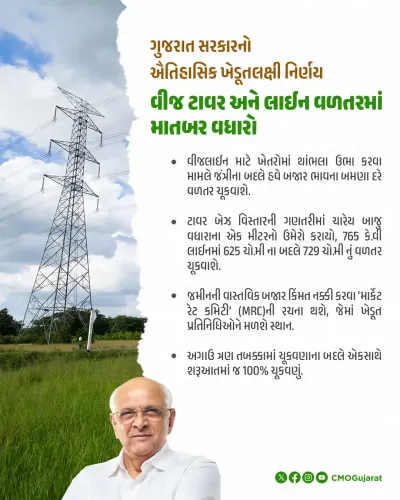
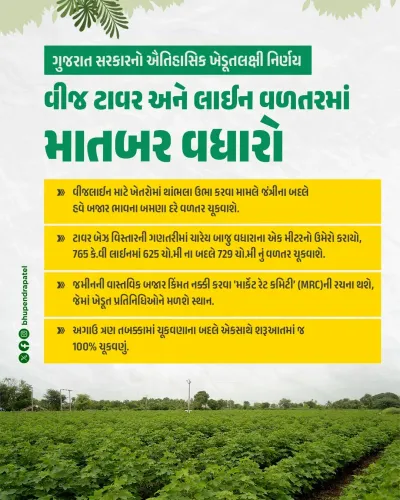
Gujarat government replaced the jantri-based compensation formula with twice the prevailing market value for agricultural land affected by power transmission projects.
Compensation will now be paid 100 per cent upfront in a single payment, replacing the earlier three-stage instalment model.
Compensable area for tower bases expanded by one metre on all four sides ; for a 765 kV line , this raises the area from 625 sq m to 729 sq m .
A Market Rate Committee (MRC) including the District Collector, farmer representatives, and authorised valuers will determine land prices transparently.
Right of Way corridor compensation set at 30% (rural), 45% (municipal), and 60% (municipal corporation) of market value.
Farmers who already received compensation on ongoing projects are also eligible for benefits under the revised framework.
The Gujarat government on 4 July 2025 announced a sweeping overhaul of its compensation policy for agricultural land affected by power transmission infrastructure, replacing the decades-old jantri-based valuation formula with a market-value-linked framework that pays farmers twice the prevailing market rate — and upfront in a single payment. The revision, declared from Gandhinagar, is among the most significant pro-farmer policy shifts in the state's power sector in recent years.
Key Changes in the Revised Policy
Under the earlier framework, compensation for transmission lines passing through agricultural land was pegged at 200 per cent of the jantri value — the government-notified benchmark rate, widely criticised for lagging actual market prices. The revised policy replaces this with compensation at twice the prevailing market value of the land, a shift that is expected to significantly increase payouts in areas where market prices have outpaced jantri valuations.
The calculation area for land occupied by electricity transmission towers has also been expanded. Previously, only the actual measured foundation area was compensable. Under the new rules, an additional one metre on all four sides of the tower base will be included. For a 765 kV transmission line, this means the compensable area rises from 625 square metres to 729 square metres.
Upfront Payment Replaces Instalment Model
A critical change concerns the timing of disbursements. Landowners previously received compensation in three tranches — 40 per cent at the foundation stage, another 40 per cent during tower erection, and the remaining 20 per cent after transmission wires were installed. Under the revised policy, eligible landowners will receive 100 per cent of the compensation in a single upfront payment, eliminating the financial uncertainty associated with staggered payouts.
Market Rate Committee to Determine Land Value
To determine land values under the new framework, the state government will constitute a Market Rate Committee (MRC). The committee will include the District Collector, representatives of landowners, the transmission service provider, affected farmers, and authorised market valuers representing farmers. Officials said the committee is intended to ensure that market values are determined 'in a transparent and impartial manner.'
The revised policy also specifies compensation for the Right of Way (RoW) corridor through which transmission lines pass. Based on the MRC-determined market value, compensation will be paid at 30 per cent in rural areas, 45 per cent in municipal areas, and 60 per cent in municipal corporation areas.
Political Leadership and Farmer Consultations
The decision was taken under the leadership of Chief Minister Bhupendra Patel and the guidance of Deputy Chief Minister Harsh Sanghavi, following consultations with farmers' organisations. Agriculture Minister Jitu Vaghani, Energy Minister Rushikesh Patel, and Minister of State for Energy Kaushik Vekariya were also involved in the deliberations. The state government said the revision was prompted by representations from multiple farmers' organisations seeking a more realistic basis for compensation.
Retroactive Benefits and Scope
Notably, farmers who had already received compensation under the earlier policy but whose transmission line projects are still under execution will also be eligible for benefits under the revised framework. The policy is expected to apply to power transmission projects involving electricity lines and towers across Gujarat. This comes amid a broader national push to accelerate grid expansion, making fair land compensation increasingly critical to project timelines.
With the MRC model set to be constituted and the upfront payment mechanism in place, the effectiveness of the policy will ultimately depend on how swiftly and transparently market valuations are conducted across districts.
Point of View
Making the old formula a quiet subsidy for transmission developers at farmers' expense. The upfront payment model is equally significant: staggered payouts had effectively made farmers involuntary creditors of infrastructure projects. The real test now is the Market Rate Committee — its composition looks balanced on paper, but District Collectors chairing such bodies have historically tilted toward project timelines over farmer interests. Whether the MRC delivers genuinely independent valuations, or becomes a procedural formality, will determine if this policy reform holds up beyond the press release.
NationPress
2 Oct 2026
Frequently Asked Questions
What is Gujarat's new land compensation policy for power transmission projects?
The Gujarat government has replaced the jantri-based compensation formula with a new policy that pays farmers twice the prevailing market value for agricultural land used for power transmission lines and towers. All compensation is now paid upfront in a single payment rather than in instalments.
What was wrong with the old jantri-based compensation formula?
The jantri value is a government-notified benchmark rate that often lags actual market prices, meaning farmers received payouts well below what their land was worth. Farmers' organisations had made representations to the state government seeking a more realistic basis for compensation, which prompted the revision.
Who will determine the market value of land under the new policy?
A Market Rate Committee (MRC) will be constituted for this purpose, comprising the District Collector, representatives of landowners, the transmission service provider, affected farmers, and authorised market valuers representing farmers. The government says the MRC is designed to ensure transparent and impartial valuation.
Are farmers who already received compensation under the old policy eligible for the new benefits?
Yes. The state government has clarified that farmers who received compensation under the earlier policy but whose transmission line projects are still under execution will also be eligible for benefits under the revised framework.
How does the Right of Way corridor compensation work under the new policy?
Based on the market value determined by the MRC, Right of Way corridor compensation will be paid at 30 per cent of market value in rural areas, 45 per cent in municipal areas, and 60 per cent in municipal corporation areas.