Gujarat Implements Stamp Duty Cuts for Inherited Farm Land and Extends Tenant Purchase Deadline
Synopsis
In a transformative development, Gujarat's government has reduced stamp duty on inherited agricultural land transactions and extended the purchase deadline for tenant farmers. This initiative aims to ease financial burdens and simplify ownership processes for rural communities.
Key Takeaways
Stamp Duty Reduction: Rs 300 for inheritance-related agricultural land transactions.
Deadline Extension: Tenant farmers can now secure ownership until December 31, 2026.
Focus on Legal Clarity: The reforms aim to simplify property division and reduce disputes.
Support for Farmers: Initiatives driven by community feedback and farmer organizations.
Encouraging Formal Transactions: The government seeks to improve legal documentation for land dealings.
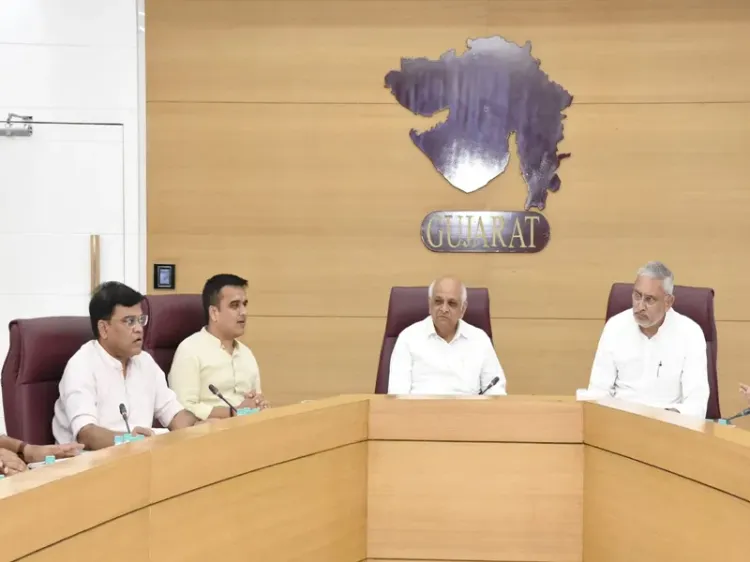
Gandhinagar, March 27 (NationPress) In a significant move, Gujarat Chief Minister Bhupendra Patel announced a substantial reduction in stamp duty applicable to inheritance-related transactions of agricultural land. Additionally, the state has extended the deadline for tenant farmers to obtain ownership rights. These initiatives are designed to alleviate legal complexities and financial burdens in rural communities.
The government will now impose a nominal stamp duty of Rs 300 for certain cases involving inherited agricultural land, providing relief from the current jantri-based stamp duty regulations.
This new regulation pertains to transactions within families, covering direct line heirs and, in their absence, collateral heirs.
According to the revised guidelines, if one or more heirs among joint holders relinquish their rights to one or more other heirs, regardless of whether this occurs in single or multiple phases, a stamp duty of Rs 300 will apply to each relinquishment deed.
Similarly, when the names of heirs are updated in the record of rights—whether for direct line heirs or collateral heirs when direct heirs are deceased—a stamp duty of Rs 300 will be charged for each entry.
In instances where jointly recorded holders partition inherited property over time, including direct line heirs or applicable collateral heirs, each partition deed will incur a stamp duty of Rs 300.
This same rate will be enforced for transactions involving only collateral heirs when no direct line heirs are available, covering rights relinquishment, name entries during the lifetime, and partitions, with each document subject to the fixed duty.
The Chief Minister stated that this decision was made following requests from community representatives and farmer organizations.
“By alleviating the burden of jantri-based stamp duties, the state government aspires to lighten the financial strain on farmers and streamline inheritance-related land transactions,” he mentioned.
He emphasized that simplifying property division among family members would aid in minimizing disputes and legal confrontations.
Officials noted that this initiative is anticipated to promote formal documentation of transactions, which often remain unregistered due to high stamp duty, thus enhancing legal clarity.
The government highlighted that improved records of rights would diminish confusion regarding land ownership and reduce conflicts while also expediting processes.
Moreover, enhancing the ease of transactions is expected to foster a better business environment.
In a related development, the state government has prolonged the deadline for tenant farmers, referred to as Ganotiyas, to settle the purchase price of land under the Gujarat Tenancy and Agricultural Lands Act, 1948.
The new deadline has been pushed back by one year to December 31, 2026, as per Section 32.
Under Section 32G of the Act, the purchase price determined by the Mamlatdar and the Agricultural Tribunal must be paid within a specified timeframe for the farmer to be officially recognized as the legal owner.
Authorities indicated that there were cases where farmers could not meet the payment deadline due to lack of awareness, resulting in their inability to attain legal ownership.
“In such instances, farmers encounter challenges in selling agricultural land or using it for non-agricultural purposes. Considering the feedback received and the number of pending cases as of December 31 last year, the state has opted for a more accommodating stance, extending the deadline to December 2026,” officials explained.
This extension is expected to allow eligible farmers the opportunity to complete their payments, regularize their ownership, and navigate the legal and administrative challenges associated with incomplete transactions.
Point of View
It's crucial to recognize the significance of Gujarat's recent policy changes. By reducing stamp duties and extending deadlines for tenant farmers, the government is addressing vital concerns within the agricultural community, promoting legal clarity and easing financial pressures. These reforms reflect a proactive approach to rural development and land ownership rights.
NationPress
16 Sept 2026
Frequently Asked Questions
What is the new stamp duty for inherited agricultural land?
The new stamp duty is a nominal fee of Rs 300 for specified cases involving inherited agricultural land.
Who does the stamp duty reduction apply to?
It applies to internal transactions among heirs, including direct line heirs and collateral heirs.
What is the new deadline for tenant farmers to secure ownership?
The deadline has been extended to December 31, 2026.
Why was the deadline for tenant farmers extended?
The extension was made to accommodate farmers who faced challenges in meeting the original payment schedule due to lack of awareness.
What impact will these changes have on farmers?
These changes aim to reduce financial burdens, simplify inheritance processes, and promote formal documentation of land transactions.