Haryana CEO refutes 2024 Assembly poll discrepancy claims in 51 seats
Synopsis
The Haryana CEO has pushed back against a Reporters' Collective report alleging vote-count mismatches in 51 Assembly seats, releasing ECI index card data for Kaithal to show how postal votes and procedural deductions account for the figures cited as discrepancies. The clarification goes to the heart of a recurring trust deficit around India's electoral data.
Key Takeaways
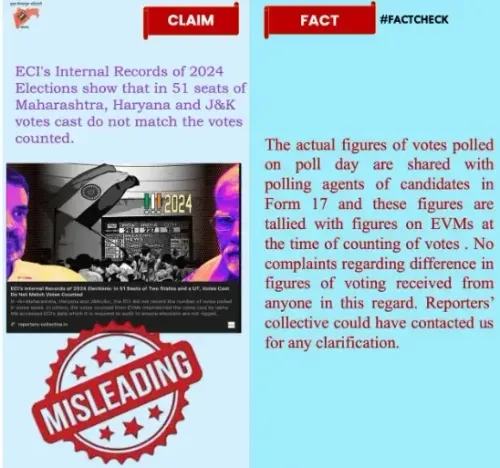
The Haryana CEO declared a media report alleging vote discrepancies in 51 Assembly constituencies during the 2024 elections as misleading.
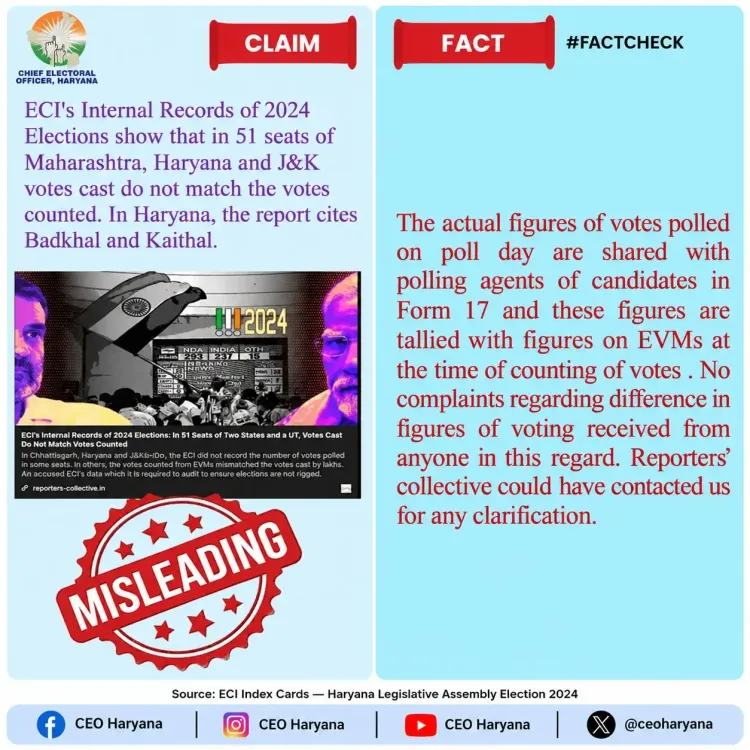
The report by Reporters' Collective claimed internal ECI records showed mismatches in seats across Haryana , Maharashtra , and Jammu and Kashmir .
The CEO clarified that actual polling figures are shared with candidates' agents via Form 17 and tallied against EVM data at counting.
For Kaithal constituency, total votes polled including postal ballots were 1,68,851 against 2,23,449 registered electors — not inflated as alleged.
After deducting 512 test/rejected votes and adding 1,427 valid postal votes, total valid votes polled stood at 1,68,200 .
The CEO noted no complaints about vote-figure discrepancies were received from any candidate or agent.
The Chief Electoral Officer (CEO) of Haryana has dismissed as misleading a media report that alleged discrepancies between votes polled and votes counted in 51 Assembly constituencies during the 2024 Assembly elections, clarifying that actual polling figures were duly shared with candidates' polling agents and subsequently matched against data recorded on Electronic Voting Machines (EVMs).
What the Report Claimed
The report, published by Reporters' Collective, alleged that internal records of the Election Commission of India (ECI) showed mismatches between votes cast and votes counted across 51 seats spanning Maharashtra, Haryana, and Jammu and Kashmir. The report specifically named Badkhal and Kaithal constituencies in Haryana as examples where such discrepancies were identified.
CEO's Clarification on the Procedure
Responding through an official fact-check statement on its social media platforms, the CEO's office explained that actual polling figures on election day are shared with polling agents of all candidates through Form 17. These figures are then cross-verified against EVM data at the time of counting, leaving no room for undetected divergence.
'No complaints regarding differences in the figures of votes received from anyone in this regard. Reporters' Collective could have contacted us for any clarification,' the CEO's office said.
Kaithal Constituency: The Numbers Explained
To illustrate its position, the CEO's office cited the official ECI index card for the Kaithal Assembly constituency. According to that record, Kaithal had 2,23,449 registered electors. Votes polled through EVMs stood at 1,67,285, and an additional 1,566 valid postal votes were recorded, bringing the total votes polled — including postal ballots — to 1,68,851.
The CEO's office said the media report had attempted to mislead readers by claiming the ECI counted 1,67,070 more votes than were actually cast. It maintained that this figure failed to account for the complete tally, including postal ballots. After deducting 512 votes from EVM figures on account of test votes, rejected votes, and other procedural exclusions, and adding 1,427 valid postal votes counted, the total valid votes polled came to 1,68,200.
Broader Context and ECI Transparency
This clarification comes at a time when questions about election data accuracy have surfaced with increasing regularity following state assembly polls. Notably, challenges to EVM-based counting and demands for greater data transparency have been raised by various opposition parties since the 2019 general elections. The CEO's office reiterated that official polling records as well as figures published on the ECI website provide the accurate account of votes polled in each constituency.
The authority's prompt fact-check response signals an intent to counter misinformation on electoral processes before it gains wider traction, particularly ahead of future election cycles.
Point of View
But the speed with which it was issued — and the absence of a formal complaint from any candidate — raises a broader question: why are these clarifications reactive rather than pre-emptive? The ECI publishes final vote tallies, but the granular Form 17 data that would allow independent verification remains largely inaccessible to journalists and civil society. If the numbers genuinely add up, proactive publication of constituency-level breakdowns — including postal ballot figures — would make such 'misleading' narratives far harder to construct in the first place. The trust deficit around Indian election data is not purely the opposition's creation; it is also an institutional transparency gap.
NationPress
11 Nov 2026
Frequently Asked Questions
What discrepancies did the media report allege in the 2024 Haryana Assembly elections?
The report by Reporters' Collective alleged that internal ECI records showed mismatches between votes cast and votes counted in 51 Assembly seats across Haryana, Maharashtra, and Jammu and Kashmir, specifically naming Badkhal and Kaithal constituencies in Haryana.
How did the Haryana CEO respond to the discrepancy allegations?
The Haryana CEO issued an official fact-check stating the report was misleading. It explained that actual polling figures are shared with candidates' polling agents via Form 17 and tallied against EVM data at the time of counting, and that no complaints about figure differences were received from any candidate or agent.
What do the Kaithal constituency figures actually show?
According to the ECI index card for Kaithal, the constituency had 2,23,449 registered electors. EVM votes polled totalled 1,67,285, and 1,566 valid postal votes were added, giving a total of 1,68,851 votes polled. After accounting for 512 deducted test and rejected votes and 1,427 valid postal votes counted, total valid votes came to 1,68,200.
Why do total votes polled sometimes differ from final counted votes?
The difference arises from procedural deductions — such as test votes cast before polling begins, rejected votes, and tendered votes — as well as the separate counting of postal ballots. These adjustments are standard ECI procedure and are recorded in the official index card for each constituency.
Where can voters and journalists find official election data to verify these figures?
The CEO's office stated that official polling records and all relevant figures are publicly available on the ECI website, which is considered the authoritative source for constituency-level vote tallies.