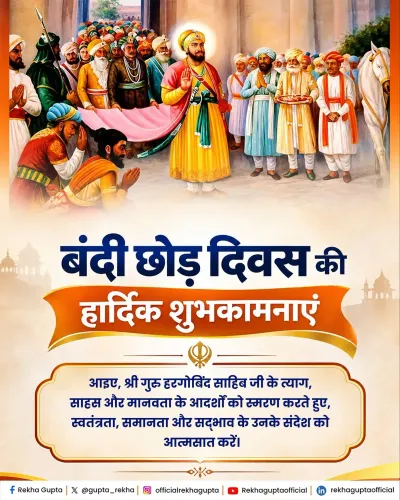
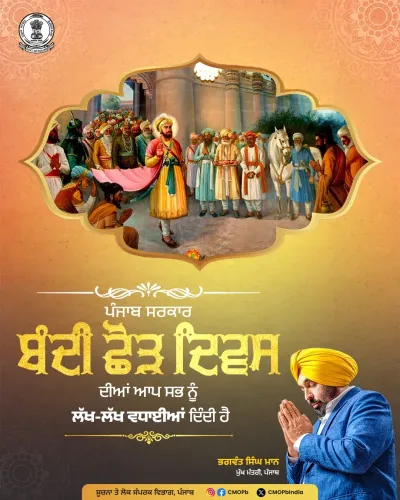
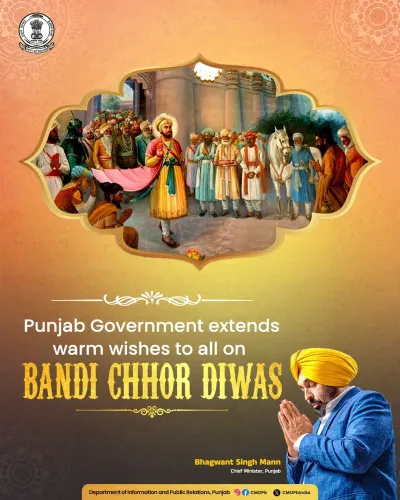
Haryana CMO extends Bandi Chhor Divas wishes to Sikh community

Synopsis
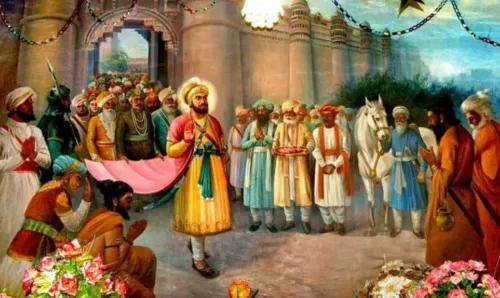
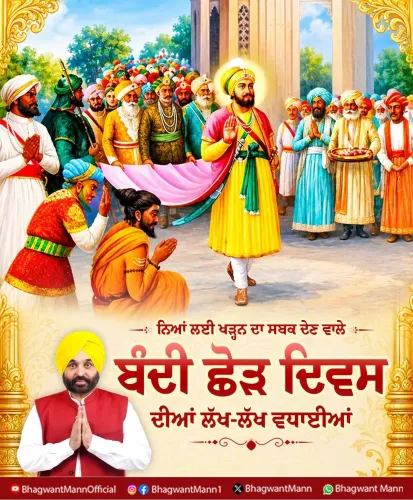
The Chief Minister's Office of Haryana offered 'lakh-lakh' congratulations to the Sikh congregation on Bandi Chhor Divas, the festival commemorating Guru Hargobind's 1619 liberation of himself and 52 fellow prisoners from Gwalior Fort under Mughal Emperor Jahangir.
Key Takeaways
The Chief Minister's Office of Haryana posted official greetings on Bandi Chhor Divas on 8 November 2026 .
Bandi Chhor Divas marks the 1619 release of Guru Hargobind , the Sixth Sikh Guru, from Gwalior Fort by Mughal Emperor Jahangir .
Guru Hargobind secured the freedom of 52 other prisoners alongside himself, which is the moral centrepiece of the festival.
The festival typically coincides with Diwali on the Hindu lunar calendar, making it a doubly significant occasion in north India.
Haryana has strong historical and demographic ties to the Sikh community, with several historic gurdwaras located across the state.
A festival rooted in a 17th-century act of liberation — and one that resonates with millions of Sikhs across India — was acknowledged on Sunday, 8 November 2026 by the Chief Minister's Office of Haryana, which extended warm greetings to the entire sangat (congregation) on the occasion of Bandi Chhor Divas.
The post, shared in Hindi, reads: 'Bandi Chhor Divas ki samast sangat ko lakh-lakh badhaiyaan evam hardik shubhkamnaayein' — 'A hundred thousand congratulations and heartfelt good wishes to the entire congregation on Bandi Chhor Divas.'
The history behind the day of liberation
Bandi Chhor Divas — literally 'the day of the prisoner's liberation' — commemorates one of the most pivotal moments in Sikh history: the release in 1619 of Guru Hargobind, the Sixth Sikh Guru, from Gwalior Fort. Mughal Emperor Jahangir had imprisoned Guru Hargobind, and legend holds that upon his release he insisted that 52 other Hindu rajas held captive alongside him be freed as well. It is this act of communal compassion — refusing freedom for himself alone — that the day celebrates. Guru Hargobind was also the Guru who introduced the doctrine of miri-piri, the twin swords symbolising temporal and spiritual authority united in one person — a cornerstone of Sikh theology that the Bandi Chhor story embodies in action.Haryana's deep ties to Sikh tradition
Haryana carries significant weight in the Sikh world. The state is home to historic gurdwaras linked to the Sikh Gurus, and its sizable Sikh community observes Bandi Chhor Divas with prayers, langar (community meals), and illuminations that often coincide with Diwali — the two festivals share the same lunar date in most years, lending the day a doubly festive character across north India. State governments across India regularly issue greetings on major religious occasions as a mark of social inclusion, and Haryana — given its demographic and historic ties to the Sikh faith — has consistently recognised such observances through official channels. The liberation of Guru Hargobind from Gwalior Fort was not just a moment of personal deliverance. It was a declaration that freedom is indivisible. That message, four centuries old, is what the Chief Minister's Office of Haryana put back into the public conversation today.Point of View
Making Sikh festival acknowledgements a consistent feature of its governance communication. The timing also reflects how north Indian state governments use the Diwali-Bandi Chhor Divas overlap as a moment to project inclusive symbolism across Hindu and Sikh constituencies simultaneously. At a broader level, the gesture fits a nationwide pattern of chief ministers' offices using social media to maintain real-time cultural presence with diverse communities. It signals institutional continuity in Haryana's relationship with Sikh religious tradition, with no discernible policy shift implied.
NationPress
8 Nov 2026
Frequently Asked Questions
What is Bandi Chhor Divas?
Bandi Chhor Divas is a Sikh festival commemorating the release of Guru Hargobind, the Sixth Sikh Guru, from Gwalior Fort in 1619 along with 52 other prisoners held by Mughal Emperor Jahangir. The name means 'the day of the prisoner's liberation.'
Why does Bandi Chhor Divas coincide with Diwali?
The two festivals share the same date on the lunar calendar in most years, as Guru Hargobind's return to Amritsar reportedly occurred on the same night as Diwali, leading Sikhs to celebrate both occasions together with lights and prayers.
What did Guru Hargobind do at Gwalior Fort?
Guru Hargobind, the Sixth Sikh Guru, was imprisoned at Gwalior Fort by Mughal Emperor Jahangir. When offered his freedom, he refused to leave unless 52 Hindu rajas imprisoned with him were also released, and Emperor Jahangir granted this request.
What is the significance of Bandi Chhor Divas for Haryana?
Haryana has a significant Sikh population and is home to historic gurdwaras linked to the Sikh Gurus, making Bandi Chhor Divas an important occasion for the state government to acknowledge through official greetings.
What does 'miri-piri' mean in Sikh tradition?
'Miri-piri' refers to the doctrine introduced by Guru Hargobind symbolising the union of temporal (worldly) and spiritual authority, represented by two swords, which remains a foundational concept in Sikh theology.