Is Heavy Smog Covering Delhi-NCR Signaling a Health Crisis?
Click to start listening
Synopsis
As Delhi-NCR grapples with a severe smog crisis, air quality plummets to alarming levels. This article explores the implications for public health, the factors contributing to this environmental issue, and what residents can do to protect themselves.
Key Takeaways
- Delhi-NCR's AQI has reached alarming levels, posing serious health risks.
- Children and the elderly are particularly vulnerable to pollution-related health issues.
- Environmental factors contributing to smog include stagnant winds, emissions, and crop burning.
- Authorities recommend limiting outdoor activities and wearing masks.
- Awareness and action are essential to combat air pollution in urban areas.
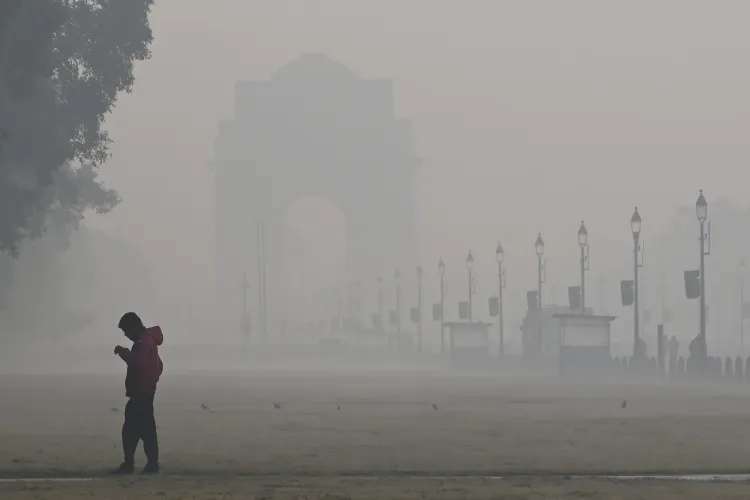
New Delhi, Dec 13 (NationPress) A thick layer of smog has blanketed the National Capital Region (NCR) on Saturday, causing air quality to plummet to alarming levels and raising significant public health alarms.
The overall Air Quality Index (AQI) for Delhi has reached 387, firmly placing it in the “very poor” category, indicating serious health risks, especially for children, the elderly, and individuals with respiratory conditions.
Throughout the week, air quality has progressively worsened.
On Tuesday, the city recorded an AQI of 282, categorized as “poor,” which was followed by a reading of 259 on Wednesday. Pollution levels sharply escalated, hitting 307 on Thursday and reaching 349 on Friday, edging dangerously close to the “severe” threshold.
Environmental specialists have linked this decline in air quality to a mix of stagnant winds, vehicle emissions, industrial operations, and seasonal factors, notably crop residue burning in nearby states.
Much of the National Capital Territory is currently facing hazardous air quality.
As per official reports, up to 18 localities recorded an AQI exceeding 400, categorizing them as “severe.”
Wazirpur was the most affected area, with an AQI of 443, closely trailed by Jahangirpuri at 439 and Vivek Vihar at 437. Other severely polluted regions include Rohini and Anand Vihar (434 each), Ashok Vihar (431), Sonia Vihar and Delhi Technological University (427 each), Narela (425), Bawana (424), Nehru Nagar (421), Patparganj (419), ITO (417), Punjabi Bagh (416), Mundka (415), Burari Crossing (413), Chandni Chowk (412), and DU North Campus (401).
Health professionals caution that long-term exposure to such high pollution levels can lead to aggravated asthma, reduced lung function, cardiovascular strain, and irritation of the eyes and throat. Authorities are advising residents to limit outdoor activities, wear protective masks, and adhere to guidelines issued under the Graded Response Action Plan (GRAP), which may be tightened if conditions do not improve.
Meanwhile, Delhi is currently experiencing cool and cloudy weather, with temperatures around 10 degrees Celsius. The minimum temperature is predicted to drop to 8 degrees Celsius later tonight.
Although conditions are relatively milder than what is typically expected in mid-December, dense fog during early mornings and late evenings has compounded the difficulties for commuters. Meteorological officials have indicated that colder weather is likely to set in as the month progresses, which may further worsen air quality if wind speeds remain low.
Point of View
I emphasize the urgent need for awareness and action regarding the alarming air quality in Delhi-NCR. This ongoing crisis demands a collective response from authorities, experts, and residents alike. We must prioritize public health and advocate for sustainable solutions to combat air pollution, ensuring a safer environment for all.
NationPress
13/12/2025
Frequently Asked Questions
What is the current AQI in Delhi?
The current AQI in Delhi is 387, categorized as 'very poor'.
What health risks are associated with high AQI levels?
High AQI levels can lead to aggravated asthma, reduced lung function, cardiovascular issues, and irritation of the eyes and throat.
What measures can residents take to protect themselves?
Residents should limit outdoor activities, wear protective masks, and adhere to advisories issued under the Graded Response Action Plan (GRAP).
Why is the air quality worsening in Delhi?
The worsening air quality is attributed to stagnant winds, vehicular emissions, industrial activities, and seasonal crop burning in neighboring states.
What areas in Delhi are most affected by pollution?
Areas like Wazirpur, Jahangirpuri, and Vivek Vihar are among the most affected, with AQI readings exceeding 400.