Himachal CMO: Healthy citizens are state's biggest strength
Synopsis
The Chief Minister's Office of Himachal Pradesh has reiterated that healthy citizens form the state's biggest strength, pledging continued work to extend better health facilities to every needy resident and prevent financial distress during treatment, in line with broader state and central health coverage frameworks.
Key Takeaways
The Himachal CMO posted on 3 June 2026 framing citizen health as the state's biggest strength.
Government pledged to reach every needy resident with better health facilities.
Message emphasised preventing financial hardship during medical treatment.
Aligns with Ayushman Bharat PM-JAY, offering up to Rs 5 lakh family cover since 2018.
Sukhvinder Singh Sukhu has led the Congress government in the state since December 2022.
Budget 2026-27 allocations and hospital empanelment expansion will be the next signposts.
The Chief Minister's Office of Himachal Pradesh on Wednesday, 3 June 2026, reaffirmed the state government's commitment to expanding healthcare access and shielding residents from out-of-pocket medical expenses. In a post published from Shimla, the office framed citizen health as the foundation of a prosperous state and pledged continued work to reach every needy resident.
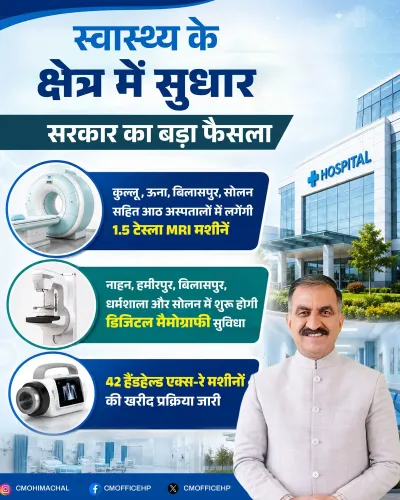
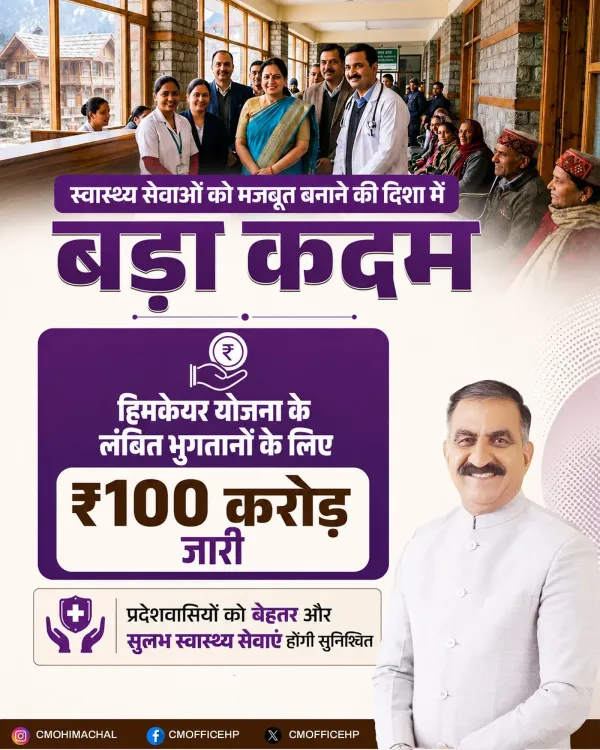
The post stated, in translation from Hindi, that 'healthy citizens are the biggest strength of a prosperous state' and that the government is working continuously to ensure that 'har jarooratmand vyakti' (every needy person) receives better health facilities without facing financial hardship during treatment. The accompanying image marked a routine communication from the state's apex executive office.
Context
Himachal Pradesh, governed by a Congress administration led by Chief Minister Sukhvinder Singh Sukhu since December 2022, has consistently flagged healthcare delivery in difficult Himalayan terrain as a governance priority. The hill state spans remote districts where distance to tertiary care centres has long shaped policy thinking around mobile medical units and district-level hospital empanelment.
The latest message from the CMO does not announce a new scheme but reiterates a broader political positioning: that the state will keep absorbing costs that would otherwise fall on low-income households during hospitalisation.
Policy backdrop
The framing dovetails with two long-running central frameworks. The Ayushman Bharat Pradhan Mantri Jan Arogya Yojana, launched in 2018, offers up to Rs 5 lakh in annual hospitalisation cover per family for secondary and tertiary care for targeted beneficiaries. The National Health Mission, operational since 2005, has funded primary healthcare infrastructure and ASHA workers in hill districts.
India's National Health Policy 2017 set out a long-term path towards universal health coverage and higher public health spending. States, particularly those run by the Congress after 2022, have increasingly layered their own top-up insurance products over PM-JAY to plug coverage gaps and reduce catastrophic spending.
Stakeholders and impact
The direct beneficiaries of any expanded financial-protection push remain low-income families, residents of remote panchayats, and patients in tribal belts such as Lahaul-Spiti and Kinnaur, where travel to a tertiary facility can itself become a major cost. Empanelled private hospitals in Shimla, Mandi, Kangra and Solan are typically the referral points under existing insurance schemes.
For state finances, the trade-off is between rising premium subsidies for residents and the political return of visibly reducing distress borrowing for medical bills, a pattern documented across multiple Indian states layering state schemes over the central cover.
What's next
Attention will turn to the state's 2026-27 budget allocations for health and to any expansion in the list of empanelled hospitals when the assembly meets in its monsoon session. Movements on premium thresholds, treatment packages, and the scope of state-funded coverage will indicate whether the CMO's framing translates into measurable widening of benefits.
For now, the post signals continuity in the Sukhu government's stated emphasis on financial protection during treatment, an arc the administration has invoked repeatedly since taking charge.
Point of View
That messaging carries particular weight given the cost of accessing tertiary care from remote valleys. The real test, however, lies not in declarations but in budgetary follow-through, premium subsidies and the breadth of empanelled hospitals. Watch the upcoming assembly session for concrete numbers behind the sentiment.
NationPress
20 Oct 2026
Frequently Asked Questions
Who runs the Himachal Pradesh government in 2026?
The Congress-led government headed by Chief Minister Sukhvinder Singh Sukhu has been in office in Himachal Pradesh since December 2022, following the state assembly elections that year.
What does Ayushman Bharat PM-JAY cover?
Ayushman Bharat Pradhan Mantri Jan Arogya Yojana, launched in 2018, offers up to Rs 5 lakh per family per year for secondary and tertiary hospitalisation to targeted low-income beneficiaries across empanelled public and private hospitals.
Why is health access a major issue in Himachal Pradesh?
The state's mountainous terrain, with districts like Lahaul-Spiti and Kinnaur lying far from tertiary care centres, makes both physical access and out-of-pocket expenditure significant challenges, prompting reliance on mobile medical units and district-level empanelment.
Has Himachal Pradesh announced a new health scheme?
The latest post from the Chief Minister's Office does not announce a new scheme. It reiterates a broader policy stance on expanding health access and shielding residents from financial distress during treatment.
What should observers watch next on Himachal health policy?
Key signposts include the 2026-27 state budget's health allocation, any expansion in empanelled hospitals under state insurance schemes, and announcements during the monsoon session of the state assembly.