Himachal forest bio-resources valued at ₹22,600 crore annually, report finds
Synopsis
A joint report by Himachal Pradesh's Forest Department and the Bharti Institute of Public Policy puts the state's forest bio-resources at ₹22,600 crore in annual value — backed by 2,00,000 geo-tagged field observations and AI-driven species mapping. With 258 million tons of carbon stored and forest cover up from 25.7% to 28% over two decades, Himachal is positioning itself as a national model for a climate-positive forest economy.
Key Takeaways
Himachal Pradesh's primary forest bio-resources carry a cumulative annual value of ₹22,600 crore , according to a joint report released on 19 June .
Forest cover in the state grew from 14,353 sq km in 2003 to 15,580 sq km in 2023 , raising its share from 25.7% to 28% of the state's area.
Himachal's forests store an estimated 258 million tons of carbon across biomass and soil pools.
The report was compiled using over 500 forest guards and nearly 2,00,000 geo-tagged observations , integrated with satellite imagery and AI models.
The state's biochar initiative — using pine needles, lantana, and bamboo — is cited as a replicable model for converting problematic biomass into industrial feedstocks.
68 per cent of Himachal Pradesh's geographical area is legally classified as forest.
Himachal Pradesh's primary forest bio-resources carry a cumulative annual value of ₹22,600 crore, according to a joint report released on Friday, 19 June. The study argues that this natural capital, if systematically unlocked, can strengthen the state's fiscal position, generate rural employment, and help India meet its national climate commitments.
About the Report
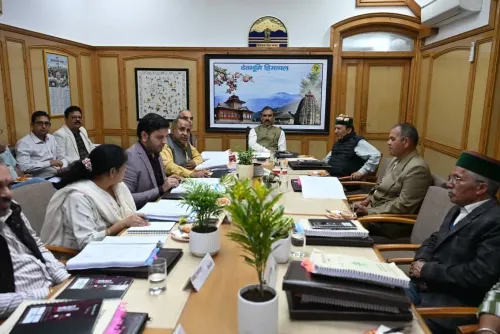
The report, titled 'Counting Green Wealth: Towards a Future-Ready People's Forest Economy in Himachal Pradesh', was compiled jointly by the Himachal Pradesh Forest Department and the Bharti Institute of Public Policy. It draws on a large-scale field effort involving over 500 forest guards and nearly 2,00,000 geo-tagged observations, integrating ground-level data with satellite imagery to build AI and machine learning models for species mapping, biomass estimation, and forest resource assessment.
Scale of Himachal's Forest Cover
Approximately 68 per cent of Himachal Pradesh's geographical area is legally classified as forest — an unusually high concentration of natural capital for a relatively small mountain economy. According to assessments based on Forest Survey of India data, forest cover expanded from roughly 14,353 sq km in 2003 to approximately 15,580 sq km in 2023, raising the share of forest cover from 25.7 per cent to around 28 per cent of the state's total area. Tree cover has additionally grown to about 855 sq km, or roughly 1.5 per cent of the state's area.
Carbon Stock and Climate Significance
Himachal Pradesh's forests store an estimated 258 million tons of carbon across biomass and soil pools, positioning the state as a significant contributor to India's terrestrial carbon sink. This is directly relevant to India's Nationally Determined Contribution (NDC), which commits the country to creating an additional carbon sink of 2.5–3.0 billion tons of CO2 equivalent through additional forest and tree cover by 2030, alongside a long-term net-zero emissions target by 2070.
The report notes that a scientifically credible carbon strategy requires more than aggregate forest-cover statistics — it demands species-level inventories, above-ground biomass monitoring, spatially explicit carbon accounting, and uncertainty-informed systems for monitoring, reporting, and verification.
Biochar and Biofuel Initiatives
The state-supported biochar initiative — which converts pine needles, invasive lantana, bamboo, and other biomass residues into high-value industrial feedstocks — is cited in the report as evidence that problematic biomass can be repurposed productively. According to the report, the success of these biochar and biofuel campaigns demonstrates that frontline forest staff are critical co-producers of the state's intelligence layer, ensuring long-term institutional ownership and adaptive learning. The report argues that this positions Himachal Pradesh as a potential national demonstrator for climate-positive forest economy pathways.
What Comes Next
The report describes itself as an important step in building the data and analytical foundation needed to unlock the state's forest economy and climate potential. Policymakers and researchers are expected to use its findings to design targeted interventions linking forest resource monetisation with rural livelihoods and carbon market participation. Whether the state can translate this valuation into actionable fiscal and climate policy will be the defining test of the initiative.
Point of View
600 crore annual valuation is a headline that demands scrutiny: natural capital accounting is only as useful as the policy architecture built around it. Himachal Pradesh has the forest cover and the carbon stock, but translating geo-tagged observations into fiscal revenue or carbon credits requires regulatory frameworks — state and national — that are still nascent. The biochar initiative is promising precisely because it is concrete and measurable, unlike aggregate forest valuations that can sit in reports without moving budgets. The deeper question is whether this report catalyses a forest economy bill or simply adds to a growing library of well-intentioned green assessments that governments acknowledge and shelve.
NationPress
19 Sept 2026
Frequently Asked Questions
What is the annual value of Himachal Pradesh's forest bio-resources?
According to a joint report by the Himachal Pradesh Forest Department and the Bharti Institute of Public Policy, the state's primary forest bio-resources hold a cumulative annual value of ₹22,600 crore. The report was shared with media on 19 June 2025.
How much has Himachal Pradesh's forest cover grown in the last two decades?
Forest cover in Himachal Pradesh increased from approximately 14,353 sq km in 2003 to about 15,580 sq km in 2023, according to Forest Survey of India data cited in the report. This raised the share of forest cover from 25.7 per cent to around 28 per cent of the state's geographical area.
How does Himachal Pradesh contribute to India's climate targets?
Himachal's forests store an estimated 258 million tons of carbon across biomass and soil pools, making it a significant contributor to India's terrestrial carbon sink. India's NDC commits to creating an additional carbon sink of 2.5–3.0 billion tons of CO2 equivalent by 2030, and Himachal's expanding forest cover and biochar initiatives support that goal.
What is the biochar initiative mentioned in the report?
The state-supported biochar initiative converts problematic biomass — including pine needles, invasive lantana, and bamboo — into high-value industrial feedstocks. The report cites it as proof that frontline forest staff can drive climate-positive economic outcomes and that Himachal Pradesh can serve as a national model for such pathways.
How was the data for this report collected?
The report drew on a large-scale field effort involving over 500 forest guards and nearly 2,00,000 geo-tagged observations. Ground data was integrated with satellite imagery to develop AI and machine learning models for species mapping, biomass estimation, and forest resource assessment.