Assam CM Himanta highlights Class IX bicycle scheme for govt schools
Synopsis
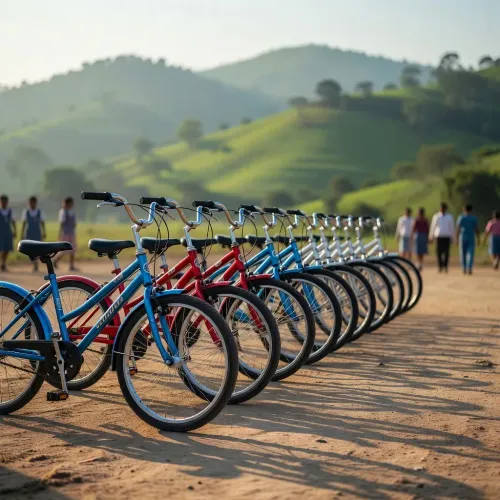
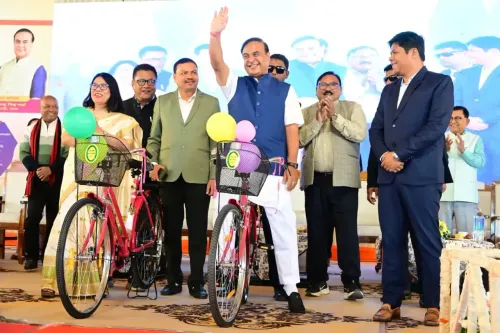
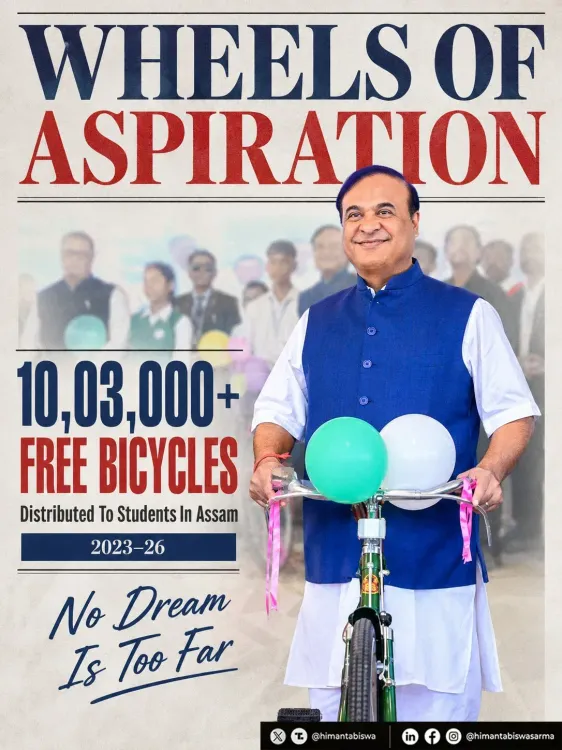
Assam Chief Minister Himanta Biswa Sarma highlighted the state's free bicycle programme for every Class IX student in government schools, calling it a quiet but powerful tool to arrest secondary dropouts and ease the burden of distance on young learners in rural areas.
Key Takeaways
Every Class IX student in Assam's government schools receives a free bicycle under the state programme.
CM Himanta Biswa Sarma credits the scheme with arresting secondary-stage dropout rates.
The intervention targets distance as a key barrier to continued schooling in rural Assam.
India's bicycle-for-school model dates to Bihar's 2007 girls' cycle scheme, later adopted by Odisha and West Bengal .
State efforts complement the central Samagra Shiksha Abhiyan framework for secondary education equity.
Assam Chief Minister Himanta Biswa Sarma on Wednesday, 3 June 2026, spotlighted the state's free bicycle distribution programme for every Class IX student in government schools, framing it as a quiet but decisive intervention against secondary-stage dropouts. In a post on X, the chief minister said the scheme has helped students continue their education by removing distance as a barrier.
'Every Class IX student in Assam's Govt schools gets a bicycle,' Sarma wrote. 'May sound like a routine policy but on ground this intervention has ensured that we can arrest the secondary dropout rates and encourage our young ones to complete their education without having to worry about distance.'
Context
The post positions a recurring welfare delivery as a structural fix rather than a giveaway. By tying bicycles directly to the transition from upper primary into secondary school, the chief minister is pointing at the precise grade where Indian states have historically seen the sharpest fall-off, particularly in rural and remote belts.
Assam's geography — with riverine char areas, tea-garden settlements and hill districts — means many Class IX students live several kilometres from the nearest secondary school. A cycle, in that setting, converts a long walk into a manageable commute and, by extension, a viable school day.
Policy backdrop
Bicycle distribution as an education tool entered the Indian policy mainstream with Bihar's Mukhyamantri Balika Cycle Yojana, launched in 2007 for girls and widely credited with boosting secondary enrolment. Between 2010 and 2015, states including Odisha and West Bengal rolled out their own cycle schemes for Class IX students to tackle the same access problem.
These state interventions sit alongside the central Samagra Shiksha Abhiyan, the integrated school education programme that since 2018 has funded equity and retention measures from pre-primary through Class XII. Cycle schemes have become a low-cost, high-visibility lever within that broader architecture, aligned with Right to Education goals on universal secondary access.
Stakeholders and impact
The most direct beneficiaries are government school students in Class IX, the grade where the secondary cycle begins and where families in low-income and rural households often weigh the cost of continued schooling against farm or wage work. A bicycle reduces both the time cost and the safety concerns, particularly for adolescent girls travelling alone.
Rural households gain a second-order benefit: the cycle frequently doubles as a household asset for errands and short trips, lowering the perceived 'opportunity cost' of keeping a child enrolled. For school administrators, steadier attendance translates into better board-exam cohorts and stronger learning continuity into Class X.
The chief minister's framing — that a 'routine policy' is doing heavy lifting on dropouts — also signals how the Assam government wants the scheme read politically: not as charity, but as infrastructure for human capital.
What's next
The immediate watch is on Assam's annual school education statistics, particularly Class IX-to-X transition and dropout figures, which will indicate whether the bicycle scheme's reach is translating into measurable retention gains. State budget cycles will also reveal whether the programme is expanded in scale, extended to additional grades, or paired with complementary interventions such as residential hostels and transport subsidies in remote blocks.
For other states tracking secondary-stage attrition, Sarma's emphasis is a reminder that the cheapest interventions — a cycle, a uniform, a textbook delivered on time — often do the most to keep an adolescent in the classroom.
Point of View
The chief minister is aligning Assam with a tested template pioneered by Bihar and replicated across eastern India, while staking ownership of its on-ground outcomes. The framing also reflects a broader BJP-led pitch in the Northeast that conflates routine delivery with governance credibility. The real test will be in Assam's transition and dropout numbers, not in the optics of distribution.
NationPress
21 Oct 2026
Frequently Asked Questions
What is the Assam Class IX bicycle scheme?
It is a state programme under which every Class IX student enrolled in Assam's government schools receives a free bicycle to help them travel to school and stay enrolled through the secondary stage.
Why is the Assam government giving bicycles to students?
The state says the bicycles reduce the distance barrier that often pushes rural students out of school after Class VIII, helping arrest secondary dropout rates and improve attendance.
Who is eligible for the free bicycle in Assam?
Students enrolled in Class IX in Assam's government schools are eligible, according to Chief Minister Himanta Biswa Sarma's statement on the scheme.
Which Indian state first launched a bicycle scheme for students?
Bihar launched the Mukhyamantri Balika Cycle Yojana in 2007 for girls, and it became the model that several states later adapted for Class IX students.
How does the bicycle scheme fit into India's school education policy?
It complements the central Samagra Shiksha Abhiyan, which since 2018 has funded equity and retention measures across school education, including interventions to keep students enrolled through secondary grades.