CM Himanta expands Assam student scheme to boys, cites ₹447cr spend
Synopsis
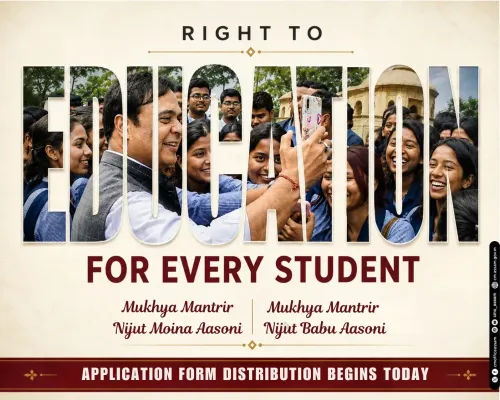
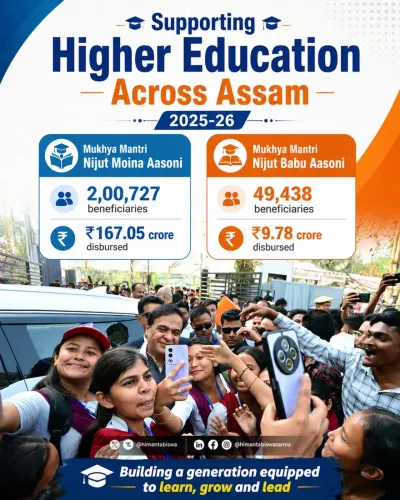
Assam Chief Minister Himanta Biswa Sarma has announced the expansion of a student welfare scheme to include boys from poor and middle-class families, after spending over ₹447 crore in two years. The move widens a programme previously focused on girls, citing encouraging early results.
Key Takeaways
Assam CM Himanta Biswa Sarma announced on August 6, 2026 that an existing student welfare scheme will be expanded to include boys from poor and middle-class families.
The state has spent over ₹447 crore on the scheme over the past two years .
The expansion is driven by what the CM described as 'encouraging results' from the scheme's current run.
The government confirmed it will 'continue to support our young minds,' signalling sustained future spending.
Revised eligibility norms and updated budget allocations are expected to be detailed in upcoming state budget or assembly sessions.
A student welfare scheme in Assam that began by targeting girls from economically weaker households is now being opened up to boys — a shift Assam Chief Minister Himanta Biswa Sarma announced on Thursday, August 6, 2026, citing strong early results and a cumulative state outlay of over ₹447 crore across the past two years.
From girls to all: the scheme widens its net
The expansion is a direct response to what the Chief Minister described as 'encouraging results' from the scheme's existing run. Writing in a thread on X, Sarma said the outcomes had 'motivated us to expand the scheme to include boys from our poor and middle class families, so that they can also pursue their goals.' The logic is incremental but deliberate: prove the model works for one group, then scale.
The move brings boys from low- and middle-income households into a programme that had, until now, primarily served girls. Assam has a track record of using gender-targeted welfare as a proof-of-concept before broadening eligibility — a pattern visible in several northeastern states trying to stretch limited fiscal space further.
₹447 crore and counting
The ₹447 crore figure — spent over two years — signals that this is not a pilot on a shoestring. That kind of sustained outlay in a state the size of Assam reflects a political commitment to keeping education access on the budget sheet even as competing welfare demands pile up. Sarma confirmed the government 'will continue to support our young minds,' leaving the door open for further allocations.
The next concrete markers to watch: revised eligibility norms and fresh budget lines, likely to surface in an upcoming state budget session or assembly announcement. Until those details land, the scale and mechanics of the boy-inclusive expansion remain to be formalised.
Welfare arithmetic in the northeast
Assam sits at the centre of Sarma's broader project of consolidating BJP influence across the northeast through the North-East Democratic Alliance (NEDA). Student welfare spending — visible, direct, and hard to argue against — fits neatly into that political calculus. Widening a popular scheme to cover boys doubles the number of families with a direct stake in its continuation.
The broader national pattern mirrors this: state governments across India have found that targeted education-support schemes, once established for girls, face pressure to extend to boys precisely because success becomes its own argument. Assam is now at that inflection point.
The question is whether the expanded scheme arrives with matching infrastructure — counselling, institutional tie-ups, disbursement pipelines — or whether the announcement runs ahead of the apparatus. That gap, if it exists, will show up fast.
Point of View
Let results build political goodwill, then expand eligibility to maximise the voter base without launching an entirely new programme. The ₹447 crore outlay over two years is substantial for a northeastern state and reflects a deliberate strategy of using education spending as both social policy and political capital. For NEDA's consolidation project, a scheme that now touches boys and girls across income brackets is a far stickier asset than one confined to a single group. The real test will be whether implementation keeps pace with the expanded promise.
NationPress
20 Sept 2026
Frequently Asked Questions
What scheme is Assam expanding to include boys?
Assam is expanding a student welfare scheme — previously focused on girls from economically weaker sections — to also cover boys from poor and middle-class families, as announced by CM Himanta Biswa Sarma on August 6, 2026.
How much has Assam spent on this student scheme?
Assam has spent over ₹447 crore on the scheme over the past two years, according to CM Himanta Biswa Sarma's post on X.
Why is Assam expanding the student welfare scheme to boys?
CM Sarma cited 'encouraging results' from the scheme's existing run as the motivation to widen eligibility so that boys from poor and middle-class families can also pursue their educational goals.
When will the expanded Assam student scheme take effect?
A formal announcement with revised eligibility norms and budget allocations is expected in an upcoming state budget session or assembly sitting; no specific date has been confirmed yet.
What is Himanta Biswa Sarma's role in Assam?
Himanta Biswa Sarma is the Chief Minister of Assam and a senior BJP leader. He also serves as the convenor of the North-East Democratic Alliance (NEDA).