CM Himanta Sarma Tours Granth Kutir at Rashtrapati Bhavan
Synopsis
Assam Chief Minister Himanta Biswa Sarma toured the Granth Kutir at Rashtrapati Bhavan in New Delhi, praising its curation of centuries of Indian literary and intellectual traditions and thanking the President's Secretariat for the installation that offers a window into the country's civilisational heritage.
Key Takeaways
Assam CM Himanta Biswa Sarma visited Granth Kutir at Rashtrapati Bhavan on 3 June 2026.
He described the exhibit as preserving 'centuries of India's literary & intellectual traditions' under one roof.
Sarma thanked the President's Secretariat for curating the installation.
The visit aligns with a wider focus on Indian knowledge systems under NEP 2020.
BJP-ruled state chief ministers have frequently engaged with Rashtrapati Bhavan's cultural programming.
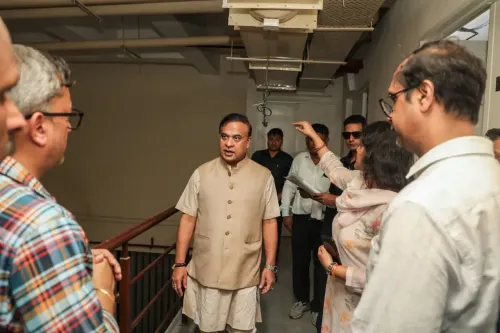
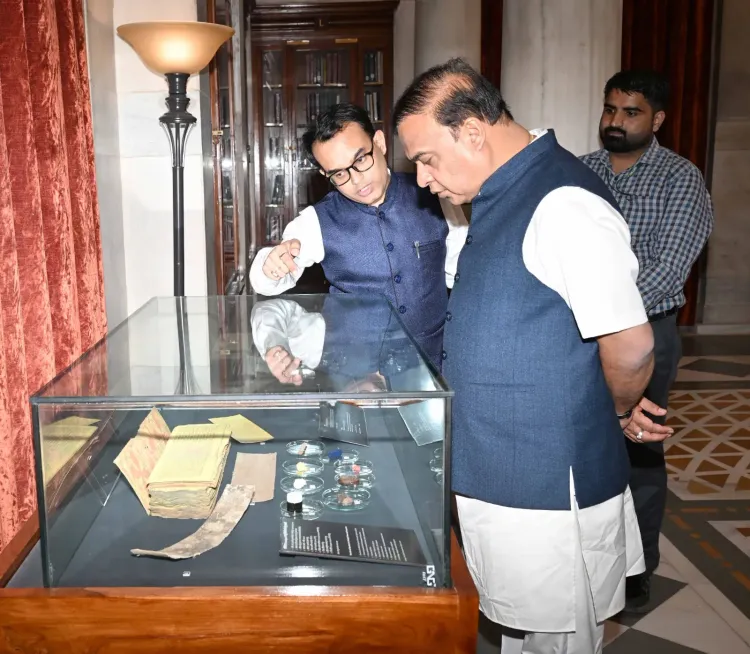
Assam Chief Minister Himanta Biswa Sarma visited the Granth Kutir at Rashtrapati Bhavan in New Delhi, describing the experience as a 'fascinating' encounter with centuries of Indian literary and intellectual traditions preserved within a single repository. The visit, shared by the Chief Minister on the evening of 3 June 2026, came with two photographs from inside the curated space.
In his post, Sarma wrote that he had 'spent some time exploring Granth Kutir at Rashtrapati Bhavan' and thanked the President's Secretariat for 'curating this insightful window into our civilisational heritage.' He framed the installation as a window into India's intellectual lineage rather than a routine protocol stop.
Context
Sarma, the Chief Minister of Assam and convenor of the North-East Democratic Alliance (NEDA), frequently travels to the national capital for inter-governmental engagements. Visits to Rashtrapati Bhavan — the official residence and workplace of the President of India — typically combine official calls with stops at the estate's heritage installations, which are managed by the President's Secretariat.
The Chief Minister did not detail the specific manuscripts or collections he viewed, but his framing of 'centuries of India's literary & intellectual traditions' situates Granth Kutir within the broader effort to consolidate textual heritage in public-facing exhibits at the presidential estate.
Policy backdrop
The emphasis on indigenous literary traditions echoes commitments made under the National Education Policy 2020, which calls for the integration of Indian knowledge systems and heritage preservation across public institutions. Rashtrapati Bhavan has, over successive presidencies, evolved into a venue that pairs constitutional functions with curated cultural programming open to invited visitors and scholars.
Sarma's acknowledgement of the President's Secretariat as curator points to the institutional role that the office plays in mounting such displays — a role that extends beyond protocol to active stewardship of artefacts and manuscripts housed within the estate.
Stakeholders and impact
For heritage scholars and the wider public, high-profile visits by serving chief ministers function as signals that route attention to lesser-known cultural assets within state institutions. Sarma's note adds a north-eastern voice to a stream of endorsements that BJP-ruled state leaders have offered for Rashtrapati Bhavan's cultural programming in recent years.
Within Assam, where the state government has invested in promoting manuscript traditions associated with Vaishnavite sattras and other regional repositories, the Chief Minister's framing aligns with a state-level narrative that positions textual heritage as a pillar of identity. The visit therefore plays to constituencies both in the capital and back home.
What's next
The Chief Minister's post did not indicate further engagements tied to the visit, and no formal announcement accompanied it. Observers will watch whether additional state delegations or chief ministers follow with similar tours of Granth Kutir, and whether the President's Secretariat opens broader public access windows to the installation in the months ahead.
For Sarma, who balances his Guwahati responsibilities with a national role through NEDA, such cultural endorsements offer a low-friction way to thread civilisational themes into a schedule otherwise dominated by administrative and political business.
Point of View
He routes attention to an institution whose cultural role rarely competes with its constitutional one. For a chief minister who also helms NEDA, signalling continuity between regional traditions and national repositories is politically efficient. The post is ceremonial, but the framing is deliberate.
NationPress
18 Oct 2026
Frequently Asked Questions
What is Granth Kutir at Rashtrapati Bhavan?
Granth Kutir is a curated space within Rashtrapati Bhavan in New Delhi that, per Chief Minister Himanta Biswa Sarma's description, preserves centuries of India's literary and intellectual traditions under one roof. It is maintained by the President's Secretariat.
When did Himanta Biswa Sarma visit Granth Kutir?
The Assam Chief Minister shared his visit on 3 June 2026 via a post on X, accompanied by two photographs from inside the installation.
Who curates exhibits at Rashtrapati Bhavan?
The President's Secretariat is the administrative body responsible for curating exhibitions and cultural programming at Rashtrapati Bhavan, including the Granth Kutir installation referenced by Sarma.
Why is the visit politically significant?
It places a senior BJP chief minister and NEDA convenor publicly behind Rashtrapati Bhavan's civilisational heritage programming, reinforcing themes consistent with the National Education Policy 2020's push for Indian knowledge systems.
Did Sarma announce any policy during the visit?
No. The post was a personal acknowledgement of the exhibit and a note of thanks to the President's Secretariat, with no policy announcement attached.