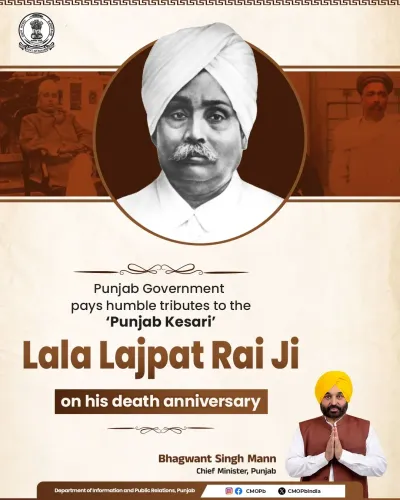
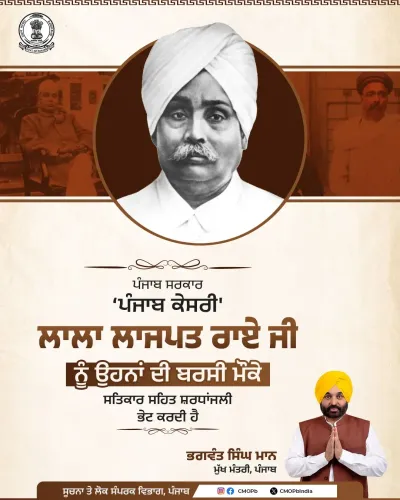
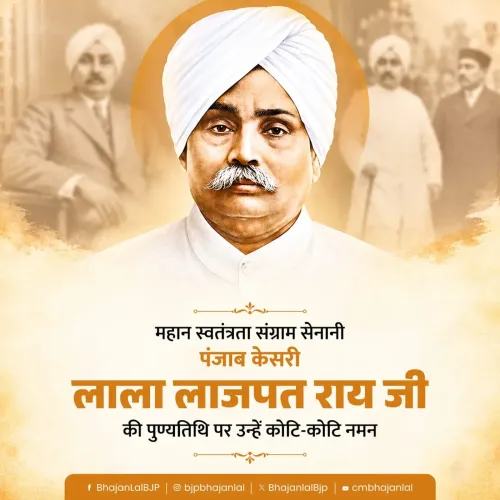
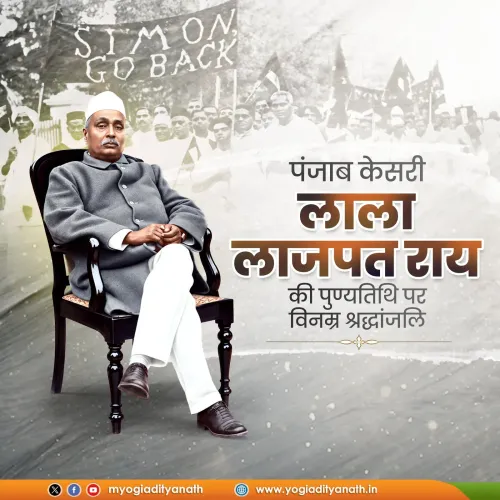
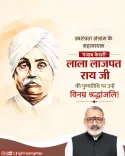
HP CM Sukhu pays tribute to Lala Lajpat Rai on death anniversary
Synopsis
Himachal Pradesh Chief Minister Sukhvinder Singh Sukhu paid tribute to Lala Lajpat Rai on his death anniversary on 17 November 2026, honouring the nationalist leader known as 'Punjab Kesari' who died in 1928 from injuries sustained during protests against the Simon Commission.
Key Takeaways
Himachal Pradesh Chief Minister Sukhvinder Singh Sukhu paid tribute to Lala Lajpat Rai on his death anniversary, 17 November 2026 .
Lajpat Rai, known as 'Punjab Kesari' (Lion of Punjab), was part of the celebrated Lal-Bal-Pal nationalist trio.
He died on 17 November 1928 from injuries sustained in a police lathi charge during protests against the Simon Commission in Lahore.
His death directly inspired revolutionary Bhagat Singh and galvanised the broader independence movement.
The tribute was issued via the official Chief Minister's Office of Himachal Pradesh X account.
On the death anniversary of one of India's most defiant freedom fighters, Himachal Pradesh Chief Minister Sukhvinder Singh Sukhu paid solemn tribute to Lala Lajpat Rai — the leader whose very last act was a protest that shook an empire.
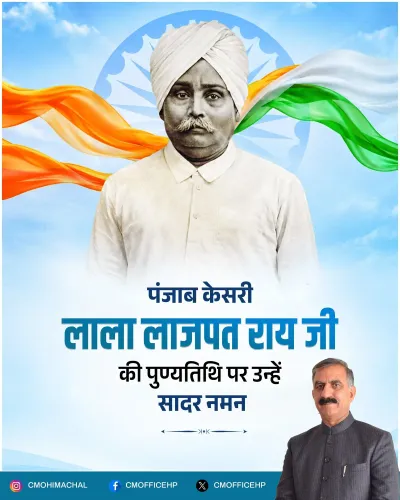
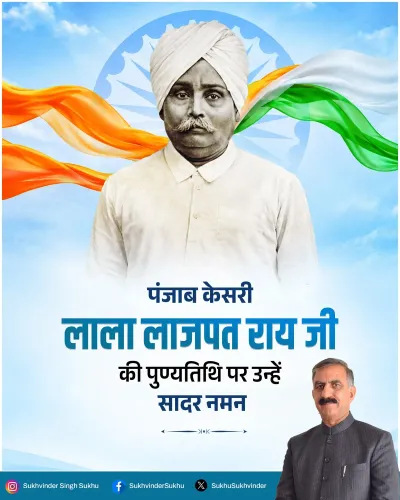
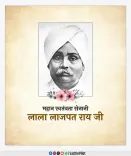
Posted through the Chief Minister's Office of Himachal Pradesh on 17 November 2026, the message reads: 'Punjab Kesari' Lala Lajpat Rai ji ki punyatithi par unhe sadar naman. ('Respectful salutations to 'Punjab Kesari' Lala Lajpat Rai on his death anniversary.') — signed by Chief Minister Thakur Sukhvinder Singh Sukhu.
Who was 'Punjab Kesari'?
Lala Lajpat Rai earned the title Punjab Kesari — 'Lion of Punjab' — through decades of unyielding resistance to British rule. He was the 'Lal' in the celebrated Lal-Bal-Pal trio alongside Bal Gangadhar Tilak and Bipin Chandra Pal, three leaders who together redefined the character of Indian nationalism in the early twentieth century.
His death on 17 November 1928 remains one of the most charged moments in India's independence story. Weeks earlier, he had led a massive protest in Lahore against the Simon Commission — a British parliamentary body that excluded Indian members entirely. The colonial police responded with a brutal lathi charge. Lajpat Rai absorbed blows to his chest and was heard to declare that every strike on his body would become a nail in the coffin of British imperialism. He died from his injuries within the month.
His death galvanised the freedom movement and directly inspired a young Bhagat Singh, who vowed revenge and carried out the act that would seal his own legendary status.
Indian state governments routinely mark the anniversaries of independence-era figures with public statements — a practice that keeps the memory of the freedom struggle in civic consciousness. For Himachal Pradesh, a state carved from the Punjab hill territories that Lajpat Rai spent his life fighting for, the tribute carries particular resonance.
Point of View
But the gesture carries institutional weight — it signals which figures a ruling dispensation chooses to centre in public memory. For the Congress-led Himachal Pradesh government, invoking Lala Lajpat Rai, a figure whose legacy is claimed across the ideological spectrum, is a broadly unifying act. The tribute also subtly underlines the Punjab hill region's organic connection to Lajpat Rai's legacy, grounding a national memory in local identity. Such observances, however formulaic they may appear, function as soft civic education — keeping the texture of the independence struggle alive in state communication.
NationPress
17 Nov 2026
Frequently Asked Questions
Why is Lala Lajpat Rai called Punjab Kesari?
Lala Lajpat Rai was called 'Punjab Kesari' — meaning 'Lion of Punjab' — because of his fierce and uncompromising leadership in the Indian independence movement, particularly his work in mobilising Punjab against British rule.
How did Lala Lajpat Rai die?
Lala Lajpat Rai died on 17 November 1928 from injuries he sustained when British police carried out a lathi charge on protesters demonstrating against the Simon Commission in Lahore. He died within weeks of the assault.
What was the Simon Commission and why was it protested?
The Simon Commission was a British parliamentary committee formed in 1927 to review constitutional reforms in India. Indians protested it because all seven of its members were British and no Indian was included, making it a symbol of colonial exclusion.
Who is Sukhvinder Singh Sukhu?
Sukhvinder Singh Sukhu is the Chief Minister of Himachal Pradesh. He issued this tribute to Lala Lajpat Rai through the official Chief Minister's Office account on 17 November 2026.
What is the Lal-Bal-Pal trio in Indian history?
Lal-Bal-Pal refers to Lala Lajpat Rai, Bal Gangadhar Tilak, and Bipin Chandra Pal — three nationalist leaders of the early twentieth century who advocated a more assertive, mass-based approach to India's independence movement.