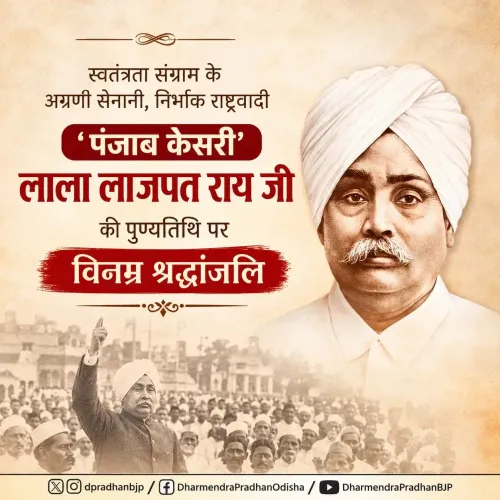
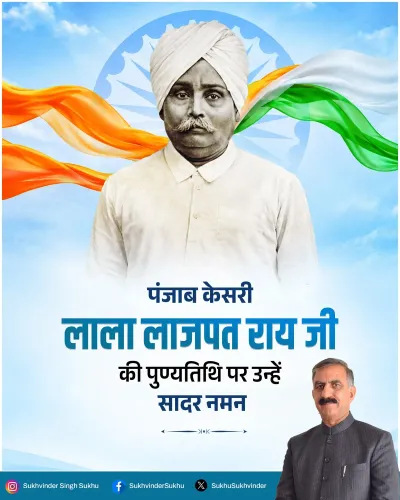
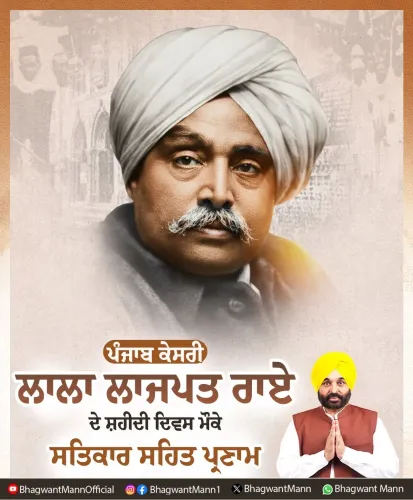
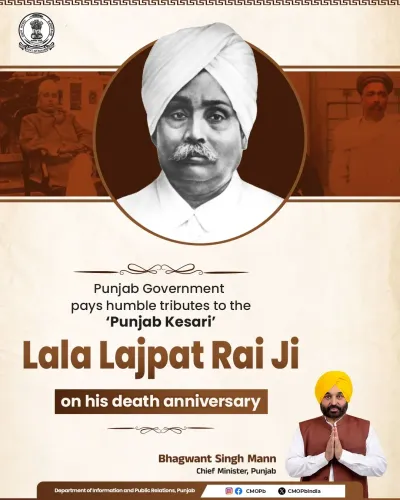
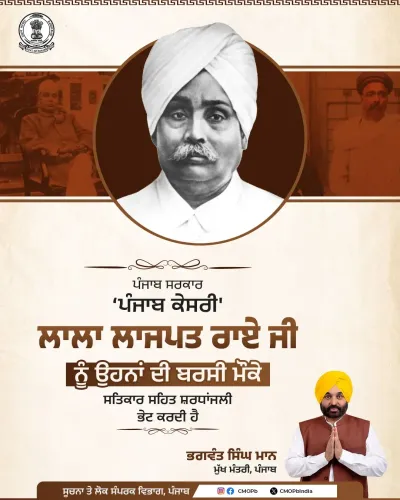
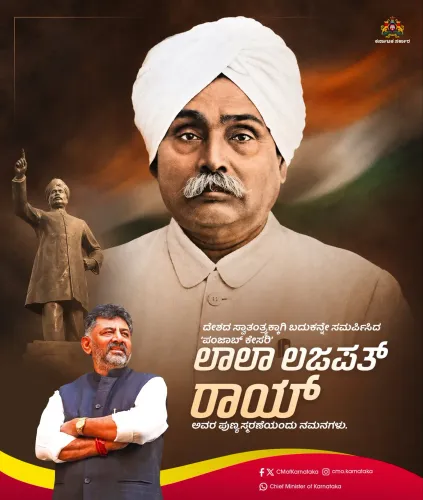
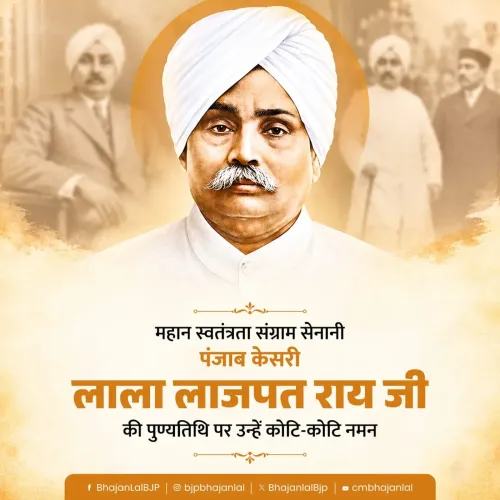
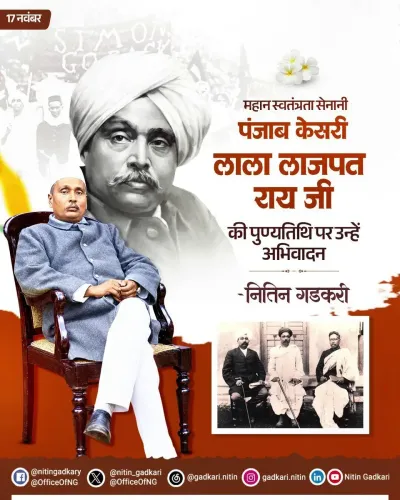
HP CM Office Pays Tribute to Lala Lajpat Rai on Death Anniversary
Synopsis
On Lala Lajpat Rai's death anniversary, 17 November 2026, Himachal Pradesh's Chief Minister's Office paid tribute to the nationalist icon, recalling his fearless resistance to British rule, his role in the freedom struggle, and his enduring inspiration for India's youth.
Key Takeaways
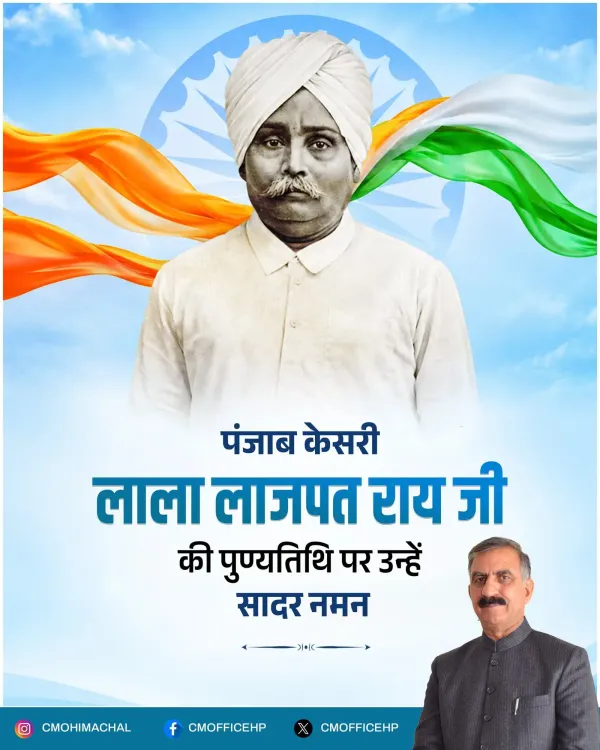
Himachal Pradesh's Chief Minister's Office posted a tribute to Lala Lajpat Rai on 17 November 2026 , his death anniversary.
The tribute honoured Rai's 'fearless leadership and powerful ideas' that energised the independence movement against British rule.
Lala Lajpat Rai (1865–1928) was the 'Lal' of the iconic Lal-Bal-Pal triumvirate and was widely known as Punjab Kesari .
He died on 17 November 1928 from injuries sustained during a lathi charge while leading protests against the Simon Commission in Lahore.
His martyrdom directly inspired subsequent acts of resistance by figures including Bhagat Singh .
Indian state offices routinely mark such anniversaries as part of a national practice of commemorating freedom movement leaders.
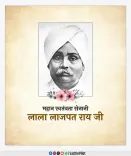
Ninety-eight years after a British lathi charge cut short one of India's most fearless lives, Himachal Pradesh's Chief Minister's Office marked Lala Lajpat Rai's death anniversary on 17 November 2026 with a tribute honouring his role in igniting the freedom struggle against colonial rule.
The post, written in Hindi, remembered Rai's 'fearless leadership and powerful ideas' — 'निर्भीक नेतृत्व और ओजस्वी विचारों' — as a force that brought fresh energy to the independence movement against British oppression and awakened patriotic spirit in the youth of the nation. 'His sacrifice and martyrdom for the motherland will continue to inspire forever,' the message concluded.
The Man Who Stared Down the Simon Commission
Lala Lajpat Rai, born 28 January 1865, was one of the most commanding figures of India's nationalist movement — the 'Lal' in the celebrated Lal-Bal-Pal triumvirate alongside Bal Gangadhar Tilak and Bipin Chandra Pal. Known widely as Punjab Kesari — the Lion of Punjab — he combined mass mobilisation with fierce ideological conviction across decades of colonial resistance.
His final act of defiance came in October 1928, when he led a protest march in Lahore against the all-British Simon Commission, appointed to review India's constitutional future without a single Indian member. Police superintendent James Scott ordered a lathi charge on the demonstrators. Rai took direct blows to his chest. 'Every blow struck on my body,' he declared from a public platform days later, 'is a nail in the coffin of the British Empire.' He died on 17 November 1928 from injuries sustained in the assault — a death that galvanised a generation and directly inspired Bhagat Singh's subsequent acts of resistance.
A Ritual of Remembrance in Indian Public Life
Tributes of this kind from state government offices on the anniversaries of freedom movement icons are a consistent feature of Indian political communication — a deliberate, recurring effort to keep the memory of colonial-era sacrifice alive in public consciousness. For the youth the post specifically addresses, such messaging frames the independence struggle not as distant history but as a living moral inheritance.
Rai's legacy endures well beyond the textbook: the Lala Lajpat Rai Memorial Medical University in Meerut and multiple institutions across north India bear his name, and his writings on nationalism, self-reliance, and civic duty remain in circulation. His belief that political freedom must be matched by social and economic empowerment has resonated across successive generations of Indian reformers.
Courage, it turns out, has a very long half-life.
Point of View
Such messaging shapes how successive generations are encouraged to interpret national sacrifice. The consistent repetition of this practice across party lines suggests it has become a non-negotiable grammar of Indian governance.
NationPress
17 Nov 2026
Frequently Asked Questions
Why is 17 November significant for Lala Lajpat Rai?
17 November 1928 is the date Lala Lajpat Rai died from injuries sustained when police carried out a lathi charge on protesters opposing the Simon Commission in Lahore, making it his death anniversary.
Who was Lala Lajpat Rai?
Lala Lajpat Rai (1865–1928) was a prominent Indian nationalist leader, known as Punjab Kesari (Lion of Punjab) and one-third of the celebrated Lal-Bal-Pal triumvirate, alongside Bal Gangadhar Tilak and Bipin Chandra Pal.
What was the Simon Commission and why did Lala Lajpat Rai protest it?
The Simon Commission was a British constitutional review body appointed in 1927 that included no Indian members. Lala Lajpat Rai led protests against it in Lahore in October 1928 , during which a police lathi charge fatally injured him.
Why did the Himachal Pradesh CM Office pay tribute to Lala Lajpat Rai?
Indian government offices routinely issue tributes on the death and birth anniversaries of independence-era leaders. The HP Chief Minister's Office posted this tribute on 17 November 2026 to mark Rai's death anniversary and honour his contribution to the freedom movement.
How did Lala Lajpat Rai inspire Bhagat Singh?
Lala Lajpat Rai's death following the 1928 lathi charge in Lahore directly motivated Bhagat Singh and his associates to avenge the killing, which subsequently shaped a critical chapter of India's militant nationalist resistance.