HP CM Office Urges Residents to Share Data for Welfare Schemes

Synopsis
The Chief Minister's Office of Himachal Pradesh has appealed to state residents to share accurate personal information with the government, pledging full confidentiality, so that schemes in education, health, employment, and infrastructure can be made more effective.
Key Takeaways
The Chief Minister's Office of Himachal Pradesh posted the appeal on June 1, 2026 via its official X account.
Residents were urged to provide correct and complete personal information to aid government planning.
The government pledged that all personal data would be kept entirely confidential .
The data is intended to improve scheme delivery in education, health, employment, and infrastructure .
The exercise reflects a broader pattern of Indian states refreshing household-level data beyond the decade-old Census of India 2011 .
No specific survey mechanism or timeline has been publicly announced yet.
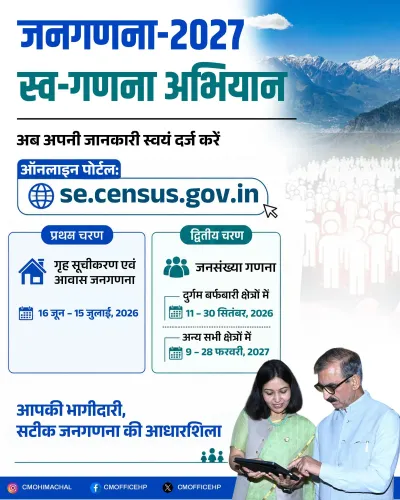
The Chief Minister's Office of Himachal Pradesh on Monday, June 1, 2026, appealed to residents of the state to provide accurate and complete personal information to the government, assuring them that all data shared would be kept strictly confidential. The appeal, posted on the office's official X account, linked the quality of citizen-supplied information directly to the effectiveness of welfare delivery across the state.
Context
The post, written in Hindi, told residents: 'aapki or se di gayi sahi aur poorn jaankari' ('the correct and complete information provided by you') would help the government design schemes in education, health, employment, infrastructure, and other public-welfare areas more effectively. It added that all personal details would be kept 'poori tarah gopaneeya' — entirely confidential. The message is framed as a direct call to action for ordinary citizens, positioning their participation as essential to the quality of governance they receive.
Policy Backdrop
Himachal Pradesh, a northern Indian hill state, administers a range of centrally and state-funded welfare programmes covering education, rural health, employment generation, and basic infrastructure. Like most Indian states, it has historically relied on Census of India 2011 data for household-level welfare targeting — data that is now more than a decade old. Indian state governments periodically conduct their own household surveys or data-collection exercises to fill gaps left by outdated national figures, especially when planning localised schemes. Such exercises typically invoke privacy assurances under existing information-technology and data-protection frameworks to encourage candid participation from residents who may be wary of sharing personal details.
The urgency of refreshed data is particularly acute in sectors such as education enrolment, health coverage, and employment status, where ground realities shift faster than decennial census cycles can capture. Accurate household-level data allows planners to identify under-served pockets, calibrate beneficiary lists, and reduce leakage in scheme delivery.
Stakeholders and Impact
The primary stakeholders are Himachal Pradesh's approximately 7.5 million residents, who stand to benefit from better-targeted welfare if the data exercise yields reliable results. Gram panchayats, urban local bodies, and district administrations are the likely implementation nodes for any survey or data-collection drive. Civil-society organisations working on social audits and digital-rights advocates will also watch how the collected data is stored, used, and protected — particularly in the context of India's evolving data-protection legislative landscape. Beneficiaries of schemes in education and health, including students, daily-wage workers, and rural households, are the end-users whose lives the exercise is intended to improve.
What's Next
The government has not publicly specified the precise mechanism — whether a formal household survey, a digital portal, or a door-to-door enumeration drive — through which residents are expected to submit information. Observers will watch for an official notification detailing the scope, timeline, and legal basis of the data-collection exercise. The more significant downstream question is how the state translates the incoming data into revised scheme parameters, updated beneficiary rolls, or new policy announcements in education, health, and employment. Any state-level legislation or executive order governing data retention and citizen privacy in this context will be a bellwether for how Himachal Pradesh balances welfare efficiency with digital rights.
Point of View
The CM Office is acknowledging a real trust deficit that has historically depressed participation in government surveys, especially among marginalised households. If the exercise generates reliable, granular data, it could give the state a meaningful edge in rationalising its welfare budget and reducing duplication. However, the absence of a named legal framework for data protection means the initiative's credibility will depend heavily on the transparency of implementation.
NationPress
16 Oct 2026
Frequently Asked Questions
Why is the Himachal Pradesh government asking citizens for personal information?
The government says accurate citizen data will help it design more effective schemes in education, health, employment, and infrastructure. Outdated national census figures have limited precise welfare targeting, prompting state-level data exercises.
Will my personal information shared with the HP government be kept private?
The Chief Minister's Office has explicitly assured residents that all personal information shared will be kept entirely confidential, in line with existing information-technology and data-protection frameworks.
What schemes will benefit from the data collected by the Himachal Pradesh government?
The CM Office mentioned education, health, employment, basic infrastructure, and other public-welfare schemes as areas that will be better designed using the information provided by residents.
How can Himachal Pradesh residents share their information with the government?
The specific mechanism — whether a digital portal, household survey, or door-to-door drive — has not been publicly announced yet. Residents should watch for official notifications from the state government.
Why do Indian state governments conduct their own data collection exercises?
India's last national census was conducted in 2011, leaving a significant data gap. State governments run their own surveys to capture current household-level realities and better target welfare spending.