HP CM's Office: OPS Here to Stay Despite Lok Sabha Losses
Synopsis
The Chief Minister's Office of Himachal Pradesh declared on 24 October 2026 that the Old Pension Scheme will not be rolled back despite the ruling Congress party failing to win any of the state's four Lok Sabha seats, reaffirming the policy as a welfare commitment to state employees.
Key Takeaways
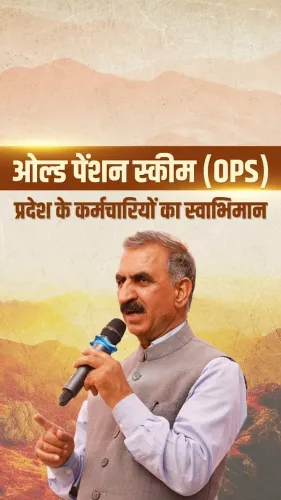
The Chief Minister's Office of Himachal Pradesh posted on 24 October 2026 defending its continuation of the Old Pension Scheme (OPS) .
The statement explicitly acknowledges losing all four Lok Sabha seats in the state but declares the policy decision unchanged.
OPS guarantees a defined pension based on last drawn salary , unlike the market-linked New Pension Scheme introduced centrally in 2004 .
CM Sukhvinder Singh Sukhu fulfilled the Congress party's 2022 assembly election pledge by restoring OPS after taking office in December 2022 .
Himachal Pradesh joins states like Rajasthan and Chhattisgarh in reversing NPS, a trend that has raised central government concerns about state fiscal sustainability.
Electoral setbacks will not reverse a welfare promise — that is the unambiguous signal the Chief Minister's Office of Himachal Pradesh sent on Saturday, 24 October 2026, doubling down on the state's restoration of the Old Pension Scheme (OPS) even after the ruling Congress failed to win any of the state's four Lok Sabha seats.
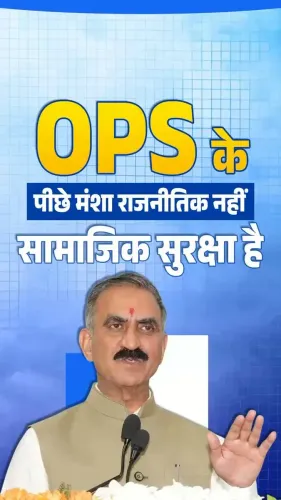
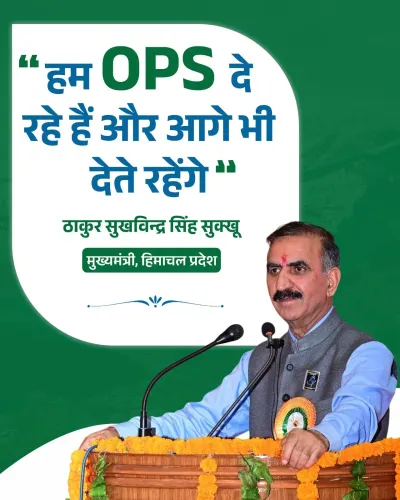
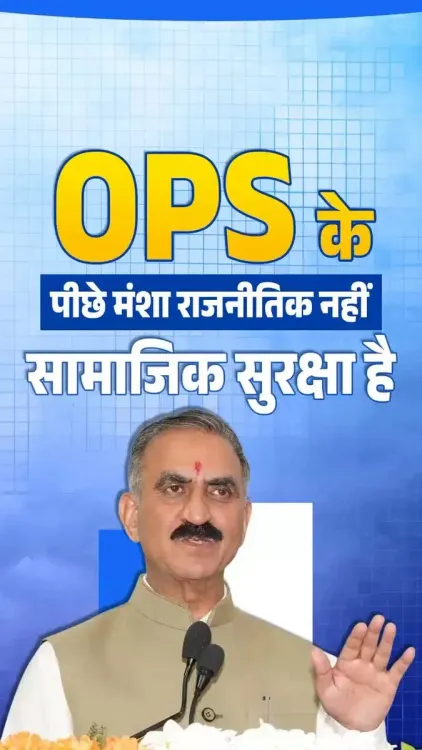
The post, shared from the official CMO handle, stated in Hindi: 'हमने OPS अपने कर्मयोगी कर्मचारी भाइयों-बहनों के बुढ़ापे को आर्थिक रूप से सुरक्षित बनाने के उद्देश्य से लागू की है। चारों लोकसभा सीटों पर जीत नहीं मिली, लेकिन हम अपने फैसले पर कायम हैं।' ('We have implemented OPS with the purpose of financially securing the old age of our hardworking employee brothers and sisters. We did not win the four Lok Sabha seats, but we stand firm on our decision.')
What OPS means for Himachal's government employees
The Old Pension Scheme guarantees a defined monthly pension tied to an employee's last drawn salary — a fixed, predictable security blanket for retirement. Its replacement, the New Pension Scheme (NPS), introduced by the central government in 2004, shifted that certainty into a market-linked contributory system, leaving retirement income vulnerable to market fluctuations. For a large section of state government employees, that shift felt like a broken social contract.
The Congress party had made OPS restoration a centrepiece of its 2022 Himachal Pradesh assembly election campaign, responding to years of pressure from employee unions. Chief Minister Sukhvinder Singh Sukhu delivered on that promise after the government was formed in December 2022, making Himachal Pradesh one of a handful of states to walk back NPS for its workers.
Why the Lok Sabha results make this statement politically significant
The CMO's post is notably self-aware: it concedes a clean sweep of all four Lok Sabha constituencies in the state slipping out of the party's hands, yet frames that loss as irrelevant to the policy commitment. The message is deliberate — OPS was not passed as an electoral gambit, it insists, but as a genuine welfare obligation to the state's 'karmayogi' (dedicated, duty-bound) employees.
That framing matters, because critics of OPS restoration — particularly central fiscal authorities — have long argued that defined-benefit pensions impose unsustainable long-term liabilities on state budgets. By anchoring the justification in employee welfare rather than vote arithmetic, the Sukhu government pre-empts the narrative that the policy is being reconsidered in the wake of poor electoral performance.
A state-level trend with national fiscal consequences
Himachal Pradesh is not alone. States including Rajasthan and Chhattisgarh have also moved to restore OPS after respective election cycles, creating a visible pattern among opposition-run governments. The decisions have generated persistent debate between employee welfare imperatives and long-term pension fund sustainability — a tension that central finance policymakers are watching closely through state budget allocations and fiscal deficit trajectories.
For Himachal Pradesh's government employees, the CMO's statement is a clear, if politically bruised, guarantee: their retirement security remains non-negotiable, regardless of what the ballot box said.
Point of View
The Sukhu government is trying to decouple welfare credibility from electoral outcomes, arguing that good governance is not contingent on winning. It also immunises the policy against internal party pressure to course-correct after electoral failure. The broader arc here is a growing federalist assertion: multiple non-BJP state governments have used pension restoration as a marker of ideological differentiation from central policy, turning a fiscal debate into a contest over the meaning of state sovereignty in social security. Fiscal hawks will note that the long-term liability question remains unresolved, and the real test will come in the next state budget's pension provisioning.
NationPress
24 Oct 2026
Frequently Asked Questions
What is the Old Pension Scheme in Himachal Pradesh?
The Old Pension Scheme (OPS) in Himachal Pradesh guarantees state government employees a fixed monthly pension based on their last drawn salary after retirement, unlike the contributory New Pension Scheme introduced centrally in 2004. The Sukhu government restored it after winning the 2022 state assembly elections.
Why did the Himachal Pradesh government bring back OPS?
The Congress party promised OPS restoration during the 2022 Himachal Pradesh assembly elections in response to long-standing pressure from state government employee unions who felt the New Pension Scheme left their retirement income uncertain and market-dependent.
Will OPS be scrapped after the Congress lost Lok Sabha seats in Himachal Pradesh?
No. The Chief Minister's Office stated on 24 October 2026 that despite losing all four Lok Sabha constituencies, the government remains committed to the Old Pension Scheme as a welfare obligation to employees.
What is the difference between OPS and NPS for government employees?
OPS provides a defined, guaranteed pension — typically 50 per cent of the last drawn salary — funded entirely by the government. NPS is a contributory, market-linked system where both the employee and government contribute to a pension corpus, and the final payout depends on investment returns.
Which other states have restored the Old Pension Scheme?
States including Rajasthan and Chhattisgarh have also reverted to OPS following their respective state election cycles, creating a pattern among several opposition-governed states responding to employee union demands.