Could I-PAC Office Raids and Mamata's Allegations Echo the Watergate Scandal?
Synopsis
The recent I-PAC office raids involving Mamata Banerjee evoke memories of the Watergate scandal, illustrating the ongoing interplay of politics and scandal. This article explores the implications of these events and their historical context, drawing parallels with past incidents both in India and globally.
Key Takeaways
Political Accountability: The I-PAC raids raise questions about the conduct of elected officials during investigations.
Media Influence: The rapid coining of the term 'I-PAC-gate' reflects the media's role in shaping public perception.
Historical Context: Drawing parallels with Watergate highlights the ongoing relevance of political scandals.
Public Response: Mixed reactions indicate the complexity of public sentiment in politically charged situations.
Legal Proceedings: The outcomes of the ongoing legal actions will be crucial for future political actions.
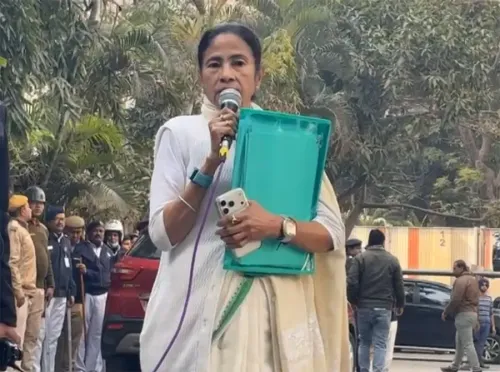
New Delhi, Jan 9 (NationPress) The term 'gate' has become synonymous with scandals since the infamous Watergate scandal of the 1970s in the US. Recently, West Bengal Chief Minister Mamata Banerjee's actions during a raid by a probe agency have led to a new branding of events as 'I-PAC-gate'.
This situation arose during the Enforcement Directorate's (ED) raids on the Indian Political Action Committee (I-PAC) in Kolkata on Thursday.
The I-PAC provides services to various national political parties, including the Trinamool Congress.
The ED’s investigations are focused on alleged financial discrepancies associated with I-PAC, where officials reportedly confiscated documents and digital data during the operation, raising concerns about money laundering and misuse of funds.
During the raid, Mamata Banerjee was observed entering the ED's premises and personally retrieving documents, which is considered against standard protocol for a sitting Chief Minister.
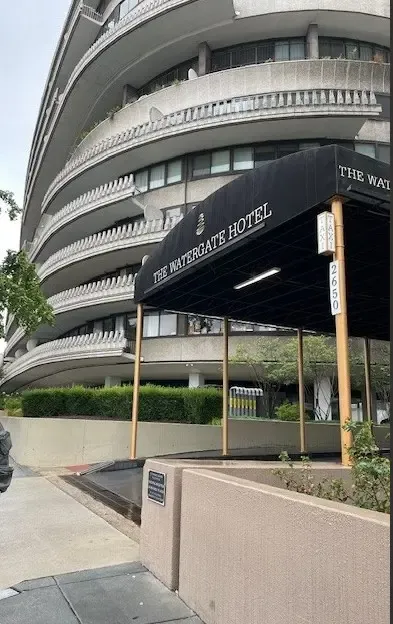
Media outlets quickly coined the term 'I-PAC-gate', drawing comparisons to the 1972 burglary and subsequent cover-up at the Democratic National Committee's headquarters in Washington, DC.
In India, similar scandals have been labeled with the 'gate' suffix, such as 'Coalgate' (coal block allocation scam), 'Vyapam-gate' (Madhya Pradesh recruitment scam), and 'Choppergate' (Agusta Westland helicopter deal).
Internationally, terms like 'Dieselgate' (Volkswagen emissions scandal) and 'Bridgegate' (New Jersey traffic scandal) continue to proliferate.
The original Watergate break-in was executed by operatives linked to President Richard Nixon's re-election campaign, who attempted to wiretap phones and steal sensitive documents.
Despite a cover-up by the Nixon administration to obstruct investigations, investigative journalism, particularly by The Washington Post, unveiled the scandal.
Journalists Bob Woodward and Carl Bernstein became notable figures, aided by a whistleblower known as 'Deep Throat'. This scandal revealed a politically motivated espionage scheme funded through donor contributions.
Nixon's administration denied involvement, destroyed evidence, and even bribed the burglars involved.
While initially successful, the revelations during the 1973 trial led to a US Senate investigation.
This resulted in multiple indictments and convictions of Nixon's aides, ultimately leading to the President's resignation in August 1974 to evade impeachment.
The Watergate episode is viewed as a significant abuse of power, marking a pivotal moment for political accountability in the US.
While there are no direct parallels between the Kolkata incident and Watergate, the context differs vastly: in Kolkata, it’s a Chief Minister versus a federal agency, whereas, in Washington, it was campaign operatives against the Opposition.
The motivations in Kolkata appear to defend party interests, with critics alleging obstruction, while the incidents in Washington were focused on espionage.
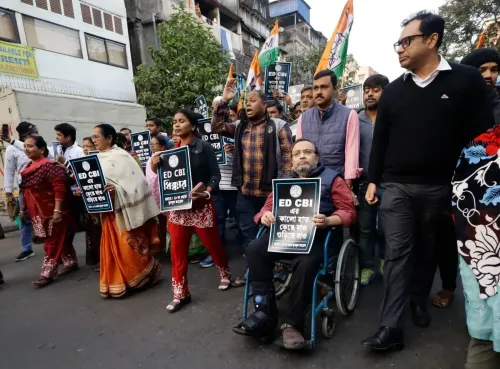
Public sentiment is reportedly mixed, with Mamata Banerjee's supporters viewing her actions as courageous defiance, while detractors label them as obstruction.
The Watergate incident, however, was widely condemned as an abuse of power.
Legal actions have been initiated by both parties involved in Thursday's unusual developments, and the outcomes will be crucial for determining future actions.
Point of View
It's essential to approach the unfolding situation with impartiality. While the parallels drawn with Watergate are compelling, the context and motivations behind these actions must be critically analyzed to understand their implications for political accountability in India. Our responsibility is to report on these events with transparency and integrity, ensuring that the public is informed and empowered to form their own opinions.
NationPress
23 Sept 2026
Frequently Asked Questions
What are the I-PAC office raids about?
The I-PAC office raids are part of an investigation by the Enforcement Directorate into alleged financial irregularities linked to the Indian Political Action Committee.
Why is the incident being termed 'I-PAC-gate'?
The term 'I-PAC-gate' has been coined by media outlets drawing parallels to the Watergate scandal due to the involvement of a prominent political figure in the raid.
What are the implications of Mamata Banerjee's actions during the raid?
Mamata Banerjee's actions during the raid have sparked debate over political accountability and the proper conduct of elected officials during investigations.
How does this incident compare to the Watergate scandal?
While both involve political figures and allegations of misconduct, the motivations and contexts of the Kolkata incident and Watergate are fundamentally different.
What is the public sentiment regarding the I-PAC-gate?
Public sentiment is divided, with supporters viewing Banerjee's actions as defiance against injustice, while critics see them as obstruction of justice.