IAF Chief AP Singh calls Shubhanshu Shukla's book an inspiration for India's youth
Synopsis
India's second astronaut has written a book — and the IAF chief wants it to make the first one obsolete. At the launch of 'The Second Orbit', Air Chief Marshal AP Singh called on India to produce so many astronauts that Shubhanshu Shukla 'fades into the background.' It is a striking benchmark for a country whose last space traveller flew more than four decades ago.
Key Takeaways
Air Chief Marshal A.P.
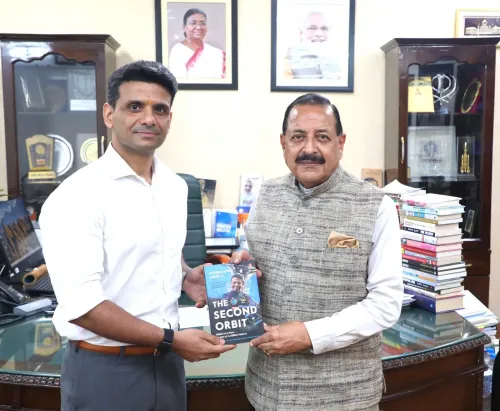
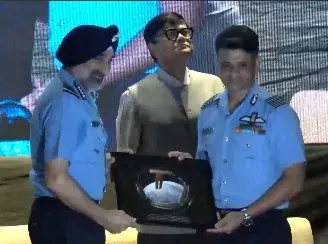
Singh attended the launch of 'The Second Orbit' by IAF Group Captain Shubhanshu Shukla in New Delhi on 25 June .
Singh expressed hope that India would produce many more astronauts, saying Shukla should eventually 'fade into the background.' Four IAF officers were trained for the space mission; Shukla was selected and flew the Axiom-4 mission to the ISS in 2025 .
Shukla is the second Indian to travel to space, after Wing Commander Rakesh Sharma .
During his 20-day mission, Shukla conducted research experiments and grew fenugreek and mung beans in microgravity.
Singh called the book 'a great motivator for all the coming generations.'
Air Chief Marshal A.P. Singh on Thursday, 25 June praised IAF Group Captain Shubhanshu Shukla for chronicling his 20-day space journey in a new book, expressing hope that the astronaut's story would spark a new generation of Indian space explorers. The remarks came at the launch of 'The Second Orbit', Shukla's account of his historic mission to the International Space Station (ISS), held in New Delhi.
What the IAF Chief Said at the Launch
Addressing the gathering, Air Chief Marshal Singh said, 'I hope we have more and more Shubhanshus coming out, and very soon he will fade into the background because there will be so many of us who have been there.' He added that while Shukla may not relish sharing his spotlight, that is precisely how India's space programme should grow. 'You will still remain the first one after such a long gap,' Singh noted.
The Air Chief Marshal also revealed that four IAF officers, including Shukla, had undergone training for the space mission. 'He was the lucky one. He must have been the best and must have done better. I hope the others also get a chance someday,' he said.
A Message to India's Young Aspirants
Singh used the occasion to deliver a broader motivational message to young Indians, drawing on Shukla's journey as a template. 'It is not where you land up but you must enjoy the journey. Shubhanshu's final journey was for 20 days but it was the process of years that he enjoyed — that is what kept the smile on his face,' he said.
He urged youth not to fixate on a single destination. 'Don't get bogged down to one thing in life. Wherever you go, whatever you do or whatever you become, do well there. It is not where you reach but what you did with that qualification that matters,' the Air Chief Marshal added.
Speaking on the sidelines to reporters, Singh said he had not yet read the book in full but called what he had heard 'a great motivator for all the coming generations.'
Shukla's Historic Mission
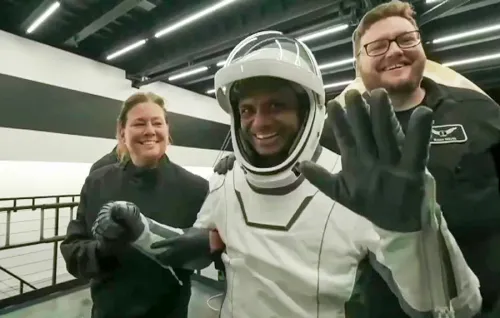
Group Captain Shubhanshu Shukla flew to the ISS under the Axiom-4 mission in 2025, becoming the second Indian astronaut to travel to space after Wing Commander Rakesh Sharma — a gap of several decades between the two milestones. During his 20-day stay aboard the station, Shukla conducted multiple research experiments, including agricultural trials in microgravity. He successfully cultivated fenugreek and mung beans in space, results that hold potential significance for long-duration human spaceflight.
Shukla has since been recognised for displaying exceptional courage, swift decision-making, and an unwavering commitment to duty throughout the Axiom-4 mission.
Significance of 'The Second Orbit'
The book represents the first detailed first-person account by an Indian astronaut of a contemporary space mission. Notably, it arrives at a moment when India's human spaceflight ambitions — anchored by the Gaganyaan programme — are accelerating. For the IAF, which has been central to astronaut selection and training, Shukla's public account serves both as institutional pride and a recruitment signal to the next cohort of officer-candidates who may one day follow him beyond Earth's atmosphere.
Point of View
Arriving as India's human spaceflight programme moves toward its first indigenous launch, is either perfectly placed or premature — and that distinction will be settled by execution, not inspiration.
NationPress
24 Sept 2026
Frequently Asked Questions
What is 'The Second Orbit' by Shubhanshu Shukla?
'The Second Orbit' is a first-person account by IAF Group Captain Shubhanshu Shukla of his 20-day journey to the International Space Station under the Axiom-4 mission in 2025. It is the first such detailed memoir by a contemporary Indian astronaut.
Who is Shubhanshu Shukla and why is he significant?
Group Captain Shubhanshu Shukla is the second Indian astronaut to travel to space, after Wing Commander Rakesh Sharma . He flew to the ISS on the Axiom-4 mission in 2025, conducting research experiments and successfully growing fenugreek and mung beans in microgravity.
What did IAF Chief AP Singh say about the book?
Air Chief Marshal A.P. Singh called the book a 'great motivator for all the coming generations' and expressed hope that India would produce so many astronauts that Shukla would 'fade into the background.' He also revealed that four IAF officers were trained for the mission.
How many IAF officers were trained for the Axiom-4 space mission?
According to Air Chief Marshal Singh , four IAF officers including Shukla underwent training for the space mission. Shukla was ultimately selected to fly, and Singh expressed hope that the other three would also get their chance in future missions.
What experiments did Shubhanshu Shukla conduct in space?
During his 20-day stay aboard the ISS, Shukla carried out several research experiments, including agricultural trials in microgravity. He successfully cultivated fenugreek and mung beans — results relevant to sustaining human life on long-duration space missions.