IMF projects India's GDP growth at 7% in 2025, fastest major economy
Synopsis
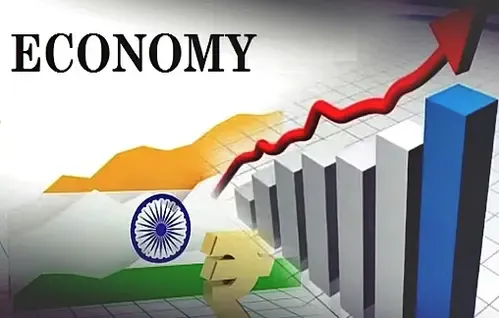
The IMF's latest WEO Update places India's calendar-year growth at 7 per cent — more than double the global average of 3 per cent and well ahead of China's 4.6 per cent. With the World Bank, UN, Goldman Sachs, and Bank of America all clustering around similar numbers, there is now a rare multilateral consensus: India's growth engine is not just fast, it is structurally durable.
Key Takeaways
The IMF projected India's GDP growth at 7 per cent for the current calendar year in its WEO Update released on 8 July .
On a fiscal-year basis, India is projected to grow at 6.4 per cent this year, rising to 6.7 per cent the next — still the fastest among major economies.
China is second at 4.6 per cent ; the US third at 2.3 per cent ; the EU at just 0.9 per cent this year.
The World Bank , UN , RBI , Goldman Sachs , and Bank of America all project India's growth in the 6.4–7 per cent range for 2025–26.
India's fiscal-year growth was 7.7 per cent in 2025-26 before the Iran war's economic impact set in, according to the WEO Update.
Growth is driven by private consumption , services activity , and public investment , according to the IMF and UN.
The International Monetary Fund (IMF) has projected India's GDP growth at 7 per cent for the current calendar year, reaffirming the country's position as the world's fastest-growing major economy even as global headwinds from the Middle East war and elevated interest rates weigh on peers. The projection was published in the World Economic Outlook (WEO) Update released on Wednesday, 8 July.
What the IMF Said
The WEO Update offered two sets of projections for India — one based on the calendar year and one on the fiscal year. On a calendar-year basis, India is projected to grow at 7 per cent in the current year, moderating to 6.4 per cent in the next. On a fiscal-year basis — the metric used in the report's main chart — growth stands at 6.4 per cent for the current fiscal year, rising to 6.7 per cent the following year.
The fiscal-year projection for the current year was trimmed by 0.1 percentage points from the April WEO, but the outlook for the next fiscal year was revised upward by 0.2 percentage points. The IMF attributed India's strong performance to 'strong momentum in private consumption and services activity.'
India Versus the World
India's growth projections are more than double the global average. The IMF forecast the world economy to expand by 3 per cent this year, rising to 3.4 per cent next year. China, the second-fastest-growing major economy, is projected to grow by 4.6 per cent this year, slipping to 4.1 per cent next. The United States ranked third at 2.3 per cent this year and 2.2 per cent next, while the European Union trails at just 0.9 per cent for the current year.
The IMF noted that the global economy has 'so far weathered the shock from the war better than feared,' with commodity price pressures, inflation expectations, and financial conditions remaining 'relatively limited.' It credited 'accelerated demand-driven momentum in the global technology cycle thanks to advances in artificial intelligence' as a partial offset to war-related disruptions.
US President Trump Cites India's Growth
US President Donald Trump, in a recent television interview, acknowledged India's high growth rate, saying: 'You have a couple of countries, India is one, doing very well, but it's at 7, 8 per cent.' Trump attributed the US's inability to match such rates to a conservative Federal Reserve keeping interest rates elevated.
Broad Consensus Across Institutions
The IMF's reading aligns with a growing consensus among multilateral bodies and global banks. The World Bank, in a report last month, projected India's growth at 6.6 per cent for the current fiscal year, rising to 7.2 per cent the next. The United Nations placed India's growth at 6.4 per cent for the current year, with Ingo Pitterle, the UN's senior economist heading its Global Economic Monitoring Branch, citing 'structurally very robust growth in India, driven by consumer demand, by public investment, but also by strong performance in services exports.'
The Reserve Bank of India (RBI) set this fiscal year's growth estimate at 6.6 per cent. Bank of America projected India's GDP growth in 2026 at 7 per cent, upgraded from an earlier estimate of 6.2 per cent in April. Goldman Sachs also raised its calendar-year 2026 forecast for India to 6.8 per cent from 6.5 per cent in late June.
Notably, the WEO Update flagged that India's fiscal-year growth stood at 7.7 per cent in 2025-26 before the Iran war began to register its economic impact — underscoring the resilience of the underlying growth trajectory. With major institutions now clustered around the 6.5–7 per cent band, India's growth story appears durable even in a more volatile global environment.
Point of View
But the more telling number is the fiscal-year figure of 6.4 per cent — revised down 0.1 points from April, even before the full Iran war impact is priced in. The clustering of forecasts from the World Bank, UN, Goldman Sachs, and Bank of America around the 6.4–7 per cent band signals genuine structural momentum, not just base-effect flattery. The risk is complacency: India's services-led and consumption-driven growth has so far insulated it from global shocks, but a prolonged Middle East conflict or a sharper US slowdown could pressure both export earnings and FII flows faster than any of these projections currently assume.
NationPress
7 Oct 2026
Frequently Asked Questions
What is the IMF's GDP growth projection for India in 2025?
The IMF has projected India's GDP growth at 7 per cent for the current calendar year, according to the World Economic Outlook Update released on 8 July. On a fiscal-year basis, the projection is 6.4 per cent for the current year, rising to 6.7 per cent the next.
Why is India the fastest-growing major economy?
The IMF attributes India's strong performance to robust private consumption and services activity. The UN's senior economist has also pointed to public investment and strong services exports as structural drivers.
How does India's growth compare to China and the US?
India leads at 7 per cent (calendar year), well ahead of China at 4.6 per cent and the US at 2.3 per cent. India's growth is also more than double the global average of 3 per cent projected for this year.
What do other institutions project for India's growth?
The World Bank projects 6.6 per cent for the current fiscal year rising to 7.2 per cent the next. The RBI estimates 6.6 per cent, Goldman Sachs forecasts 6.8 per cent for calendar year 2026, and Bank of America projects 7 per cent for 2026.
What risks could affect India's growth outlook?
The WEO Update notes that India's fiscal-year growth was 7.7 per cent in 2025-26 before the Iran war's economic impact registered. The IMF flagged commodity prices, inflation expectations, and financial conditions as key transmission channels, though their impact has so far been 'relatively limited.'