CM Mohan Yadav: India 90% of Way to Carbon Sink Goal
Synopsis
Madhya Pradesh CM Dr. Mohan Yadav amplified Union Minister Bhupender Yadav's claim that India has achieved nearly 90% of its 3.5 billion tonne carbon sink target under PM Modi, with full completion projected by 2030 under India's Paris Agreement commitments.
Key Takeaways
Madhya Pradesh CM Dr.
Mohan Yadav shared a statement by Union Minister Bhupender Yadav on 22 May 2026 claiming India has achieved nearly 90% of its carbon sink target.
The target cited in the post is 3.5 billion tonnes of carbon sink, higher than the 2.5–3 billion tonne range in India's formally submitted NDC to the UNFCCC.
India first made the carbon sink pledge in its 2015 NDC and reaffirmed it at COP26 in 2021 as part of the Panchamrit climate strategy.
The Ministry of Environment, Forest and Climate Change under Bhupender Yadav coordinates national afforestation programmes including the Green India Mission .
Full achievement of the carbon sink target is projected by 2030 , with India's next Biennial Update Report to the UNFCCC expected to provide independently reviewed data.
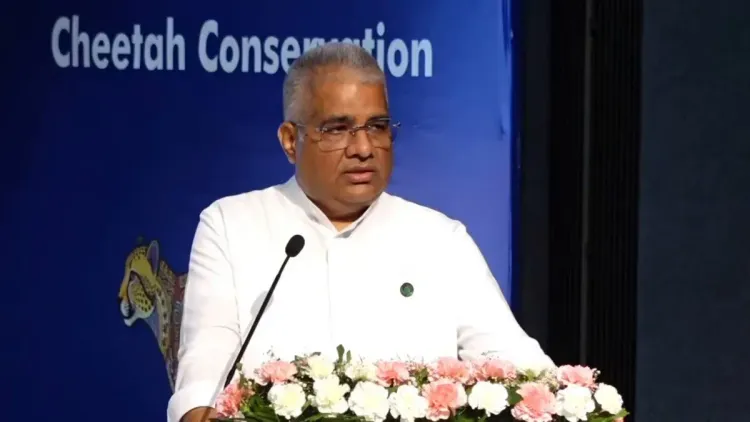
Madhya Pradesh Chief Minister Dr. Mohan Yadav on Friday, 22 May 2026, shared a statement by Union Environment Minister Bhupender Yadav highlighting that India has achieved approximately 90 per cent of its 3.5 billion tonne carbon sink target, citing the progress as a landmark under Prime Minister Narendra Modi's leadership.
Context
The post, shared from Dr. Mohan Yadav's official account, quotes Union Minister Bhupender Yadav as saying: 'माननीय प्रधानमंत्री श्री @narendramodi जी के नेतृत्व में हमने दुनिया के सामने 3.5 बिलियन टन Carbon Sink का जो लक्ष्य लिया था, भारत ने उसका लगभग 90% हासिल कर लिया है' — 'Under the leadership of the honourable Prime Minister, the target of a 3.5 billion tonne carbon sink that we committed to before the world has been approximately 90 per cent achieved by India.' The minister added that 100 per cent of the target would be met by 2030.
The carbon sink target refers to India's pledge to increase forest and tree cover so as to absorb additional carbon dioxide from the atmosphere. A carbon sink of this scale represents one of the largest forestry-based climate commitments made by any nation under the Paris Agreement.
Policy Backdrop
India first communicated its carbon sink commitment in its 2015 Nationally Determined Contribution (NDC) to the United Nations Framework Convention on Climate Change (UNFCCC), pledging to create an additional carbon sink of 2.5 to 3 billion tonnes CO2 equivalent through forest and tree cover by 2030. At COP26 in 2021, Prime Minister Modi announced the Panchamrit strategy, which included forest cover expansion as one of five core climate commitments.
In August 2022, India updated its NDC, reiterating the carbon sink goal alongside a target of 50 per cent non-fossil fuel electricity capacity. National programmes such as the Green India Mission have been central to driving afforestation and reforestation efforts that feed into India's international climate reporting.
It is worth noting that the figure of 3.5 billion tonnes cited in the post is higher than the 2.5–3 billion tonne range formally submitted in India's NDC documents to the UNFCCC. The specific claim of 90 per cent achievement has not been independently verified against published UNFCCC or government forestry records.
Stakeholders and Impact
The primary institutional actor in delivering this target is the Ministry of Environment, Forest and Climate Change, headed by Bhupender Yadav, which coordinates with state forest departments across the country. Madhya Pradesh, one of India's most forested states, is among the key contributors to national forest carbon stock, making Dr. Mohan Yadav's amplification of this message particularly relevant.
State governments, district forest offices, and communities under joint forest management programmes are the ground-level stakeholders whose plantation and conservation work underpins the national numbers. Progress on the carbon sink target also has implications for India's standing in international climate negotiations, where forest-based sequestration is a key bargaining chip.
What's Next
India's next Biennial Update Report to the UNFCCC will be a critical document to watch, as it will provide independently reviewed data on forest carbon stocks and sequestration rates. Any upward revision of state-level forest cover targets ahead of COP31 could further sharpen India's climate diplomacy posture.
With the 2030 deadline approaching, the government is expected to intensify afforestation drives and tighten monitoring of forest cover through satellite-based assessments. The messaging from both the Union minister and the Madhya Pradesh Chief Minister signals that climate achievements are being positioned as a political and diplomatic asset in the run-up to future international summits.
Point of View
CM Mohan Yadav is aligning Madhya Pradesh — one of India's most forested states — with a national narrative of climate achievement. The 3.5 billion tonne figure cited, however, sits above India's formally submitted NDC target range of 2.5–3 billion tonnes, a discrepancy that could attract scrutiny from climate observers. Overall, the messaging fits a broader BJP pattern of framing environmental policy as a deliverable of strong central leadership rather than a technocratic, institution-driven process.
NationPress
20 Sept 2026
Frequently Asked Questions
What is India's carbon sink target under the Paris Agreement?
India committed in its Nationally Determined Contribution to the UNFCCC to create an additional carbon sink of 2.5 to 3 billion tonnes of CO2 equivalent through increased forest and tree cover by 2030.
Has India achieved its carbon sink target?
Union Minister Bhupender Yadav has claimed India has achieved approximately 90 per cent of a 3.5 billion tonne carbon sink goal, though this specific figure and achievement level have not been independently verified against published UNFCCC forestry records.
What is the Green India Mission?
The Green India Mission is a national programme aimed at protecting, restoring, and expanding India's forest cover, and is one of the key schemes contributing to India's carbon sink commitments under the Paris Agreement.
What is the Panchamrit strategy announced by PM Modi?
At COP26 in 2021, PM Narendra Modi announced the Panchamrit strategy — five climate commitments including reaching 500 GW of non-fossil energy capacity, 50 per cent renewable energy, reducing carbon emissions by 1 billion tonnes, reducing carbon intensity by 45 per cent, and achieving net zero by 2070.
Why is Madhya Pradesh significant for India's carbon sink goals?
Madhya Pradesh is one of India's most forested states, making its forest conservation and afforestation efforts a significant contributor to the national carbon sequestration numbers reported to the UNFCCC.