How Will the India-Oman Free Trade Pact Unlock Opportunities?
Click to start listening
Synopsis
The proposed India-Oman Free Trade Agreement (FTA) promises to open up vast opportunities across various sectors, strengthening bilateral ties and facilitating economic growth for both nations. With a focus on youth-driven growth and strategic collaboration, the FTA marks a significant milestone in India-Oman's relationship, paving the way for enhanced market access and investment.
Key Takeaways
- India-Oman FTA to enhance opportunities in multiple sectors.
- Oman strategically positioned as a gateway to major markets.
- Significant growth in Indian investments in Oman since 2020.
- Focus on youth-driven growth and mutual collaboration.
- Partnership poised for a new phase of economic growth.
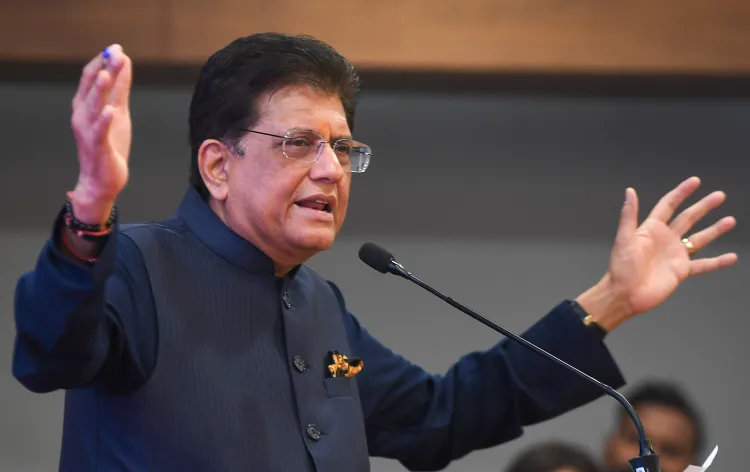
New Delhi, Dec 17 (NationPress) The Minister of Commerce and Industry, Piyush Goyal, announced on Wednesday that the anticipated India-Oman free trade agreement (FTA) is set to unveil substantial opportunities across various sectors, such as textiles, food processing, automobiles, gems and jewellery, agrochemicals, renewable energy, and auto components.
Speaking at the India-Oman Business Forum in Muscat, Goyal emphasized Oman's pivotal geographical position as a gateway to the Gulf Cooperation Council (GCC), Eastern Europe, Central Asia, and Africa, thereby enhancing market access for Indian enterprises.
Oman's Minister of Commerce, Industry and Investment Promotion, Qais Al Yousef, noted that India ranks as Oman's third-largest trading partner, with Oman being a prominent destination for Indian investments across vital sectors.
He highlighted that Indian investments in Oman have surged more than threefold since 2020, amounting to $5 billion, and spanning fields like green steel, green ammonia, aluminium manufacturing, and logistics. He underscored that these investments signify India's trust in Oman as a sustainable operating hub.
Goyal further noted that the proposed FTA represents a significant milestone in the bilateral ties between the two nations, marking Oman's first free trade agreement in nearly two decades.
He pointed out that Prime Minister Narendra Modi's upcoming visit to Oman aligns with the celebration of 70 years of diplomatic relations between India and Oman. He recalled India's choice to invite Oman as a special guest during India's G20 Presidency in 2023 as a testament to the robust mutual trust and strategic alliance between the countries.
Goyal accentuated the potential for collaborative efforts in sectors such as professional services, accounting, business process re-engineering, research and development, tourism, healthcare, and education. He identified four key areas for future cooperation: energy transition, including green hydrogen and renewable energy; infrastructure development, including ports and multimodal logistics; food security through cold chains and food parks; and collaboration between startup ecosystems, especially in deep tech, logistics, and artificial intelligence.
Addressing the common focus on youth-driven growth, the minister highlighted the alignment between India's vision of 'Viksit Bharat 2047' and 'Oman’s Vision 2040'. He asserted that the youthful dynamism and entrepreneurial spirit of both nations lay a solid foundation for enduring economic cooperation.
Goyal expressed optimism that the India-Oman partnership, built on trust, shared history, and complementary strengths, is ready to embark on a new growth trajectory. He added that businesses from both sides, working collaboratively as trusted allies, can fully capitalize on the opportunities arising from the enhanced bilateral engagement.
Point of View
The proposed India-Oman Free Trade Agreement stands as a significant development in regional trade dynamics. It not only enhances bilateral relations but also serves as a catalyst for economic growth, especially in sectors vital for both countries. This strategic collaboration reflects India's commitment to expanding its global trade footprint while simultaneously addressing the needs of its industries and young entrepreneurs.
NationPress
17/12/2025
Frequently Asked Questions
What sectors will benefit from the India-Oman FTA?
The India-Oman FTA is expected to benefit sectors such as textiles, food processing, automobiles, gems and jewellery, agrochemicals, renewable energy, and auto components.
Why is Oman considered a strategic partner for India?
Oman is strategically located, serving as a gateway to the Gulf Cooperation Council, Eastern Europe, Central Asia, and Africa, which enhances market access for Indian businesses.
What is the significance of the upcoming FTA?
The proposed FTA marks a critical milestone in India-Oman relations, being Oman's first free trade agreement in nearly two decades, and is expected to boost trade and investment.
How have Indian investments in Oman changed recently?
Indian investments in Oman have more than tripled since 2020, reaching $5 billion, covering various sectors including green steel and logistics.
What are the key areas for future cooperation between India and Oman?
Key areas for cooperation include energy transition, infrastructure development, food security, and collaboration in startup ecosystems, particularly in deep tech and artificial intelligence.