PM Modi hails India's record 114 medals at Asian Para Games 2026

Synopsis
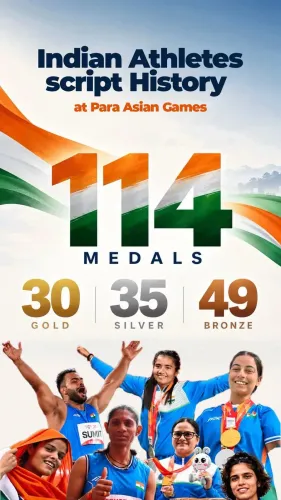
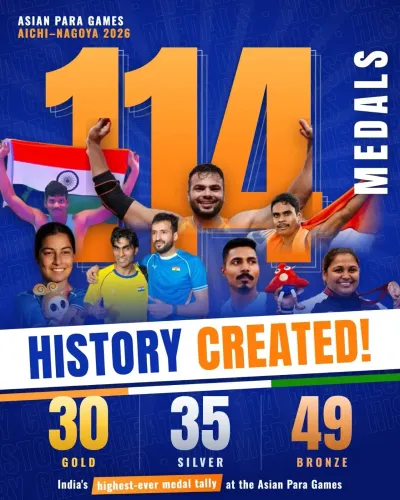
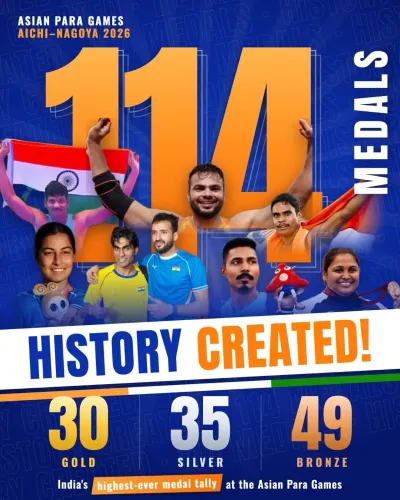
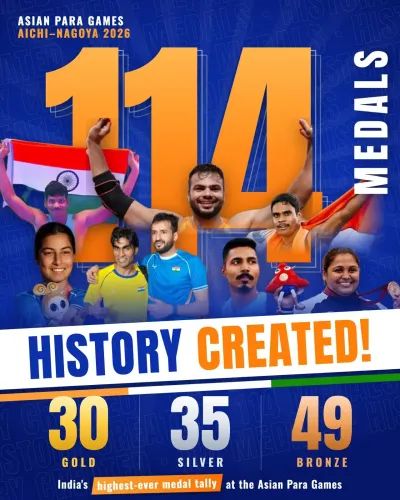
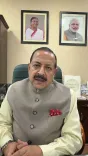
Prime Minister Narendra Modi hailed India's para-athletes after they claimed a record 114 medals at the Asian Para Games 2026, marking the country's best-ever showing at the event and reflecting a decade of growing government investment in para-sport.
Key Takeaways
114 medals — India's best-ever performance at the Asian Para Games, confirmed by Prime Minister Narendra Modi on October 25, 2026 .
PM Modi called the achievement 'an extraordinary achievement' and 'an occasion of immense pride and joy for the entire nation.' The Asian Para Games is held every four years under the Asian Paralympic Committee and is the continent's top multi-sport para event.
The Khelo India programme , launched in 2017 , has been a key driver of expanded training and infrastructure support for para-athletes.
Indian para-athletes have shown successive improvement at continental and global events over the past decade.
The record haul raises expectations ahead of the next Paralympic Games cycle.
A record haul. A nation's pride. Prime Minister Narendra Modi on Sunday, October 25, 2026, celebrated India's para-athletes after they delivered the country's best-ever performance at the Asian Para Games 2026 — finishing with a landmark 114 medals.
Posting on X, the Prime Minister called it 'an extraordinary achievement' and described the moment as 'an occasion of immense pride and joy for the entire nation,' offering congratulations to every member of the contingent. The post came hours after the curtain fell on the Games, giving the milestone its first official acknowledgement from the highest office in the country.
India's para-sport arc — a decade in the making
The 114-medal tally does not arrive out of nowhere. Over the past decade, Indian para-athletes have recorded successive improvements at both continental and global events, riding a wave of institutional support that has quietly reshaped the country's sporting infrastructure. The Khelo India programme, launched in 2017, extended its reach beyond able-bodied disciplines to include para-sport training, equipment procurement, and grassroots talent identification — a structural shift whose dividends are increasingly visible on the medal table.
Funding for para-athlete preparation has grown steadily, with dedicated pipelines now feeding into national camps ahead of major cycles. The result is a squad that no longer peaks at isolated moments but builds across quadrennials — each Asian Para Games raising the floor for the next.
What a record haul at Asia's biggest para-sport stage means
The Asian Para Games is the continent's premier multi-sport competition for para-athletes, organised under the Asian Paralympic Committee on a four-year cycle. A record performance here carries direct implications for Paralympic ambitions — the Games serve as both a competitive proving ground and a confidence-builder ahead of Paris's successor cycle. India's trajectory at this level signals that the country is no longer a mid-table finisher in Asian para-sport; it is now competing at the front of the field.
For the athletes themselves — many of whom have navigated years of sparse funding, limited infrastructure, and the sheer physical demands of their disciplines — a prime ministerial acknowledgement of this scale carries weight beyond ceremony. It puts para-sport at the centre of the national conversation, at least for today.
The real test now is whether the momentum of 114 medals translates into sustained investment and selection pathways ahead of the next Paralympic Games — because records are only worth celebrating if the system is built to break them again.
Point of View
Effusive congratulations signal that para-sport has graduated from a footnote in India's sporting narrative to a genuine political and policy priority — a positioning reinforced every time a record falls. The 114-medal tally is also a quiet advertisement for the Khelo India programme's long-term architecture, which the BJP government has consistently cited as a cornerstone of its sports-development credentials. Yet the real political test comes in the months that follow: whether this celebratory moment converts into budget allocations and institutional follow-through ahead of the next Paralympic cycle, or whether it remains a social-media milestone. India's rising para-sport curve is real — sustaining it demands more than congratulations.
NationPress
25 Oct 2026
Frequently Asked Questions
How many medals did India win at the Asian Para Games 2026?
India won a record 114 medals at the Asian Para Games 2026, the country's best-ever performance at the event, as acknowledged by Prime Minister Narendra Modi.
What is the Asian Para Games?
The Asian Para Games is a multi-sport competition for para-athletes held every four years under the Asian Paralympic Committee , bringing together countries from across the continent.
What did PM Modi say about India's performance at the Asian Para Games 2026?
PM Modi called it 'an extraordinary achievement,' describing the 114-medal haul as India's 'best-ever performance' at the Games and 'an occasion of immense pride and joy for the entire nation.'
How has India supported para-athletes in recent years?
The Khelo India programme , launched in 2017 , expanded training infrastructure and funding to para-sport disciplines, contributing to India's successive improvements at continental and global competitions.
What comes next for India's para-athletes after the Asian Para Games 2026?
The immediate focus will shift to the next Paralympic Games cycle, where India's record-breaking Asian Para Games performance is expected to raise ambitions and benchmark preparation.