India's total trade hits $506.9 bn in Q1 FY27, up 15.5%: NITI Aayog
Synopsis
India's trade engine is running hot — $506.9 billion in just one quarter, with FTA-partner exports surging 36.3% and new markets like Tanzania and South Africa breaking into the top ten. But the NITI Aayog report quietly flags a structural tension: even as exports grow, critical mineral imports have nearly doubled in a decade, underscoring a supply-chain vulnerability India has yet to fully address.
Key Takeaways
India's total trade reached $506.9 billion in Q1 FY27 (April–June 2026) , up 15.5 per cent year-on-year.
Merchandise exports were led by mineral fuels , electrical machinery , iron and steel , and vehicles .
Exports to FTA partners jumped 36.3 per cent ; FTA imports rose 10.0 per cent .
Tanzania and South Africa entered India's top ten export destinations ; Singapore also showed strong growth.
Metals and ores imports rose from $32.2 billion (2015) to $60.5 billion (2025) , driven by demand for copper, lithium, cobalt and nickel .
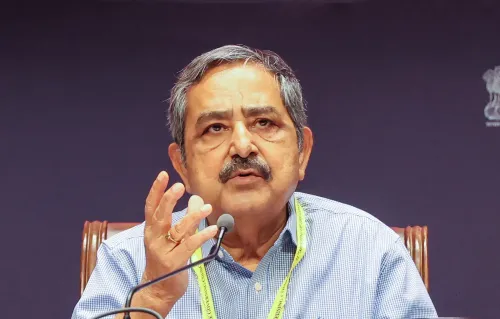
NITI Aayog Vice Chairman Ashok Kumar Lahiri called for stronger domestic capabilities and deeper value-chain integration to sustain competitiveness.
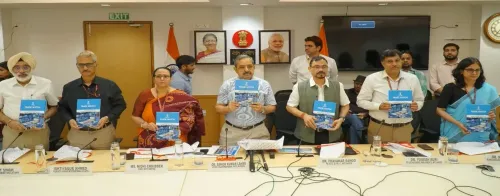
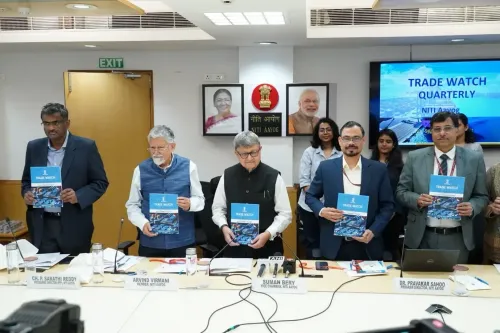
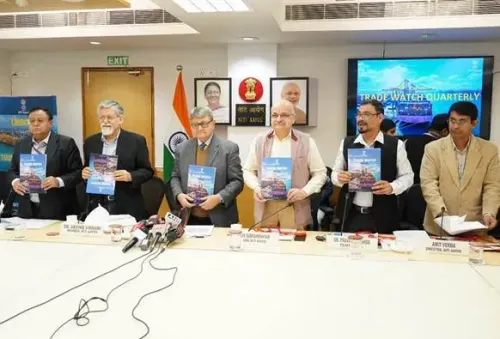
NITI Aayog Vice Chairman Suman Bery — wait, the report was presented by NITI Aayog Vice Chairman Ashok Kumar Lahiri on Wednesday, 16 September 2026, at the launch of the Trade Watch Quarterly for April–June 2026 (Q1 FY27). India's total trade — merchandise and services combined — reached $506.9 billion in Q1 FY27, registering 15.5 per cent annual growth, according to the latest edition of the quarterly publication.
Key Trade Highlights in Q1 FY27
Merchandise exports grew strongly during the quarter, led by mineral fuels, electrical machinery, nuclear reactors, iron and steel, and vehicles. A rise in shipments of petroleum products, steel, engineering goods, and automobiles provided additional momentum. On the import side, growth was concentrated in capital goods, electronic components, and copper — reflecting expanding industrial capacity and India's deepening integration with global value chains.
Export Market Diversification
India's export destinations continued to widen, with Tanzania and South Africa emerging among the top ten export markets, alongside strong growth in exports to Singapore. Imports from Latin America and West Africa recorded significant growth, supported in part by diversification of crude oil sourcing — a move that NITI Aayog says enhances resilience in India's import basket. Northeast Asia, West Asia-GCC, and ASEAN together accounted for around half of India's total imports.
FTA Partners and Metals Trade
Trade with Free Trade Agreement (FTA) partners gained further momentum, with exports rising by 36.3 per cent and imports growing by 10.0 per cent, underscoring the value of deeper economic partnerships. On metals, exports reached $34.8 billion in 2025, with iron and steel, articles of iron and steel, and aluminium collectively accounting for around 78 per cent of the total. Metals and ores imports climbed from $32.2 billion in 2015 to $60.5 billion in 2025, driven by rising demand for copper, lithium, cobalt, and nickel in line with India's manufacturing expansion, infrastructure development, and energy transition goals.
Structural Challenges and the Road Ahead
The Trade Watch Quarterly report also examines India's growing import dependence across metals and ores, with a focus on critical minerals and higher-value non-ferrous metals. It assesses structural constraints and opportunities to strengthen domestic value addition, attract investment, and sharpen global competitiveness. Lahiri emphasised that sustained trade gains will require deeper integration with global and regional value chains, stronger domestic capabilities in strategic sectors, and a policy environment that enables Indian firms to compete effectively in international markets. Notably, the sharp rise in critical mineral imports signals both an opportunity and a vulnerability — one that policymakers will need to address as India's energy transition accelerates.
Point of View
But the more important number in this report is $60.5 billion — what India now spends importing metals and ores, nearly double the 2015 figure. As critical minerals become the new oil in a decarbonising world, India's growing import dependence on copper, lithium, cobalt, and nickel is a structural risk that export diversification alone cannot offset. The FTA export surge of 36.3 per cent is a genuine bright spot, but it will need to be matched by domestic mining and processing investment if India is to avoid trading one import vulnerability for another.
NationPress
16 Sept 2026
Frequently Asked Questions
What is the NITI Aayog Trade Watch Quarterly?
The Trade Watch Quarterly is a periodic publication by NITI Aayog that tracks India's merchandise and services trade performance, export competitiveness, and import trends. The latest edition covers the April–June 2026 quarter (Q1 FY27) and focuses on metals, ores, and critical minerals.
How much did India's total trade grow in Q1 FY27?
India's total trade — merchandise and services combined — reached $506.9 billion in Q1 FY27 (April–June 2026), registering 15.5 per cent annual growth, according to NITI Aayog's Trade Watch Quarterly report.
Why are India's metals and ores imports rising so sharply?
Metals and ores imports grew from $32.2 billion in 2015 to $60.5 billion in 2025, driven by rising demand for copper, lithium, cobalt, and nickel — materials critical to India's expanding manufacturing base, infrastructure development, and energy transition. The surge reflects both industrial growth and a growing dependence on strategic imports.
Which new markets have emerged for India's exports?
Tanzania and South Africa have entered India's top ten export destinations, while exports to Singapore also recorded strong growth. Imports from Latin America and West Africa rose significantly, partly due to diversification of crude oil sourcing.
How has trade with FTA partners performed?
Trade with India's Free Trade Agreement partners accelerated markedly, with exports to FTA partners rising 36.3 per cent and imports growing 10.0 per cent in Q1 FY27, reflecting deeper economic integration and the growing value of preferential trade arrangements.